Mark Zuckerberg's Metaverse Bet: The Decision That Changed Meta's Direction
Mark Zuckerberg’s decision to transform Facebook into Meta and make the metaverse a central strategic bet reshaped the company’s direction. This is the story of the investment, risks and strategic adjustments that followed.
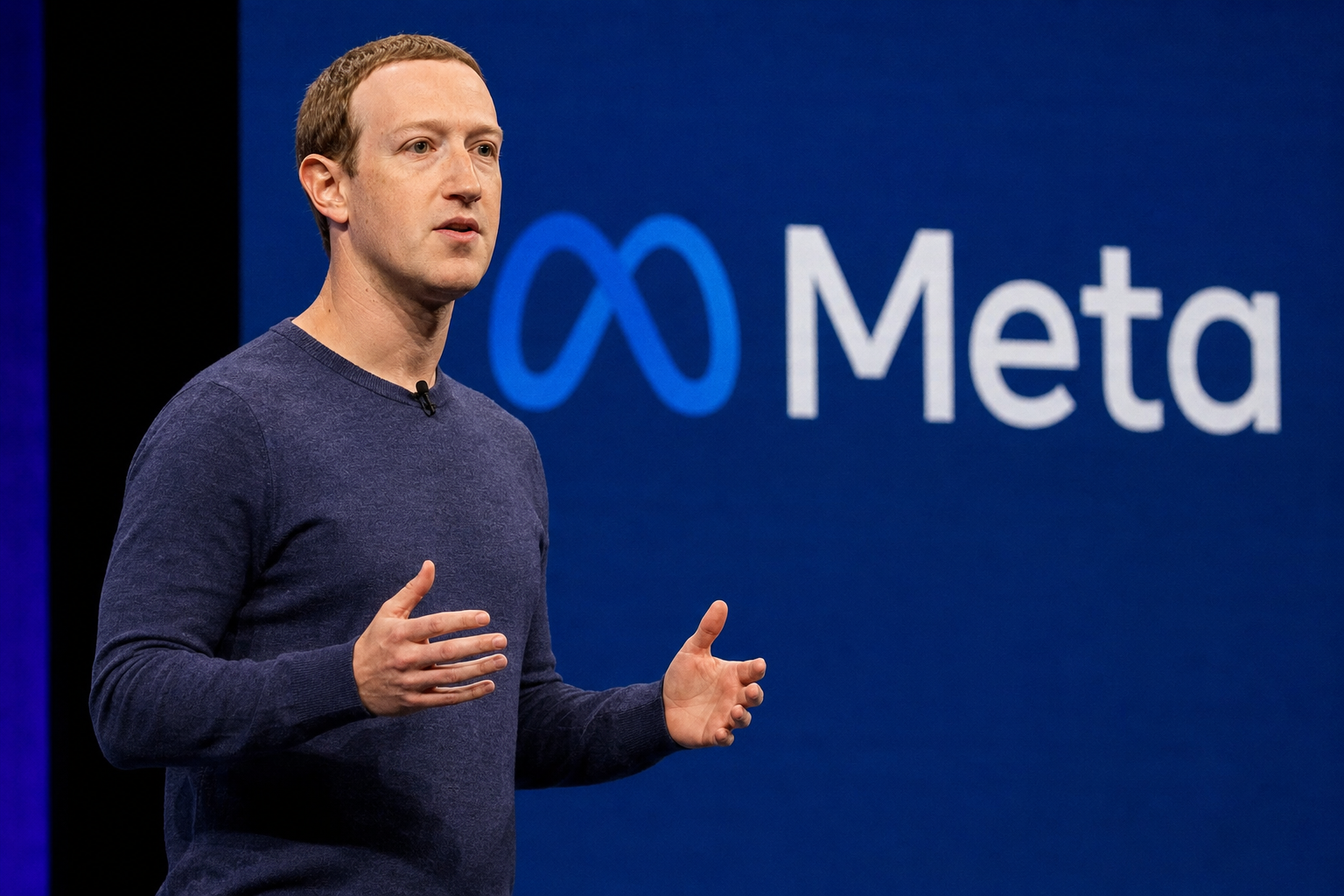
In October 2021, Mark Zuckerberg told the world that Facebook, the company he had built and run for seventeen years, would no longer be called Facebook. It would be called Meta. To most outside observers, this looked like a rebrand: a cosmetic exercise, the kind of thing a company does when its name has become a liability. That reading missed the point. Zuckerberg was not trying to escape a reputation problem. He was trying to re-anchor one of the most powerful companies on earth around a bet that the next era of computing would not happen on a screen in your pocket, but inside a three-dimensional digital space he called the metaverse.
That decision, and everything that followed it, is one of the clearest case studies available to any executive of what a long-term strategic bet actually costs, how markets punish that bet in the short run, and how a CEO decides when conviction should hold and when it should bend to new evidence. Four years later, Meta is a very different company than the one Zuckerberg described that October afternoon. Not because he abandoned the instinct that drove him, but because the world he was betting on arrived in a different form than he expected.
The Decision
The rebrand itself was simple to execute and complicated to justify. Facebook Inc. became Meta Platforms Inc. The corporate structure did not fundamentally change. Facebook, Instagram, WhatsApp and Messenger all continued operating under their own names. But the parent company's identity, its stock ticker, and, more importantly, its stated purpose all shifted. Zuckerberg framed it as an acknowledgment that the company had grown well beyond its original social network and now needed an identity broad enough to hold what he believed it was becoming: a company building the infrastructure for immersive, embodied computing.
Alongside the name change came a new reporting structure. Starting in the final quarter of 2021, Meta began breaking out the financial results of Reality Labs, the unit responsible for VR headsets, AR research, and the software meant to connect them. That disclosure decision mattered almost as much as the name itself. For the first time, investors could see exactly how much the metaverse bet was costing, quarter by quarter, at a level of financial transparency few companies volunteer for an unproven business line.
What Zuckerberg Saw
Zuckerberg's underlying argument was consistent and, on its own terms, coherent. Computing platforms shift roughly once a decade, from desktop to web to mobile, and whoever builds the dominant platform of the next shift tends to capture an outsized share of the economic value, the way Apple and Google captured the mobile era. Facebook, despite its scale, had been a follower in that mobile transition, building its business largely on top of platforms owned by others. Zuckerberg did not want to be a follower again. He believed virtual and augmented reality, combined with persistent digital identity and social presence, represented the most plausible successor platform, and that being early, even painfully early, was the only way to own it rather than rent space on someone else's.
There was a defensive logic underneath the offensive one, too. Meta's advertising business depended heavily on Apple's iOS and Google's Android as distribution layers, both companies with their own competing interests. Owning a hardware and software platform of its own, one not mediated by a rival's app store or operating system rules, would give Meta a kind of independence it had never had. In that framing, the metaverse was not just a new product category. It was a hedge against strategic dependency on two companies Meta did not control.
The Bet
What followed was one of the largest sustained R&D commitments by any consumer technology company in recent memory. Reality Labs built out the Quest line of VR headsets, invested heavily in AR research including prototype smart glasses, and poured money into Horizon Worlds and other social VR software meant to give people a reason to spend time inside the metaverse once the hardware existed. Thousands of engineers, researchers and designers were hired specifically for this effort.
The scale of the financial commitment is what set it apart from a typical corporate innovation bet. Reality Labs has now accumulated more than $80 billion in cumulative operating losses tracing back to late 2020, spending that in some individual years has exceeded what many well-known technology companies are worth in their entirety. Annual losses climbed from roughly $10 billion in 2021 to $13.7 billion in 2022, and continued widening through subsequent years, even as Meta's advertising business kept generating tens of billions of dollars in profit that effectively subsidized the buildout.
The Cost of Being Early
Markets are generally willing to fund a CEO's long-term vision as long as the near-term numbers hold up. Meta's did not, at least not right away. In February 2022, the company reported its first-ever decline in daily active users alongside a disappointing revenue outlook, driven mainly by Apple's privacy changes to iOS, which made it harder for advertisers to track and target users, and by intensifying competition from platforms like TikTok. Meta's stock fell 26 percent in a single trading session, wiping out more than $200 billion in market value. At the time, it was the largest one-day dollar loss in US stock market history for any company. Reality Labs losses were not the main driver of that specific crash, but they compounded a narrative already forming among investors: that Zuckerberg was spending enormous sums on a speculative future while the present-day business showed cracks. By the end of 2022, Meta's stock had lost roughly 60 percent of its value for the year, its worst annual performance since going public a decade earlier.
The pressure showed up inside the company as well. Zuckerberg declared 2023 the "year of efficiency," and Meta cut more than 20,000 jobs across 2022 and 2023, the largest workforce reductions in its history, including repeated rounds of cuts within Reality Labs itself. For a company that had spent years marketing itself as a place of near-unlimited ambition and headcount growth, the shift in tone was notable. Zuckerberg was not abandoning the metaverse commitment at this stage. He continued to describe it publicly as a multi-decade project. But he was clearly recalibrating how much slack the rest of the business could absorb while funding it.
The Reality Check
Some parts of the bet showed real traction. The Quest headset line became the best-selling consumer VR hardware on the market, and smart glasses built jointly with Ray-Ban's parent company, Essilor Luxottica, became a genuine commercial success, with sales more than tripling year over year at points in 2025. That was evidence Zuckerberg's instinct about wearable, camera-equipped computing was not wrong, even if the delivery vehicle turned out to be glasses rather than headsets.
But the more ambitious version of the vision, millions of people working, socializing and spending significant parts of their day inside fully immersive virtual worlds like Horizon Worlds, never materialized at anything close to the scale Zuckerberg had projected. Headset sales, while respectable, stayed a niche category rather than a mass-market one. Engagement inside Meta's flagship virtual-world software consistently fell short of internal targets reported at the time. The metaverse, as originally pitched, a persistent, headset-based alternative to the internet itself, simply did not arrive on the timeline or at the scale the 2021 rebrand had implied.
The Strategic Adjustment
What changed the calculus more than any internal metric was an external one: the arrival of large language models and generative AI as a commercially viable technology, starting in earnest in late 2022 and accelerating through 2023. Zuckerberg, by his own account, came to see AI as a more immediate and more certain platform shift than the metaverse. It was already reshaping how people search, create and communicate, and it plugged directly into Meta's existing advertising business rather than requiring an entirely new hardware ecosystem to reach users.
Meta responded by redirecting an extraordinary share of its capital toward AI infrastructure. The company spent $39.2 billion on capital expenditure in 2024 and $72.2 billion in 2025, then raised its 2026 guidance twice, ultimately settling on a range of $130 billion to $145 billion. That is nearly double the prior year's spending, and more than the company spent across 2024 and 2025 combined. Reality Labs did not disappear, but it was reframed internally as one part of a broader AI-and-wearables strategy rather than the company's defining bet. Meta laid off more than 1,000 Reality Labs employees in January 2026 specifically to shift resources toward artificial intelligence and wearable devices, including the smart glasses line that had actually found a market.
This is the part of the story that deserves the most attention from other executives, because it is easy in hindsight to characterize it as an admission of failure. That is not quite right. It reads more like a CEO recognizing that a second, faster-moving opportunity had appeared, and choosing to protect the company's position in that opportunity even at the cost of slowing the original bet. Zuckerberg has continued to describe smart glasses and AI-driven computing as connected to the same long-term thesis about ambient, embodied technology, just arriving through a different, faster door than headset-based virtual worlds.
The Current Meta
Meta's capital-intensive AI pivot has not resolved the questions raised by the metaverse era. In some ways it has intensified them. Free cash flow fell sharply in 2026 as capital spending accelerated, and investors have reacted with more skepticism toward Meta's AI spending than toward comparable spending by rivals like Alphabet and Microsoft, in part because Meta lacks a cloud-computing business that can turn AI infrastructure directly into revenue the way its competitors can.
At the same time, Meta is facing its most consequential legal test in years. A coalition of attorneys general from 29 states, led by California, Colorado, Kentucky and New Jersey, is suing Meta in federal court in Oakland, in a trial that began in August 2026 and is expected to run roughly six weeks, with Zuckerberg and Instagram head Adam Mosseri both expected to testify. The states allege that Meta designed Facebook and Instagram in ways intended to maximize the time children and teenagers spent on the platforms, that the company made public statements about safety that misrepresented what its own internal research showed, and that it improperly collected children's data in violation of federal privacy law. These are allegations, not findings. The states carry the burden of proving them, a jury will return an advisory verdict, and the presiding judge will ultimately decide Meta's liability.
Meta has denied the claims in full and disputes both the underlying science and the legal theories behind them. The company says it has invested heavily in safety tools and that its platforms remain age-restricted, and it has argued the states have not shown that any specific resident was actually harmed by a specific product decision. The financial stakes are significant regardless of outcome. Meta has said the states are seeking penalties as high as $1.4 trillion, close to the company's entire market value, though attorneys general have indicated at pretrial hearings that the figure they are actually pursuing is closer to $200 billion.
It is worth being precise about what this case is not. It is not a referendum on the metaverse decision, and it does not turn on whether Reality Labs was a good or bad use of capital. But it sits inside the same broader story: a CEO who has repeatedly made large, resource-committing bets on where technology and attention are heading, now being asked in a courtroom to defend decisions about how those platforms were designed to capture and hold that attention in the first place. The metaverse bet and the current trial are different decisions with very different stakes. But they test the same underlying question about Zuckerberg's leadership style: how much risk, financial or reputational, he is willing to accept in pursuit of platform ownership, and how the company adjusts when the evidence pushes back.
The Leadership Question
The easy version of this story asks whether Zuckerberg was right or wrong about the metaverse. That framing is less useful than it sounds. The honest answer, at this point, is that he was partially right, on a longer and messier timeline than promised, with the bet increasingly folded into a different, faster-moving strategy. The more useful question for other executives is procedural rather than evaluative: how should a CEO know when to stay committed to a long-term bet, when to modify its scope, and when to redirect capital toward a competing opportunity that emerged after the original decision was made?
Zuckerberg's approach offers a partial answer. He did not abandon the metaverse thesis when the numbers turned bad in 2022; he cut costs elsewhere to keep funding it, a defensible response to short-term market pressure on a genuinely long-term bet. He did shift resources meaningfully once a second platform shift, generative AI, became commercially undeniable, which is a defensible response to new information changing the underlying opportunity set. What he did not do, notably, was publicly declare the original bet a mistake. Instead, Meta has narrated the shift as an evolution of the same underlying thesis about ambient computing, moving the emphasis from headsets to glasses to AI-native software. Whether that framing amounts to strategic honesty or convenient narrative-smoothing is a matter of interpretation. But it reflects a real pattern in how large companies manage the psychology of a pivot: rarely with a clean admission of error, more often with a quiet redefinition of what the original bet was actually about.
Lessons for CEOs
A few practical lessons emerge from the sequence, useful well beyond social media or consumer technology.
Transparency about the cost of a long-term bet is itself a strategic choice with consequences. Breaking out Reality Labs' financials let outsiders watch the bet in real time, which built credibility for the seriousness of the commitment but also created a running scoreboard that made the eventual pivot harder to disguise.
A bet that requires an entire ecosystem to move together, hardware, software, developers and user habits all shifting at once, is fundamentally slower and riskier than a bet that can plug into distribution a company already owns. AI succeeded faster inside Meta's business partly because it layered onto products people already used every day, while the metaverse required people to first buy new hardware and then change how they spent their time.
Funding an unproven bet with a highly profitable core business is a legitimate strategy, but it is not a limitless one. Meta could absorb tens of billions of dollars in Reality Labs losses precisely because its advertising business remained extraordinarily profitable throughout. CEOs attempting something similar need real clarity about how much runway the core business can provide before investor patience, and internal morale, starts to erode.
Finally, a CEO's credibility to make the next big bet depends partly on how honestly the previous one gets discussed. Zuckerberg's continued insistence that the metaverse remained a priority, even amid heavy losses, preserved his authority to keep spending on it. It also means Meta's current framing of AI as the "real" successor platform will itself be judged, in a few years, against how the earlier framing held up.
Conclusion
Zuckerberg's metaverse bet was never really about virtual reality headsets. It was about a CEO's belief that platform ownership is worth pursuing even at enormous short-term cost, and about the discipline required to know when a bet needs to be adjusted rather than abandoned or blindly defended. Meta spent more than $80 billion finding out that the metaverse, as originally imagined, was not ready to arrive on its terms. It then redirected an even larger sum toward a platform shift that was. Neither outcome makes the original decision foolish, and neither makes the pivot to AI a simple vindication.
What the sequence really demonstrates is the ordinary, unglamorous work of running a company through genuine uncertainty: committing real resources to a long-term view, watching the evidence as it accumulates, and keeping enough organizational flexibility to redirect that commitment when a better-supported opportunity appears, all while the rest of the business, including its legal and regulatory obligations, keeps demanding attention in the present tense. That balance, more than any single bet, is the real test of Zuckerberg's leadership. It is also the one still being decided.
Frequently Asked Questions
Why did Mark Zuckerberg rename Facebook to Meta? Zuckerberg rebranded Facebook Inc. to Meta Platforms Inc. in October 2021 to reposition the company around a broader vision he called the metaverse, an immersive, three-dimensional computing platform he believed would succeed mobile as the dominant way people use technology. The individual apps, Facebook, Instagram, WhatsApp and Messenger, kept their own names.
How much money has Meta lost on the metaverse? Meta's Reality Labs division, which builds VR and AR hardware and software, has accumulated more than $80 billion in cumulative operating losses since late 2020. Annual losses rose from roughly $10 billion in 2021 to $13.7 billion in 2022 and continued widening in the years that followed.
Did Meta abandon the metaverse for AI? Not entirely. Meta significantly redirected capital toward AI infrastructure starting in 2023, raising 2026 capital expenditure guidance to as much as $145 billion, but Reality Labs continues operating, with smart glasses in particular becoming a commercial success. Zuckerberg has framed the AI pivot as an evolution of the same long-term thesis rather than an abandonment of it.
What is the Meta child-safety trial about? A coalition of 29 state attorneys general, led by California, Colorado, Kentucky and New Jersey, is suing Meta in federal court in Oakland, alleging the company designed Facebook and Instagram to maximize youth engagement and misled the public about safety risks. Meta denies the allegations. The trial began in August 2026, and a judge, not the jury, will ultimately decide Meta's liability.
How much could Meta be forced to pay in the child-safety trial? Meta has said the states are seeking penalties as high as $1.4 trillion, close to the company's total market value. Attorneys general have indicated at pretrial hearings that the figure they are actually pursuing is closer to $200 billion. No verdict has been reached, and Meta disputes the underlying allegations.
What can other CEOs learn from Zuckerberg's metaverse bet? The sequence illustrates how long-term platform bets differ from bets that plug into existing distribution, why transparency about a bet's cost carries strategic trade-offs, why a profitable core business can fund an unproven one only up to a point, and how a CEO's credibility on the next big bet depends on how honestly the previous one is discussed.