Ørsted Could Not Sell Part of Sunrise Wind on Workable Terms. Rasmus Errboe Had to Help Rebuild the Balance Sheet
Ørsted could not complete the planned partial sale of Sunrise Wind and its project financing on workable terms, so its board chose a DKK 60 billion rights issue. A year on, the balance sheet is stronger, but returns and U.S. regulatory risk remain unresolved.
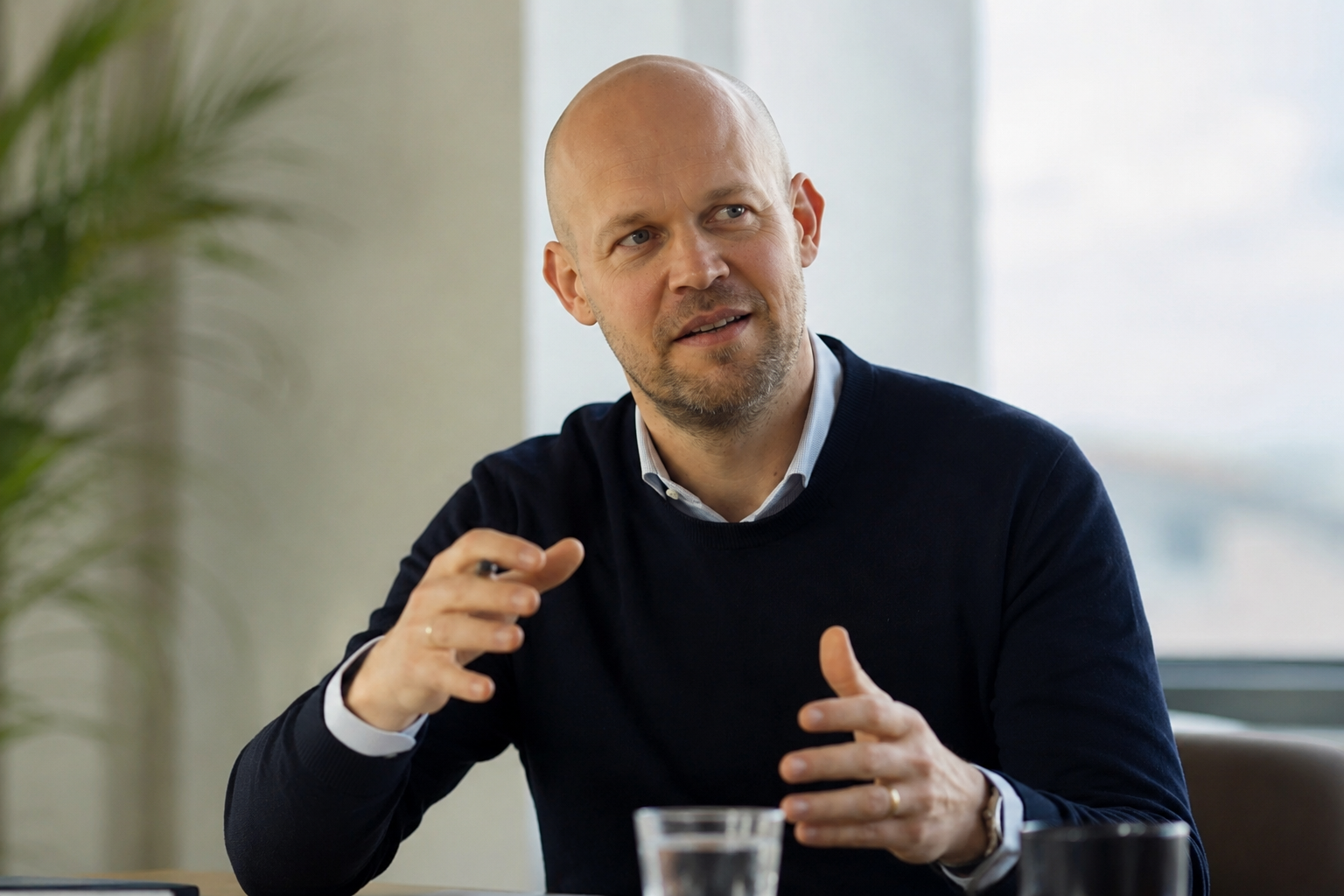
On 31 January 2025, Ørsted announced that its chief executive was stepping down. Board chair Lene Skole said the renewable energy market had “fundamentally changed” since Mads Nipper took the job in January 2021, and that supply chain bottlenecks, higher interest rates and a shifting regulatory landscape had moved the company’s focus.
The timing told its own story. Eleven days earlier, Ørsted had disclosed DKK 12.1 billion of fourth-quarter impairments tied to U.S. interest rates, seabed leases and the Sunrise Wind project, and its shares fell more than 16 percent. Reuters noted the stock was already down 83 percent from its 2021 peak. A Sydbank analyst told the agency that replacing the CEO was the simplest way to win investors back, and called Errboe the right man for the job.
Errboe, the deputy CEO, took over on 1 February. What he took charge of was not a company short of wind farms. By that summer Ørsted had 8.1 GW of offshore wind under construction. It was a company whose financing plan for one of its two U.S. projects under construction had stopped working on acceptable terms. This article follows that financing problem, the board’s decision to ask shareholders for DKK 60 billion, and what the numbers show more than a year later.
Who is Rasmus Errboe, and why did Ørsted promote an insider?
Errboe joined Ørsted in 2012. By the time of his appointment he had run the group’s M&A department, served as CFO of the offshore business, led its European operations and carried overall responsibility for the 2016 IPO and the 2017 sale of the oil and gas business. He joined executive management in 2022.
His promotions came during a difficult stretch. In late 2023, the failure of the Ocean Wind 1 project in the United States cost then-CFO Daniel Lerup his job, and Errboe took over as interim CFO on 14 November. From 1 April 2024 he was Deputy CEO and Chief Commercial Officer, with a new commercial organisation reporting to him, including the regional heads.
Errboe was not an outsider brought in to replace someone else’s plan. He was part of the executive team through the period that produced the pressure, and he understood the model he was now asked to adapt.
A note on attribution. Ørsted’s announcements credit the key decision in this story to its board of directors, and so does this article. Errboe is the CEO and the company’s public voice, not its sole decision-maker.
How does Ørsted’s farm-down model work?
An offshore wind farm costs billions of kroner and earns nothing for years. Ørsted’s usual answer has been to build and de-risk a project, then sell a share to a partner, who funds part of the construction and takes part of the future income. The cash is recycled into the next project, and Ørsted keeps a stake.
The pattern shows up across the portfolio. Ørsted sold half of the 2.9 GW Hornsea 3 project in the UK and 55 percent of Greater Changhua 2 in Taiwan. Revolution Wind in the United States is a 50/50 joint venture with Skyborn Renewables. The plan for Sunrise Wind had the same shape: sell part of the project together with its project-level financing, so that Ørsted would not carry the full cost itself.
The model works while buyers will pay acceptable prices for projects still under construction. That depends on interest rates, confidence in costs and trust in the market the project sits in. In 2024, all three moved against Ørsted in the United States. The model itself survived, as later sections show. One project’s version of it did not.
Why did 2024 expose the pressure?
The January 2025 disclosures put numbers on it. A 75-basis-point rise in long-dated U.S. interest rates raised the discount rate on the U.S. portfolio and triggered a DKK 4.3 billion impairment. Lower valuations for seabed leases off New Jersey, Maryland and Delaware added DKK 3.5 billion. Higher costs and delay at Sunrise Wind, especially around monopile foundations, added another DKK 4.3 billion. Commissioning of Sunrise Wind slipped to the second half of 2027.
For the full year, Ørsted recognised DKK 15.6 billion of impairments, DKK 14.1 billion of them linked to U.S. projects. The 2023 total had been DKK 26.8 billion. Two years of heavy write-downs, most of them American.
An impairment is not cash leaving the building. It is an accounting admission that assets are worth less than assumed. It still matters for financing, because those same costs, interest rates and lease values can also shape what a prospective partner is willing to pay.
Why did Ørsted raise DKK 60 billion instead of selling part of Sunrise Wind?
On 11 August 2025, Ørsted said a “material adverse development” in the U.S. offshore wind market meant it could not complete the planned partial sale of Sunrise Wind, and the non-recourse project financing attached to it, on terms that would strengthen its capital structure enough. The board discontinued the sale and planned a rights issue of DKK 60 billion in gross proceeds.
The arithmetic was direct. Without the sale proceeds, Ørsted had to fund the entire project on its own balance sheet, an incremental requirement of roughly DKK 40 billion. The rest was meant to strengthen the capital structure and provide more financial flexibility, including more flexibility over the timing of future farm-downs. Skole said the board had assessed all the options and concluded the rights issue was the best path. The announcement does not describe the offers that fell short.
The Danish state, which owns 50.1 percent of Ørsted, committed to take up its share, and Morgan Stanley underwrote the rest. Bloomberg reported that the shares fell 29 percent on the news.
The same announcement shows what shareholders were financing and what the choice cost. Ørsted raised its 2025–2027 investment programme to about DKK 145 billion from DKK 130 billion, citing full ownership of Sunrise Wind and higher U.S. tariffs. It said the extra capital employed would pull its average return on capital for those years down to about 11 percent, from roughly 13 percent without Sunrise. The full 8.1 GW construction portfolio is expected to add DKK 11 to 12 billion in annual EBITDA by 2028. Within it, the two U.S. projects would contribute about DKK 4.5 billion in annual run-rate EBITDA, against remaining investment of around DKK 45 billion, according to Ørsted’s later update. That ratio is not a return.
The issue priced new shares at DKK 66.60, at a ratio of 15 new shares for every 7 held, and closed in October 2025. The state took 451.5 million shares. Demand for the remaining shares exceeded what was available, so the underwriting banks were left holding none. Errboe described the work ahead in the results announcement as “a long, tough haul.”
Did the rights issue solve Ørsted’s U.S. problem?
It did not, and the timeline shows why. On 22 August, eleven days after the announcement, the Bureau of Ocean Energy Management ordered Revolution Wind to halt ongoing activities. The project was about 80 percent complete, with roughly DKK 5 billion left to spend for Ørsted’s half. Ørsted confirmed it would proceed with the rights issue anyway. A federal court enjoined enforcement of the stop-work order on 22 September.
The respite was short. On 22 December 2025, BOEM issued new orders suspending all ongoing activities at Revolution Wind for 90 days for reasons of national security, and sent similar orders to Sunrise Wind and three other projects. The agency said they rested on classified information. That material has not been made public, and nothing here speculates about it.
Ørsted’s project companies sued. The U.S. District Court for the District of Columbia granted preliminary injunctions allowing Revolution Wind to restart on 12 January 2026 and Sunrise Wind on 2 February, and both resumed work. A preliminary injunction lets construction continue while the lawsuits proceed. It is not a final ruling. Ørsted said it was seeking an “expeditious and durable resolution” with the U.S. administration.
The distinction is the useful one for any executive. A rights issue pays for a project. It does not insure it against a regulator.
What did Ørsted give up to rebuild its balance sheet?
The DKK 60 billion was one piece. Ørsted’s 2025 annual report describes four priorities: strengthening the capital structure, delivering the construction portfolio, disciplined capital allocation and improving competitiveness.
On the first, the farm-down programme carried on. On the day it dropped the Sunrise sale, Ørsted said the Hornsea 3 and Greater Changhua 2 processes were continuing and that it had started selling its European onshore business. All three were completed, raising around DKK 46 billion against a target of more than DKK 35 billion. Ørsted keeps the other half of Hornsea 3, which it calls the world’s largest offshore wind farm.
Keeping all of Sunrise had its own price. With no sale, Ørsted lost the construction-agreement earnings the farm-down would have produced, which it said slightly lowered its 2026 EBITDA expectations. It is also reconfiguring the Hornsea 4 project in the UK, while keeping the seabed lease, grid connection and key permits.
On costs, Ørsted announced it would cut about 2,000 positions toward the end of 2027. Shareholders are waiting too: the dividend returns only with the 2026 financial year, with the first payment in 2027.
What do Ørsted’s 2025 and 2026 numbers actually show?
On the balance sheet, a lot. On returns and cash, less so. Net interest-bearing debt fell from DKK 58.0 billion at the end of 2024 to DKK 19.0 billion at the end of 2025, while FFO to adjusted net debt improved from 12.7 percent to 42.9 percent. Profit for the year moved from roughly zero to DKK 3.2 billion, although free cash flow remained negative, at DKK 18.9 billion compared with negative DKK 8.8 billion a year earlier.
EBITDA excluding new partnerships and cancellation fees was DKK 25.1 billion in 2025, inside the DKK 24 to 27 billion guidance range and barely changed from the year before. Reported EBITDA fell to DKK 22.4 billion from DKK 32.0 billion, mainly because 2024 had included a DKK 7.3 billion reversal of cancellation fees. Much of the debt reduction came with the equity raise and the asset sales, so it reflects the recapitalisation more than the earnings of the assets themselves.
The first half of 2026 gives the same mixed picture. EBITDA excluding partnerships and cancellation fees was DKK 15.0 billion, up 8 percent, and offshore generation rose 23 percent to 11.2 TWh. Ørsted said every construction project, Hornsea 3 included, was on schedule and within planned costs. Free cash flow turned slightly positive at DKK 364 million, and net debt stood at DKK 22.0 billion, against DKK 67.1 billion at the end of June 2025.
Against that, return on capital employed was 3.1 percent, down from 7.5 percent. Net profit was DKK 3.3 billion against DKK 8.2 billion, which the company attributed mainly to divestment gains the year before, higher tax and non-cash impairments of DKK 2.5 billion. Ørsted is targeting an average return on capital of about 11 percent for 2026 and 2027 and above 13 percent for 2028 to 2030. It has kept its 2026 EBITDA guidance above DKK 28 billion, and plans to restart dividends at what it calls a modest level.
What can other executives learn from Ørsted’s financing reset?
Three points stand out, and each is analysis rather than something Ørsted has said.
First, a financing assumption is a strategic assumption. Ørsted’s growth plan relied on partners buying into projects on workable terms. When that failed on a single project, the cost was roughly DKK 40 billion of additional funding. The lesson is not to avoid partners or leverage. It is to name the assumption the financing plan cannot survive losing, and to know who controls it.
Second, certainty of capital has a price. The trade-off was immediate: the company secured funding certainty through a fully underwritten, state-backed raise, while shareholders absorbed a 29 percent share-price fall.
Third, funding does not fix external risk. Revolution Wind’s stop-work order arrived eleven days after the rights issue was announced. By December the capital structure was stronger, but that did not prevent a second round of regulatory disruption.
What remains unresolved?
The evidence supports a narrow claim. Ørsted’s balance sheet is far stronger than it was in 2024, construction is progressing on schedule and the company has kept its guidance.
The same record shows that returns on capital are low, impairments continue, the construction programme still demands large sums through 2027 and the U.S. cases are not finished. Sunrise Wind has to be completed and commissioned. The return-on-capital target has to be met by projects that are not yet earning. The first dividend is not due until 2027.
Errboe’s tenure will be judged less on the August 2025 announcement than on whether those projects deliver the DKK 11 to 12 billion in annual EBITDA the company expects by 2028. The rebuilding has moved faster on the balance sheet than on returns, and the second part is still to be proved.