Concentrix’s AI Bet: Why Chris Caldwell Is Disrupting the Business He Built
Half of Concentrix’s revenue now comes from work won in the AI era, the company says. It also booked a second write-down of more than a billion dollars in under a year and guided revenue lower. Whether the new economics arrive before the old ones fade is the decision that will define Chris Caldwell’s tenure.
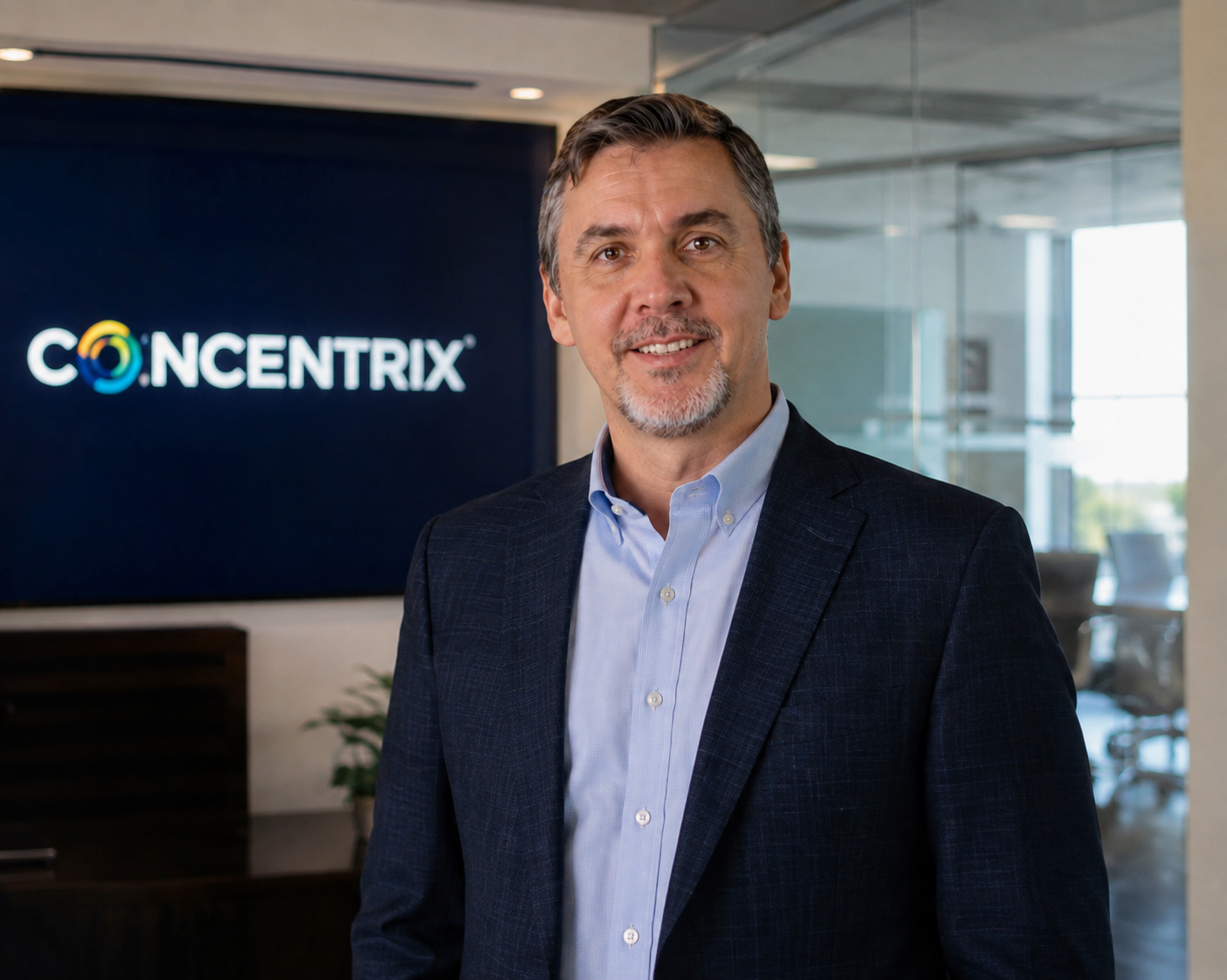
On the evening of September 29, 2026, Concentrix reported a quarter that read like two companies’ results stapled together. Revenue fell 1.2% to $2.45 billion. The company booked a $1.05 billion goodwill write-down and a net loss of $988 million. Yet adjusted operating income rose, third-quarter free cash flow set a record, and CEO Chris Caldwell described an inflection point.
The sentence that matters most in the release is a plain admission. Concentrix, Caldwell said, is “aggressively disrupting our own traditional business.” Few chief executives of a $9.8 billion company say that about their core operation in an earnings statement. Fewer still say it with the shares now far below the $120 Concentrix price used to calculate the transaction value of the 2023 Webhelp deal.
That is the Concentrix AI strategy in one line. Speed up the automation of customer-service work the company has long been paid to do with people, accept the revenue pressure that follows, and bet that a newer mix of AI-enabled and specialist services replaces what gets compressed. This piece looks at what Caldwell decided, why it made sense, what it has cost, and what the evidence supports so far.
What did Concentrix report on September 29, 2026?
Revenue was $2,453.7 million, down 1.2% as reported and 0.5% in constant currency. The $1.05 billion impairment pushed the operating result to a loss of $910.3 million. Concentrix attributes the charge mainly to the recent trading range of its stock price and market capitalization.
Take out the impairment, restructuring, amortization and share-based pay, and the picture changes. Non-GAAP operating income was $309.0 million, up 1.3%, at a 12.6% margin against 12.3% a year earlier. Adjusted EBITDA was $363.0 million, or 14.8% of revenue. Non-GAAP earnings per share came to $2.92, up from $2.78, and adjusted free cash flow was $218.3 million.
Then the guidance. Concentrix expects fourth-quarter revenue of $2.410 billion to $2.460 billion, which implies a constant-currency decline of 3% to 5%. Full-year revenue is now guided to $9.827 billion to $9.877 billion. When the fiscal year began, the range was $10.035 billion to $10.180 billion. The revenue outlook complicates the margin improvement rather than confirming it.
What is Chris Caldwell actually deciding?
The decision is easiest to see in the company’s own arithmetic. Caldwell told analysts that 50% of revenue now comes from business Concentrix has won and deployed in the last three years, since generative AI arrived. He split that half into three pieces: about $3 billion from clients whose work has been heavily transformed or is influenced by AI, $1.3 billion of net revenue resulting from compressing traditional services with the company’s iX Suite platform, and $700 million from new specialist services such as risk and compliance.
Two details stand out. The first is what the $1.3 billion represents: revenue running through iX Suite, where automation is changing how traditional work is delivered. In practical terms, it is work that has become leaner and that clients still buy from Concentrix.
The second is speed. Chief Financial Officer Andre Valentine said Concentrix had expected to cross the 50% mark around the end of the fourth quarter or the middle of the first quarter of next year. It got there a quarter and a half early. Caldwell said faster automation brings temporary headwinds to traditional revenue, and that Concentrix is doing what it can to accelerate it anyway.
The company is not treating that pressure as a reason to slow the transition. In the third quarter, Concentrix brought 61 opportunities, covering more than 30,000 advisors, live on iX Suite. It also said net new client wins involving AI rose 63% from the previous quarter.
One caution belongs here. The 50% figure is management’s own classification. It is not a GAAP segment, it has not been audited as an AI revenue line, and the company says it will break the numbers down in more detail for investors in early 2027. It is a useful account of the transition, but it is Concentrix’s account.
The business Caldwell built, and the bet on scale behind it
Caldwell has spent most of his career inside this company. He has been with Concentrix since 2007, ran it as president from 2012, and became CEO in December 2020, when Concentrix was spun out as a stand-alone public company. The model he grew was scale: large teams handling calls, chats and back-office work for big brands across dozens of countries.
In March 2023, he doubled down on it. Concentrix agreed to combine with Webhelp, the French outsourcer, in a deal valued at about $4.8 billion including net debt. Webhelp’s owners were to receive 14.9 million Concentrix shares, €500 million in cash and a €700 million note payable in two years. The company said the transaction value reflected a Concentrix share price of $120, and it projected cost synergies of $75 million in the first full year and at least $120 million, net of investments, by the third.
The accounting tells a slightly different story from the headline, and the gap matters. When the deal closed on September 25, 2023, Concentrix reported preliminary purchase consideration of about $3.75 billion, net of cash acquired. Roughly $1.9 billion of the cash went to repay Webhelp’s debt and a shareholder loan. Concentrix funded the transaction mainly with $2.15 billion of senior notes, term loans and cash on hand.
Filed pro forma figures put the combined company at about $9.5 billion in fiscal 2023 revenue and $1.57 billion in adjusted EBITDA, a 16.5% margin. Fiscal 2025 revenue was $9.83 billion, and adjusted EBITDA was $1.47 billion, a 15.0% margin, down from 16.2% in fiscal 2024. The scale held. The margin uplift the combined model was expected to deliver has been harder to sustain.
Why did Concentrix take two goodwill impairments?
The company points to one cause: a sustained fall in its stock price. After that decline, it ran an interim quantitative impairment test on November 1, 2025. The fair value of its single reporting unit came in below its carrying value, and it recorded a $1.523 billion charge in the fourth quarter of fiscal 2025. It attributes the second charge, $1.05 billion in the quarter ended August 31, 2026, to the same cause, the trading range of its stock.
Together the charges come to about $2.57 billion. Goodwill stood at $3.67 billion after the first and $2.64 billion after the second, roughly half of where it was before the first charge, by our arithmetic. Neither charge reduces cash.
It is tempting to call this the bill for Webhelp. The filings do not say that. Because goodwill is tested as one unit, the charges cannot be traced to a single acquisition, and management ties them to its share price. The record does show the timing: Concentrix recorded no goodwill impairment in fiscal 2023 or 2024. The write-downs arrived after the market began questioning what a people-intensive outsourcer is worth in an AI economy. That reading is ours, not a claim in the company’s filings.
Is AI the reason revenue is falling?
Not by itself, and Caldwell’s explanation is more specific than a headline about AI eating call centers.
On the third-quarter call he named three pressures. Two hyperscale clients are ending support for some of their customer sets. That wind-down was once expected to run from the third quarter into the second quarter of 2027. Caldwell now says it will be finished by the end of the fourth quarter, which concentrates the hit there and leaves some spillover into the first half. Clients moving work to lower-cost countries are costing about three points of growth, though Valentine said only 10% to 11% of revenue is still in the pool likely to move. And automation is going live faster than Concentrix planned.
The vertical data shows an uneven pattern. In the third quarter, technology and consumer electronics revenue fell 10%, healthcare fell 17%, and communications and media fell 7%. Banking and financial services grew 12%, and retail, travel and e-commerce grew 6%. A split like that argues against a single explanation.
The same pressures were visible in June, when Caldwell flagged clients that had decided to stop supporting some customer groups altogether, a headwind he put at about one point, alongside faster offshoring. Outside analysts see the risk too. After Concentrix cut its revenue outlook, Bloomberg Intelligence analyst Tamlin Bason said the results reinforced concern that AI is shrinking core outsourcing demand faster than higher-value AI services are growing. That is the bear case, and it comes from someone who follows the company closely. Concentrix’s numbers so far neither settle it nor dismiss it.
What do the numbers show so far?
The third-quarter margin gain is real but narrow. For the first nine months, non-GAAP operating margin is 12.1%, below 12.8% a year earlier, and adjusted EBITDA margin is 14.3% against 15.0%. Management guides to margin expansion in the second half, with the fourth-quarter guidance implying a non-GAAP operating margin near 12.9%. Full-year non-GAAP earnings per share are guided to $10.97 to $11.09, below last year’s $11.22.
Cash is the stronger evidence. Adjusted free cash flow was the highest third-quarter figure since the 2020 spin-off, and full-year guidance is $630 million to $650 million, with 2027 expected to be higher. That cash is going to debt. Total debt was about $4.375 billion at quarter end and net debt about $4.12 billion, with a target near $3.8 billion by year-end and below $3.3 billion by the end of fiscal 2027. A $375 million term loan matures in December.
The cost line that gets less attention is restructuring. Acquisition-related, integration and restructuring charges were $142.9 million in the first nine months, against $53.5 million a year earlier, mostly severance and facility consolidation tied to cost reductions. Full-year guidance implies $172.9 million.
There is a productivity signal too. On the second-quarter call, Caldwell said revenue per non-billable employee rose 14% from a year earlier, which he credited to the company’s own use of AI and automation tools internally.
What is the Concentrix AI strategy really betting on?
Strip away the vocabulary, and the bet has three parts.
The first is replacement speed. Caldwell expects new business revenue to exceed $6 billion in 2027 and to offset much, if not all, of what automation removes, with growth weighted to the second half. Asked when Concentrix could grow at a mid-single-digit rate, Valentine said the company needs a couple more quarters of automation and that this is more likely a 2028 conversation. It is a candid timetable to put on the record.
The second is margin durability. The company says the newer revenue is more profitable and retains clients at four times the rate of traditional work. It expects its iX Hero software to eventually earn margins like a software business, though Caldwell said that is a fair way off. Software licensing is expected to reach about $120 million in annual recurring revenue by the end of 2026, roughly 1% of sales. Most of the “new” revenue is still services delivered with AI, not software sold on its own.
The third is time. Debt above $4 billion and two write-downs leave less room for a slow transition than the confident tone suggests. Concentrix repurchased no shares in the quarter and raised its dividend to $0.37. It is still buying capability. On September 8 it acquired CastleHill Managed Risk Solutions, which adds governance, risk and compliance and AI governance work. Terms were not disclosed.
The logic behind the strategy is easy to state. If clients are going to automate anyway, a vendor that automates for them keeps the relationship and some of the savings, while one that resists risks losing the account. Concentrix says all of its top five clients and more than 90% of its top 100 have expanded into new services since fiscal 2023. Those are company claims, and only the coming quarters can test them.
What can other executives take from it?
The case raises three practical questions for any business that charges for labor. How much of your revenue is priced on effort rather than outcome, because that is what compresses first? Can you show clients the savings before a rival, or their own engineers, do it for them? And does your balance sheet survive the gap between the old revenue leaving and the new revenue arriving?
Concentrix reports fourth-quarter results in early 2027. They will show whether the pressure came from two clients and a few quarters of faster automation, or from something broader. The 2027 outlook matters more. Caldwell has told investors that new business will offset much, if not all, of what automation removes. If the second half of 2027 shows it, the decision will look like a transition timed deliberately ahead of the market. If it does not, the company will have spent much of its cushion proving the point.