Ton van de Ven Wants to Make Business Networking Accountable
At INC. Business Matchmakers, access is curated, introductions are purposeful, and the real scorecard begins after the meeting.
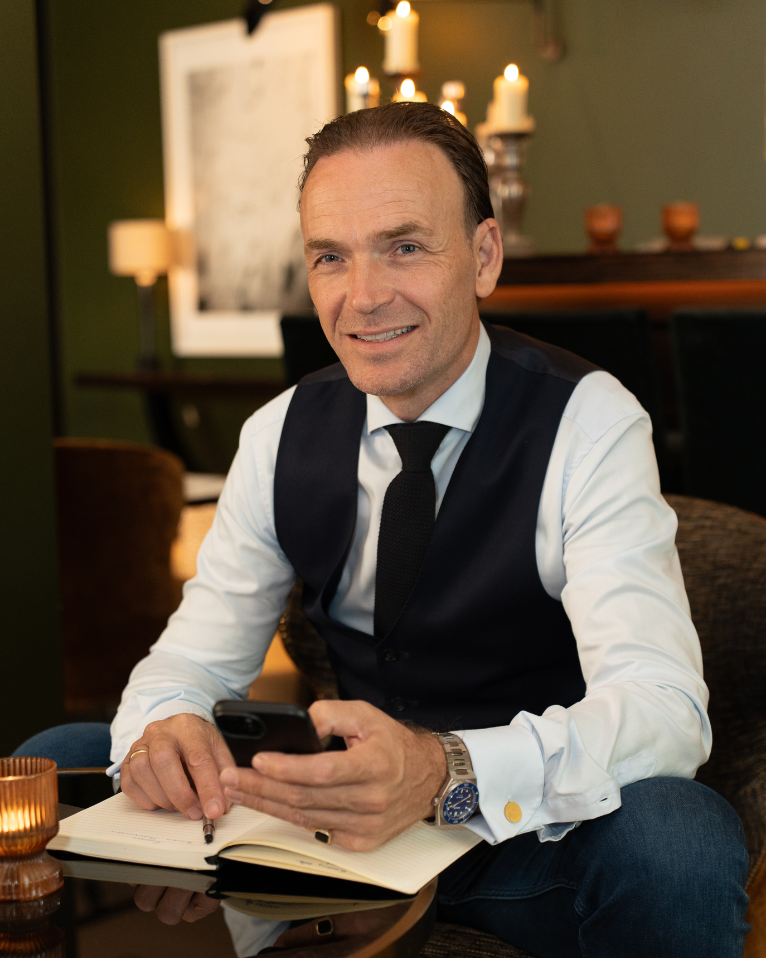
A business event can leave you with a stack of cards, a crowded camera roll and the reassuring sense that progress was made. Three months later, the cards are still on the desk and the pipeline looks exactly the same.
Ton van de Ven has spent much of his working life thinking about that gap: the distance between meeting someone and creating something of commercial value together. To solve the problem he built INC. Business Matchmakers.
As the company's founding partner and CEO, van de Ven argues that senior leaders lose hundreds of hours in rooms filled with polite conversations, vague promises and people who lack the authority to approve anything. When I asked what separates a business matchmaker from a well-connected networker, he did not begin with the size of his contact list. He talked about architecture.
His job, as he sees it, is to work backward from a defined commercial objective, find the person with the power and strategic reason to act, and create a warm, credible path into the room. The introduction is deliberate. What happens next is the member's responsibility.
The commercial education that came before the boardroom
Van de Ven's education in business began far from corporate boardrooms. He worked beside his father in a neighborhood service shop, then learned the rhythm of direct commerce at weekly markets, e-commerce . Later came ventures in St. Maarten and Munich, followed by Crovv the online networking organization.
Those environments were different, but the lesson was consistent. At a market, there is nowhere to hide behind a strategy deck. You understand what somebody needs, make an offer, keep your word and deliver. In technology, systems can create leverage, but poor alignment between people can undo a good product.
The period around 2020 tested those beliefs severely. Van de Ven's father died. He also endured organizational splits, courtroom disputes with former partners and the collapse of an automotive-lighting webshop. The combined experience stripped away his faith in goodwill without structure. Random activity and agreeable conversation were no substitute for clear expectations, disciplined execution and the courage to confront a bad fit early.
"I stopped trying to please everyone," he says. "I shifted from networking volume to matchmaking precision."
That shift eventually led the business to change its name from INC. Networking to INC. Business Matchmakers. The distinction was more than cosmetic. It was a public commitment to be judged by relevance and results instead of activity.
A matchmaker is not a more energetic networker
Traditional networking tends to optimize for exposure. Lead-generation services optimize for names and contact details. Brokers usually enter with a transaction in mind, while advisers may stop at recommendations. Van de Ven's model begins with a specific outcome: the contract, partnership, acquisition, capital relationship or market entry a member is genuinely prepared to pursue.
From there, INC. audits the gap between the member and that outcome, maps the relevant market, identifies the real decision-maker and secures a personal introduction. The point is to arrive as a credible peer rather than as another vendor pushing through a gatekeeper.
There is an important boundary in the promise. INC. can create proximity and lend the trust attached to an introduction. It cannot negotiate the final terms or do the member's follow-through. Van de Ven reduces the division of labor to one clear line: "We introduce; you close the deal." Once the meeting begins, preparation, honesty and execution belong to the person who asked to enter the room.
The model becomes more interesting when it works across what van de Ven describes as a Golden Triangle of entrepreneurs, corporations and financial partners. An entrepreneur may have a solution but lack a route into a large company. A corporate buyer may need an operator capable of moving faster than its internal structure. A financial partner may be looking for both. The opportunity often becomes visible only when all three perspectives are considered together.
INC.'s private Dealrooms are designed to support that process without turning into another crowded networking event. Invite-only evenings, walking lunches and masterclasses give selected participants enough time to understand one another. The composition of the room matters more than its size.
The scorecard starts after the meeting
This is where van de Ven is most insistent. Attendance is not a result. Neither is a pleasant conversation or a new LinkedIn connection. INC. looks instead at warm introductions accepted, qualified follow-up meetings, sales cycles shortened, partnerships formed and revenue generated.
He says several premium members attribute between 20% and 40% of their corporate revenue to introductions made through the network. One example he offers is Elisabeth Beukers of Gifts by Liz. INC. introduced her to companies employing more than 50 people. Some opportunities developed within four weeks; others took six months. Van de Ven reports that those introductions accounted for 20% of her total sales in 2025, with relationships continuing into 2026.
The timeline matters as much as the percentage. High-value business development rarely moves at the speed of a social-media lead. Trust has to survive procurement, budget cycles and internal decision-making. A strong match can shorten that journey, but it does not eliminate the work.
In another case, two entrepreneurs met at an INC. Exclusive Evening and discovered a deeper strategic fit. A year later, they established a corporate entity together. Here the attribution is different: INC. created the initial conditions, while the entrepreneurs built the company. That distinction is worth preserving. Introductions are catalysts, not contracts.
Exclusivity is not decoration
A selective, high-trust membership can easily sound like luxury positioning. For van de Ven, selection is closer to risk management. The value of every introduction depends on the credibility of the people on both sides. One poorly judged member can damage years of accumulated trust.
Most new members, he says, arrive through introductions from people already inside the ecosystem. INC. then conducts in-depth conversations to assess intent, financial capacity, strategic relevance and willingness to reciprocate. Members operate under a code of conduct covering discretion and confidentiality. Somebody who wants to harvest contacts without creating value is the wrong fit, however attractive the membership fee may be.
Commercially, turning away revenue is uncomfortable. Institutionally, it may be the entire product. The moment members suspect that access can simply be bought by anyone, the network's borrowed trust begins to lose value.
INC. uses an annual membership model, with different levels for businesses below and above 10 million euro in revenue. The distinction reflects the complexity of the mandate. A growing owner-led company may need international market access and a handful of carefully chosen introductions. A company beyond 10 million euro may be pursuing acquisitions, substantial capital or board-level expansion across several markets.
The company does not require members to refer to one another and says it charges no transaction commission. That removes the incentive to force a quick deal merely to earn a percentage. It also creates a demanding renewal test: members must continue to believe that the access, judgment and time saved justify the annual investment.
Not every carefully chosen match will produce a transaction. Van de Ven acknowledges that. A relevant introduction can still create board-level proximity or reveal that a proposed deal should not proceed. The standard, however, should remain clear: the desired outcome and the reason for the match need to be defined before anyone enters the room.
Can a trust business scale without becoming a database?
Van de Ven's three-to-five-year ambition is global. INC. lists activity across Europe, North America, Africa, and the Caribbean, and he plans to deepen the company's presence in the Americas and Europe. At the time of our exchange, he said the team was preparing to add two matchmakers in Miami.
The challenge is obvious. A relationship-driven company is closely tied to the founder's judgment, reputation and memory. Those qualities do not become scalable simply because a process has been written down. International growth will require INC. to recruit matchmakers who can apply the same standards, understand local business culture and be held accountable for the quality of every introduction.
Technology has a meaningful role. Van de Ven uses software and artificial intelligence to map markets, research companies and identify likely targets more efficiently. But he draws a firm line at the point where information becomes trust.
"AI only identifies the target," he says. "Human judgment, credibility and our established trust remain irreplaceable in executing the introduction."
An algorithm can tell you who sits on a board. It cannot make that person trust why this particular conversation deserves attention. Nor can it reliably sense the unspoken reservations, timing issues and reputational risks that experienced matchmakers notice. Technology may make the search ten times faster. The final mile remains stubbornly human.
What failure changed in the leader
Van de Ven speaks about his setbacks in unsentimental language. "Obstacles are not emotional signals," he says. "They are data points that dictate your next strategic adjustment." That does not mean loss was painless. It means he no longer treats discomfort as a reason to postpone a necessary decision.
The disputes and business collapse made him more deliberate about choosing partners, setting expectations and protecting the wider ecosystem from unresolved conflict. They also hardened his belief in total responsibility: acknowledge what is happening, remove excuses and decide what the situation requires next.
His wife, Fabiola, now serves as INC.'s managing partner and, in his words, his strategic anchor. The wider team is equally important to the next chapter. If INC. is to become an institution rather than an extension of one man's network, its partners will need the authority to challenge decisions as well as the discipline to uphold the standard.
That may be the deeper lesson beneath van de Ven's hard-edged language. Trust is not the absence of difficult conversations. It is what becomes possible when people are clear about the objective, honest about the risks and reliable in the work that follows.
A smaller room, with a higher standard
Van de Ven does not want INC.'s success to be measured by how many names it can add to a membership directory. His preferred milestones are harder to manufacture: multi-million-euro transactions, durable partnerships and member growth that can be traced to purposeful introductions.
His thesis is simple, although delivering it is not. Business development improves when leaders reduce randomness. Define the outcome before attending the event. Be selective about the people whose trust you borrow. Understand what each side can contribute. Then follow through with enough discipline to justify the introduction.
Not every company needs a professional matchmaker. Every leader, however, can apply that standard to the way relationships are built. Fewer vague coffees. Fewer rooms chosen for status. More thought about who needs to meet, why now and what both parties are prepared to do if the conversation goes well.
Perhaps the most credible part of van de Ven's proposition is its limit. He can put the right people at the same table; he cannot make them sign. INC. promises proximity. The member still has to earn the outcome.
Van de Ven returns to one idea: "Time is the only asset you cannot buy back." In an economy with almost infinite contact and increasingly scarce trust, making every serious introduction accountable may be the most valuable connection of all.
Website: https://incbusinessmatchmakers.com/
Personal LinkedIn: https://www.linkedin.com/in/tonvdven/
LinkedIn Company page: https://www.linkedin.com/company/inc-businessmatchmakers