Why LEGO Took 29 Brand Experiences In-House — and Left 11 With Its Longtime Partner
Inside Niels Christiansen's decision to redraw, not end, a 20-year partnership with Merlin Entertainments
At the end of a record-breaking 2025, most toy companies would have spent the closing weeks of the year celebrating. LEGO had just posted revenue of DKK 83.5 billion, up 12 percent, with net profit up 21 percent and consumer sales growing more than twice as fast as the global toy market. Set in motion three months earlier, one decision from that year stands out from the rest of LEGO's 2025 record — and it wasn't a new product line, a licensing deal or a factory groundbreaking. It was a decision about who gets to run the rooms where children touch the LEGO brand with their hands.
On September 24, 2025, the LEGO Group announced it had agreed to buy 29 LEGO and LEGOLAND Discovery Centres from Merlin Entertainments, the company that had built and operated them for nearly two decades. The deal closed on February 27, 2026, for a cash consideration LEGO's own announcements rounded to £0.2 billion. It brought roughly five million annual visitors, nine countries' worth of retail-and-play locations, and about 1,500 Merlin employees under the LEGO Group's own roof.
What makes the move worth examining isn't the price tag. It's what LEGO chose to keep for itself and what it chose to leave behind. In the same breath as the acquisition, Merlin retained the license to run 11 LEGOLAND Resorts around the world, including its newly opened park in Shanghai. LEGO didn't sever a 20-year partnership. It renegotiated where the line sits inside it — taking direct control of the smaller, denser, city-based attraction format while leaving the larger, capital-intensive resort business with the operator built to run it.
A company already growing strongly
The context matters. Nothing in LEGO's public disclosures points to the Discovery Centres as a response to weakness elsewhere in the business — the company's 2025 results were, by its own account, a record on nearly every metric: revenue up 12 percent to DKK 83.5 billion, operating profit up 18 percent to DKK 22.0 billion, net profit up 21 percent to DKK 16.7 billion, and an operating margin that climbed to 26.4 percent from 25.2 percent the year before. Consumer sales rose 16 percent against a toy market that grew only 7 percent. The momentum carried into 2026: first-half revenue reached a record DKK 41.9 billion, up 21 percent, with net profit up 32 percent to DKK 8.6 billion.
LEGO's own retail network was also performing well without the Discovery Centres. The company ended 2025 with 1,112 stores across 54 markets — 214 of them LEGO-owned Brand Stores, 800 LEGO Certified Retail stores, 57 LEGO Travel Retail stores, and 41 stores in LEGOLAND Parks and Discovery Centres owned and operated by partners — after opening 83 new locations during the year. In its 2025 Annual Report, the company said LEGO Brand Retail Stores and LEGO.com had welcomed a record number of visitors and achieved the highest guest satisfaction scores in the company's history.
None of that reads like a business searching for a new growth lever. It reads like a business deciding, from a position of strength, that it wanted to own a specific slice of how customers meet the brand in person — and was willing to spend real money and take on real operating complexity to get it.
The timing is also worth noting. 2025 was the year LEGO marked the 70th anniversary of the LEGO System in Play, the interlocking-brick concept the entire company is still built on, and the company used the milestone to lean harder into physical, hands-on brand moments rather than pull back from them. The same year, LEGO kept expanding on the digital side too — LEGO Fortnite Odyssey reached more than 1 billion player hours since launch, while new Formula 1-branded sets and track-side activations ran across more than 20 Grand Prix weekends. The Discovery Centres acquisition landed inside that pattern, not against it: a company investing in brand experience wherever people are willing to have it, physical or digital, owned or licensed.
The decision, in the company's own words
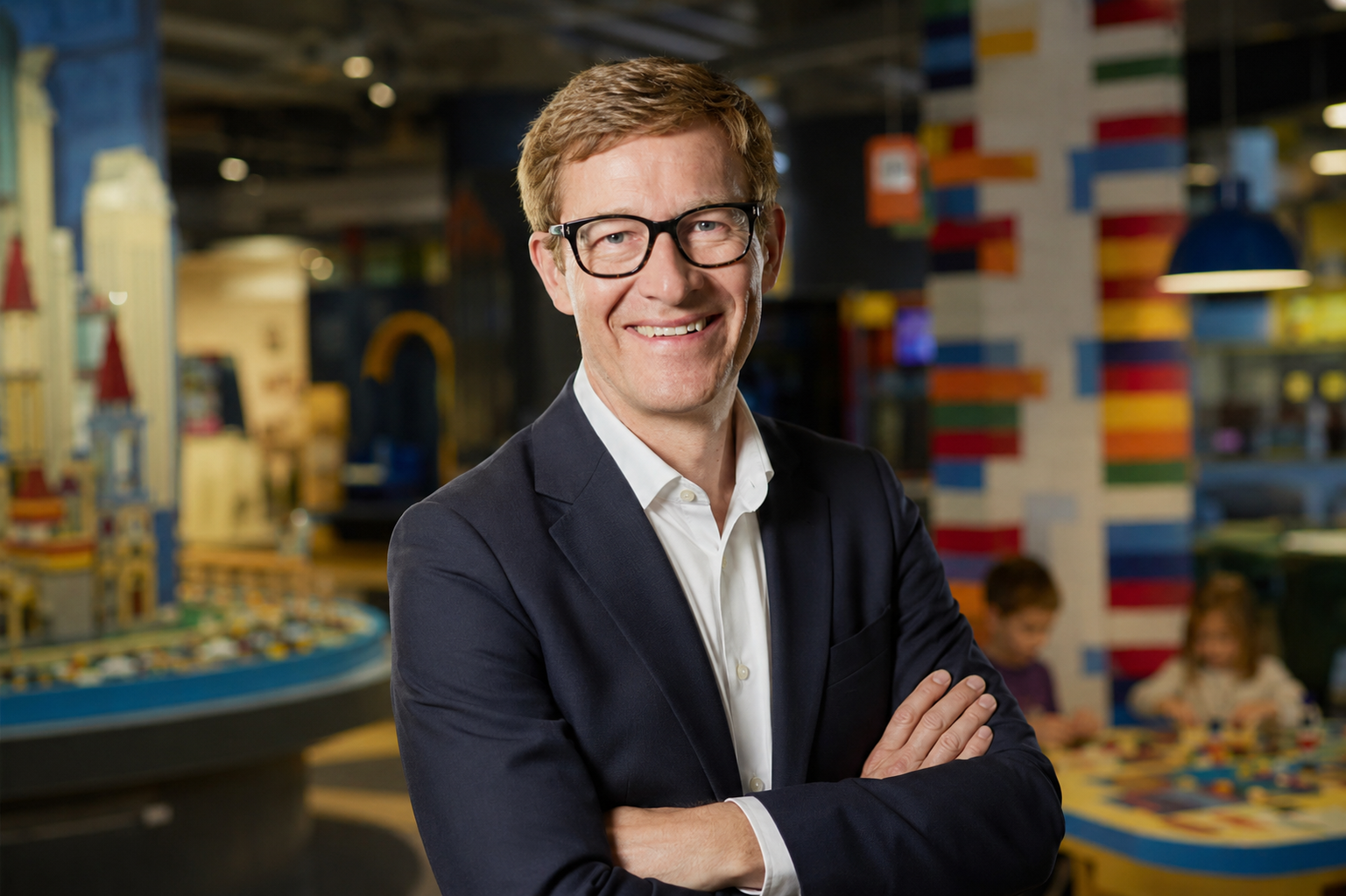
LEGO CEO Niels B Christiansen framed the deal, from the first announcement, as an extension of retail rather than a new business line. "They will be an important addition to our global network of retail stores and allow us to offer fans of all ages even more memorable hands-on brand and shopping experiences," he said when the agreement was announced. When the deal closed five months later, he was more direct about what the company was actually buying: "They will play an important role in helping us to connect with even more fans around the world."
In LEGO's 2025 Annual Report, Christiansen described the acquisition in similarly restrained terms, calling it "an important step towards creating even more immersive, LEGO branded experiences for families" — language that treats the Discovery Centres less as a new venture and more as a natural extension of a retail strategy the company had already been pursuing for years. As he told Fortune in 2024, well before the Merlin talks became public: "There's no market in which we're not investigating for a new store." Discovery Centres, on that reading, were simply the next format in a retail expansion Christiansen had already been running since he took over as CEO in October 2017, after nine years running Danfoss and a career that started at McKinsey.
Merlin's side of the announcement is worth reading just as closely, because it frames the same event as a strategic narrowing rather than a loss. Merlin Entertainments CEO Fiona Eastwood said the move let her company "strengthen its focus on driving the growth and success of LEGOLAND Resorts," calling it "a natural next step" after 20 years of running the Discovery Centre business. Neither company described this as an acquisition that ended a relationship. Both described it as one that reorganized it.
A partnership with a shared owner
There is a structural detail in LEGO's own governance disclosures that adds useful context, and it rarely appears in coverage of the deal: LEGO and Merlin are not entirely unconnected companies. KIRKBI A/S, the investment company controlled by the Kirk Kristiansen family that founded LEGO, owns roughly 75 percent of the LEGO Group. KIRKBI has also held a stake in Merlin Entertainments. According to LEGO's 2025 Annual Report, Thomas Kirk Kristiansen — chair of the LEGO Group's board and chair of KIRKBI — also sits on the board of Merlin Entertainments Limited. So does Søren Thorup Sørensen, KIRKBI's chief executive and deputy chair of LEGO's board.
LEGO states in the same report that it follows the arm's-length principle and OECD transfer-pricing rules in its related-party dealings, and nothing in the public record suggests otherwise. What the overlap does establish is that this deal sits between companies with shared governance connections, not between two parties with no connection beyond a 20-year licensing arrangement. The economic case for the split — LEGO running city-based retail-and-play, Merlin running resort-scale attractions — stands on its own regardless of ownership structure. The governance overlap is simply part of the factual backdrop worth knowing when reading the context in which that split was agreed.
What LEGO actually bought, and what it built around it
The clearest sign that this was more than a real-estate purchase came in a leadership appointment announced alongside the deal's completion in February 2026, one that got far less attention than the acquisition itself. LEGO named Kathrine Kirk Muff — who had run LEGO House, the company's flagship brand attraction in Billund, since 2022 — to the role of Head of LEGO Location-based Experiences. Her mandate now spans LEGO House, the LEGO Discovery Centres and the LEGOLAND Discovery Centres together, under one leader. Rasmus Duun, previously head of LEGO's in-house creative agency, succeeded her as Head of LEGO House.
That reorganization put "location-based experience" under a single accountable leader rather than treating the Discovery Centres as a scattered set of attractions bolted onto retail. LEGO has also separately been hiring for a Location Planning Manager role focused specifically on the Discovery Centres network — building data-driven blueprints and portfolio recommendations for it — which suggests the integration work is still active rather than finished on day one.
The trade-off nobody announces in a press release
Owning 29 attractions across nine countries is a different operating problem than owning a brand that other people pay to use. Merlin had run these centres for nearly 20 years, since the first opened in Berlin in 2007, building the staffing models, guest-flow design and day-to-day operating discipline that a hands-on indoor attraction requires. LEGO now owns that operating burden directly, along with 1,500 employees whose day-to-day work has nothing to do with molding plastic bricks or running an e-commerce platform. Retail stores and a theme-park-style attraction business are not the same discipline, and the fact that LEGO created a dedicated leadership structure for it — rather than folding it quietly into an existing retail division — suggests the company knows that.
There is a second, quieter detail in the numbers worth sitting with. Even as LEGO added a physical-experience business, its core store count didn't simply grow. By the middle of 2026, the company reported 1,106 branded stores across the same 54 markets — six fewer than the 1,112 it had at the end of 2025 — even as it continued to open new locations. LEGO hasn't explained that net decline, so it would be a stretch to call it a deliberate trade-off. But the contrast is real: a conventional store count that slipped slightly, alongside DKK 1.9 billion of fresh investment specifically in the Discovery Centre network in the first half of 2026 alone. Whatever is driving the store-count dip, it isn't a company pulling back on physical retail broadly.
It is also worth being precise about what LEGO paid, because the company's own disclosures aren't perfectly consistent on the point. The September 2025 announcement and the February 2026 completion statement both describe the cash consideration as an estimated £0.2 billion, rounded, "subject to customary closing adjustments." LEGO's 2025 Annual Report later recorded the total cash consideration at £215 million, or DKK 1.83 billion — a modest but real gap between the headline number the two companies put in their press releases and the number that eventually shows up in the accounting. For a deal this size, that gap is unremarkable. But it's a reminder that the clean, round figures attached to most acquisition headlines are approximations agreed on for public communication, not the number that ultimately clears the books.
What LEGO has to make work now
LEGO has not claimed the acquisition has already paid off, and the public record doesn't support that claim either. What exists is a company reporting record results before, during and immediately after the deal, a new leadership structure built specifically to run the combined attraction portfolio, and early hiring evidence that LEGO is still building the standardization work — location planning, portfolio recommendations — that a newly absorbed 29-site network requires. The near-term test isn't whether LEGO can absorb 1,500 new employees on a balance sheet; its 2025 results show a company more than capable of that. It's whether five million annual visitors walking through a Discovery Centre can translate into stronger brand engagement and retail value now that LEGO owns the experience directly.
The more interesting lesson from LEGO's move is narrower: a 20-year partnership doesn't have to be all-or-nothing. LEGO didn't decide Merlin was a bad partner — Merlin still runs 11 LEGOLAND Resorts under license, and both companies' public statements describe the partnership as continuing. What LEGO decided was that one specific part of the customer relationship — the smaller, more frequent, city-based touchpoint — mattered enough to control directly, while the larger, more capital-intensive part still belonged with the partner built to run it. That is a more precise kind of ownership decision than most acquisitions represent, and it is a useful example of how a company can redraw the boundary of a long-term partnership without ending it.
LEGO does not currently break out Discovery Centre performance as its own reporting line, so outside observers will have to judge this mostly through what surfaces in store-network commentary, hiring activity and, eventually, Christiansen's own account of it in a future annual report. The next 12 to 18 months of that evidence will show what LEGO gains from owning that part of the experience directly.