The Seam Between Boeing and Spirit: Inside the Decision to Reverse a 20-Year Outsourcing Bet
Boeing sold its Wichita fuselage plants in 2005 and bought back the company that inherited them in December 2025 for about $8.4 billion. The Boeing Spirit AeroSystems acquisition is a test of where a manufacturer's boundary should sit, and the evidence so far is mixed.
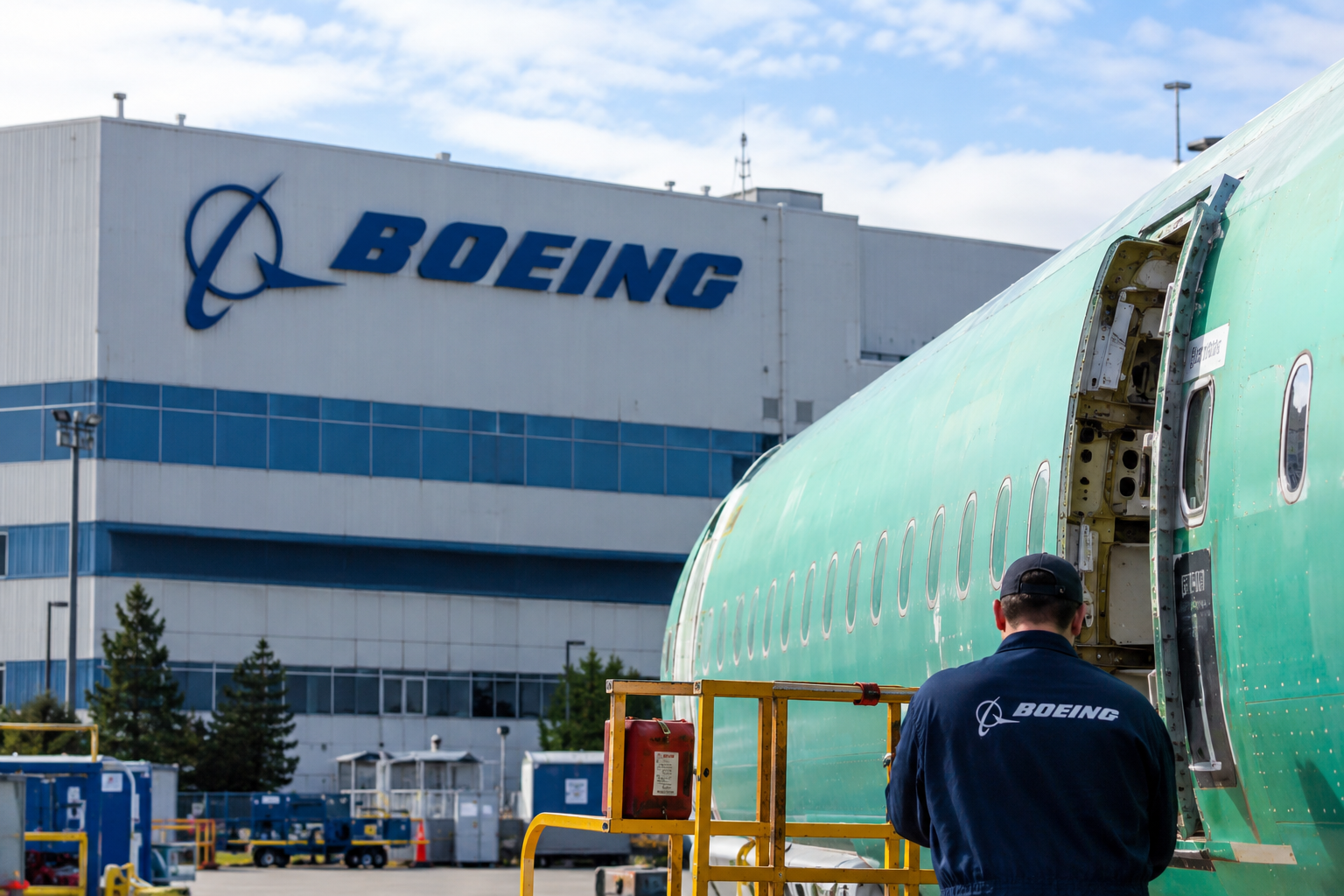
At the end of August 2023, a 737 MAX 9 fuselage built in Wichita, Kansas, arrived at Boeing's factory in Renton, Washington, with damaged rivets near a door plug. On September 18, Boeing personnel opened the plug to give access for the repair, which meant removing its four securing bolts. Spirit AeroSystems personnel did the rivet rework. Nobody created a record of the removal, and investigators found no one who said they knew who had opened the plug. The bolts were never put back.
On January 5, 2024, that plug separated from Alaska Airlines Flight 1282 about six minutes after takeoff from Portland, with 171 passengers and six crew aboard. It landed in a backyard. The airplane returned safely. The National Transportation Safety Board's probable cause was Boeing's failure to provide adequate training, guidance and oversight for its parts-removal process, and it faulted FAA oversight as well. It did not assign probable cause to Spirit's rivet work. But the accident happened where one company's work met another's, and that is a place most executives never look.
Twelve days later, Boeing's chief executive called the chairman of that supplier.
Why did Boeing sell its Wichita plants in the first place?
The 2005 sale is easy to mock now. It was not careless at the time.
Boeing said in April 2004 that it was studying a sale of its Wichita, Tulsa and McAlester operations. In February 2005 it agreed to sell them to Onex, and the deal closed on June 16, 2005, for roughly $900 million in cash plus long-term supply agreements. About 9,000 people worked at the sites. Boeing's stated case was lower procurement costs, with the new company free to win business from other customers.
Wichita had been an internal supplier. Spirit's later filings say it had very few sales outside Boeing. Selling a captive factory to an owner who could fill it with other customers' work was a coherent bet.
It was not simply a $900 million windfall, either. Boeing's 2005 annual report put the net loss on the sale at $287 million, including pension effects.
The contract is what deserves attention. Spirit's 2006 IPO filing described it as Boeing's exclusive supplier for substantially all of the work Wichita had done, for the life of those programs, and said Boeing could not produce the products internally or buy them elsewhere. Prices for existing products were fixed through May 2013. Boeing had not only handed the work to someone else. It had agreed not to take it back.
How independent was Spirit, really?
Spirit did grow beyond Boeing. It built a real Airbus business. On paper it was an independent company. The filings show something closer to a dependent one.
Between 2021 and 2023, Spirit booked net forward-loss charges of $241.5 million, $250.3 million and $264.7 million. Forward losses arrive when a company expects a program to cost more than it will earn. The causes varied: production-rate swings, labor, supply chain, rework, and programs for customers other than Boeing. The charges say the economics were under strain. They do not say Boeing's outsourcing caused them.
The trouble was visible before the accident. In April 2023 Spirit told Boeing about a quality problem with 737 vertical fin fittings and estimated a hit of about $31 million. In the third quarter of that year it booked $101.1 million of forward-loss charges and $64.0 million of unfavorable catch-up adjustments, including rework costs tied to a 737 quality issue. Alaska 1282 did not start the strain. It made the strain public.
Boeing's cash support came in steps. Under an agreement from April 2023, it advanced Spirit $180 million to support 737 production rates. In April 2024 it advanced a further $425 million to support Spirit's liquidity. In November 2024 it agreed to provide up to $350 million more, and $200 million of that had been drawn by year-end. Airbus advanced $70 million and opened a $107 million credit line. These were separate agreements with separate repayment terms, so they should not be added together as a single figure.
Spirit's third-quarter 2024 net loss was $477 million, and it said then that it would need additional liquidity to operate over the next twelve months. By the end of 2024, Spirit carried about $4.4 billion in debt against $537 million in cash. It reported a net loss of roughly $2.1 billion for the year and warned that it would need more funding to keep operating.
Spirit's own annual report explains part of the squeeze in terms that sound a lot like a seam. It cited higher factory costs to keep up with production-rate readiness, including quality-verification steps that had moved from Renton to Wichita, along with limits on how fast Boeing could raise 737 output.
Legally, Spirit was a separate company. Economically, its biggest customer was helping fund its production. That is an editorial reading. The figures behind it come from Spirit's own filings.
What did the FAA find, and when did the talks become public?
The FAA's response came in stages. In March 2024 it finished a six-week audit prompted by the accident and found multiple instances where Boeing and Spirit had failed to comply with manufacturing quality-control requirements. It held 737 production at 38 aircraft a month, a cap that stayed in place until October 2025.
The agency also said it had found hundreds of quality-system violations at Boeing's Renton plant and Spirit's Wichita plant between September 2023 and February 2024. In September 2025 it proposed a civil penalty of about $3.1 million, which Boeing paid in January 2026.
In early March 2024, while the audit findings were fresh, Boeing confirmed it was in talks to buy Spirit. Its statement said reintegration would strengthen aviation safety and improve quality.
Why did Boeing buy Spirit AeroSystems back?
Boeing publicly framed the deal around safety and quality. The merger proxy shows what management thought ownership could change, and it records that thinking before anything was signed.
In early January 2024, senior Boeing managers discussed reintegrating Spirit. After consulting advisers they concluded that, on appropriate terms, it would serve the flying public, both companies' employees and customers, and Boeing shareholders. On January 17, David Calhoun called Spirit chairman Robert Johnson. On January 25 Boeing made a non-binding proposal.
The proxy's account of management's reasoning centers on safety and quality. The timing after Alaska 1282 is hard to ignore, but the document does not say the accident caused the call, and a careful reader should not say so either.
Boeing and Spirit signed on June 30 and announced on July 1, 2024: an all-stock deal at $37.25 a share, about $4.7 billion in equity value and roughly $8.3 billion including debt. Calhoun said the combination would line up Boeing's production systems, its safety and quality management systems and the incentives of both workforces.
Kelly Ortberg became CEO in August 2024. The Spirit deal was already signed. He did not choose the strategy, the price or the timing. He inherited the deal, oversaw its closing and now owns the integration challenge. That is a different job from making the original call, and in some ways a harder one. What he chose was how hard to lean in: a $1 billion plan for Wichita, regular public updates on the integration, and a steady message that it was tracking to plan.
What did Boeing pay, and what came with it?
Boeing completed the acquisition on December 8, 2025. Ortberg called it a pivotal moment and said the focus was maintaining stability while the two companies came together. Boeing's June 2026 quarterly filing puts total consideration at $8.389 billion: $4.704 billion in Boeing stock, $2.589 billion to settle loans, advances and other payments, $948 million of debt repaid on Spirit's behalf, $109 million of premium on assumed notes and $39 million for share-based awards.
That is the cost of buying Spirit. It is not the cost of the 2005 decision, and nobody can reliably calculate that number.
Boeing also recorded provisional goodwill of $10.278 billion, assigned to Commercial Airplanes, and $1.52 billion in accrued liabilities for off-market customer contracts, meaning agreements priced worse than current market terms. Boeing says the accounting is preliminary.
Boeing did not take everything. The Federal Trade Commission proposed a consent order on December 3, 2025 and finalized it on February 17, 2026. Its concern was that owning Spirit could let Boeing raise costs or degrade access for Airbus, and favor itself against rival military contractors. Spirit's Airbus work went to Airbus. Its Malaysian plant went to CTRM. Spirit Defense became a separate subsidiary, and parts of Belfast became Short Brothers. About 15,000 employees joined Boeing.
Boeing wanted more control over its supply chain, and regulators wanted it to have less control over everyone else's. The final structure is the compromise.
What has changed since Boeing took control?
The financial news came first and it was not good. On March 17, 2026, chief financial officer Jay Malave told a conference that Commercial Airplanes would return to profit in 2027 rather than 2026, citing higher-than-expected costs from the Spirit purchase. Reuters reported that the division lost $2.1 billion in 2024 and $632 million in 2025. Malave also said a buyer does not see everything until the deal closes. In the second quarter of 2026 the division's operating margin was negative 2.7 percent.
The operating news has been better. The FAA approved a 737 rate of 42 a month on October 17, 2025, ending the 38 cap. In late May 2026 the FAA said it supported Boeing's move to 47. Boeing began low-rate production on its 737 North Line in July, and in July the FAA allowed it to resume issuing airworthiness certificates for 737 MAX and 787 airplanes.
In May 2026, Boeing announced a plan to invest $1 billion in Wichita over three years, covering facilities, training and production systems.
On the July 28 earnings call, Ortberg said Wichita integration was going well and that teams were meeting targets for fewer quality defects before fuselages ship to final assembly. He saw no near-term problem with rate increases from Wichita. He also said there is still work to do there for higher 737 and 787 rates.
Those words are careful, and they should be read that way. Improving is not proven.
An analyst on that call asked whether Boeing's future would require more vertical integration. Ortberg said it could require a little more, not a massive amount, along with different partnerships and a different level of engagement with suppliers, depending on the part. That was about future aircraft strategy. It does not describe Boeing leaving outsourcing.
What is the decision really betting on?
Boeing is betting that an ownership boundary can fix what contracts, audits, cash advances and regulators could not: one quality system, one set of incentives and one body of data on both sides of the handoff.
Before December, a quality escape in Wichita meant notices, warranty claims and negotiation between two companies. Now it sits inside one company, one set of books and one chain of accountability. Boeing is wagering that removing the negotiation shortens the distance between a defect and its fix.
The costs are visible. Boeing took on customer contracts it now values as worse than market terms. It is raising production at the same moment it is trying to improve quality and cut cost in Wichita. And the profit it expected this year slipped a year.
Several things will tell us whether the bet worked:
• Whether defect rates at Wichita keep falling as the 737 moves past 47 a month.
• Whether Commercial Airplanes returns to profit in 2027, as Malave now says.
• Whether the final purchase accounting, due by the end of 2026, moves again.
• Whether the new owner can lower Spirit's costs without hurting quality or output.
Boeing reports third-quarter results on October 27, 2026. They will add a quarter of evidence on all four.
What can other executives take from this?
Three lessons come out of the record, and none is "outsourcing is bad."
A boundary can be locked in by contract long after its logic changes. Boeing's 2005 deal fixed prices and exclusivity for years. When the aircraft business changed, the structure did not.
Failures cluster at handoffs. The Alaska accident surfaced where one company's work met another's. The NTSB did not assign probable cause to Spirit's rivet work and pointed at Boeing's own removal process. The lesson is about where the failure appeared, not about who built the part.
Diligence has a ceiling. Boeing studied Spirit for months, and its own finance chief still said some costs surfaced only after closing.
The reversal does not prove 2005 was a mistake. It shows that a decision can be reasonable when made and expensive to keep. Whether buying Spirit back was the right correction will not be settled by the press release, the filing or the audit. It will be settled by whether the fuselages leaving Wichita carry fewer defects and arrive in greater numbers.