Why Raj Subramaniam Split Off FedEx Freight — And What the Decision Is Really Betting On
FedEx Freight’s 2026 spin-off was more than a corporate restructuring. It was a bet that a focused, independent LTL business could make better operating and capital decisions — and deliver stronger results.
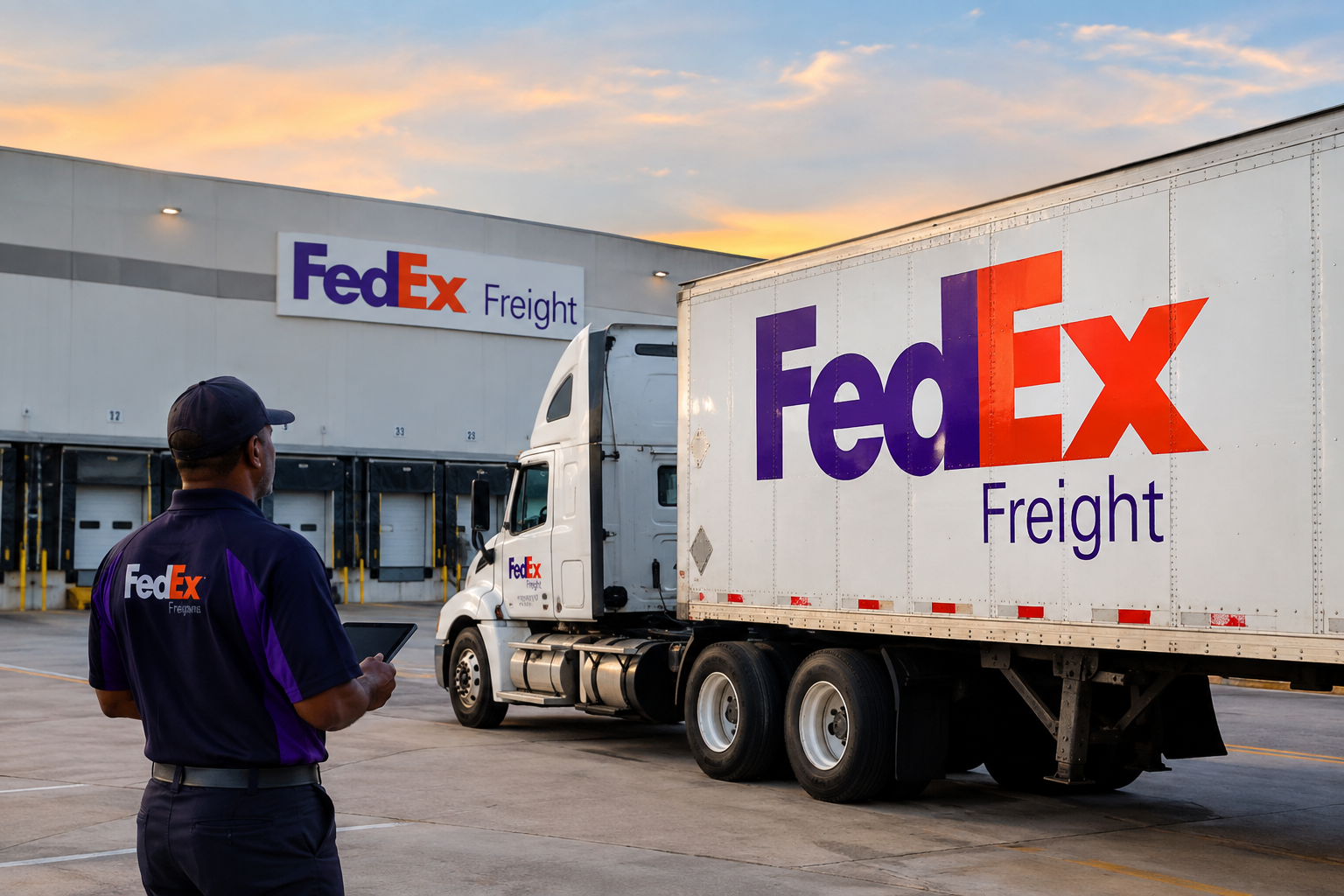
For most of its existence, FedEx Freight was simply one piece of a much larger machine — the trucking arm inside a parcel-and-logistics empire that also flew planes, ran delivery vans, and moved packages through more than 220 countries. In 2026, Raj Subramaniam and the FedEx board decided that one of the company's biggest businesses might actually be worth more standing on its own.
On June 1, 2026, FedEx completed the spin-off of FedEx Freight, creating a separately traded public company on the New York Stock Exchange under the ticker FDXF. FedEx distributed 80.1% of the new company's shares to its existing shareholders and kept the remaining 19.9% for itself, with plans to dispose of that stake within two years. FedEx Freight's own shares would trade independently from that day forward; FedEx Corporation would continue on as FDX.
The less interesting question is how FedEx pulled off the separation. It's why the company decided it should happen at all — and why now, at a moment when trucking demand was already soft and the broader freight market was still working through a prolonged downturn.
A decision bigger than a spin-off
FedEx first disclosed the plan in December 2024, when the board announced it would pursue a full separation of Freight through the capital markets. The stated logic was about focus: a standalone Freight business could make its own decisions on pricing, network design, technology and capital allocation, without those choices competing for attention against FedEx's much larger express and ground parcel operations.
That distinction mattered because the two businesses run on fundamentally different economics. Less-than-truckload freight — consolidating multiple smaller shipments from different customers onto one trailer — depends on service-center density, shipment weight, equipment utilization and freight-specific pricing discipline. Those are not the same levers that drive FedEx's parcel business, where volume, delivery speed and e-commerce demand matter more. Keeping both inside one reporting structure meant neither one could be optimized entirely on its own terms.
The separation didn't happen in isolation, either. It arrived in the middle of a much larger transformation Subramaniam has been leading across FedEx, an internal effort the company calls DRIVE, aimed at cutting structural costs, merging FedEx's Express and Ground delivery networks into a single U.S. operation, and building new data and AI-driven products out of the roughly two petabytes of shipment data FedEx generates every day. Subramaniam has described the environment underneath all of this as a period of "reglobalization" — trade routes and supply chains resetting in response to tariffs and geopolitical disruption, shifting, in his words, from one equilibrium to another.
He has been doing this in FedEx's first year without the man who built the company. Founder Fred Smith died in June 2025 at age 80. Subramaniam — who became FedEx's second-ever chief executive when Smith stepped back from the role in 2022 — has said the company's founding culture is the one thing he never intended to change, even as nearly every other part of FedEx's structure was up for revision during his tenure.
The price of independence
Splitting off a business the size of FedEx Freight wasn't free. Before the separation closed, Freight paid FedEx a cash dividend of approximately $4.1 billion, funded in part through a $3.7 billion senior notes offering the new company completed in February 2026, along with borrowings under a delayed-draw term loan facility. Freight therefore entered independence with a new capital structure and debt obligations that investors will now have to evaluate alongside its growth and margin targets.
The strategic bet is that a more focused company can eventually generate enough growth, margin improvement and free cash flow to justify that structure. But that bet doesn't resolve itself on day one. It just moves the challenge from inside FedEx's consolidated balance sheet into a new, standalone one, where investors can watch the results in real time.
Why John Smith, specifically
FedEx didn't wait until the spin-off closed to decide who would run the new company. On May 19, 2025 — more than a year before the separation was final — FedEx announced that John A. Smith, then chief operating officer, U.S. and Canada, of Federal Express, would become president and CEO of the independent FedEx Freight once the separation completed. R. Brad Martin, at the time vice chairman of FedEx's own board, was named to chair the new Freight board at the same time.
Smith wasn't a stranger to the business. He had already run FedEx Freight once before, from 2018 to 2021, growing its revenue and operating income through the pandemic, before moving on to lead FedEx Ground and later FedEx's broader U.S. and Canada surface operations. When FedEx formally named the ten-member Freight board on January 16, 2026, Smith joined it as a director alongside Martin. His old operations role didn't stay empty either — Scott Ray, a longtime FedEx executive who had been president of Surface Operations, was named to succeed him as COO, beginning the transition in February 2026 ahead of the full handover on June 1.
The choice of an internal, previously-tested operator rather than an outside hire suggests that FedEx viewed continuity of operating knowledge as an advantage during the separation. This wasn't framed publicly as an experiment in reinventing Freight from scratch. It looked instead like handing a business FedEx had already spent years building to someone who had already run it, and knew where its problems lived.
The timing wasn't the easy part
Here's the detail that makes the decision genuinely interesting rather than a routine corporate reorganization: FedEx didn't separate Freight at the top of a boom. The freight market was already under pressure before the spin-off closed. In the third quarter of fiscal 2026 — the quarter before the separation became final — Freight's revenue fell roughly 5% year over year, while average daily shipments dropped around 6%, a decline the company tied to soft industrial production, global trade policy uncertainty and excess trucking capacity across the LTL industry generally.
That means the board wasn't betting on momentum. It was betting that a more focused corporate structure could outperform a still-difficult freight market on its own — a bet whose evidence would only start to show up after the fact.
What the last numbers actually show — and what they don't
FedEx Freight reported its fourth-quarter and full-year fiscal 2026 results on June 25, 2026, three-plus weeks after the spin-off had already closed. Revenue came in at $2.4 billion for the quarter, up 4.8% year over year, helped mainly by higher fuel surcharges and a modest increase in weight per shipment. Average daily shipments were still down 5.9%. GAAP operating income fell 66.9% in the quarter to $158 million; on an adjusted basis, which strips out separation costs, operating income fell 23.9% to $363 million, and adjusted operating margin dropped to 15.1% from 20.8% a year earlier. The company said the quarter absorbed roughly $80 million in separation-related costs tied to IT systems and standalone-operations headcount, plus the effect of lapping a one-time $33 million facility-sale gain booked the prior year. For the full fiscal year, revenue was $8.8 billion, down 1.1%; GAAP operating income fell 58.6% to $616 million, weighed down by separation-related costs; and adjusted operating income was $1.1 billion, down 25.6%, for an adjusted margin of 12.6%.
Here's the important nuance that's easy to miss: FedEx Freight itself was explicit on that June release that the fourth-quarter and full-year figures were reported as the FedEx Freight segment of FedEx Corporation, and were "not presented on a carve-out basis." The fiscal year had already ended on May 31, one day before the separation took effect. What FedEx Freight published in June was a look back at the business as it existed inside FedEx, not a standalone financial statement for the company it was about to become.
The company has since filed its first annual report as an independent public company. The August 5, 2026 Form 10-K presents fiscal 2026 financial statements on a stand-alone carve-out basis, reconstructed from FedEx's historical accounting records to reflect the business as if it had operated independently. That filing tells a starker story than the June release did: carve-out operating income fell approximately 62%, from $1.404 billion to $540 million. The filing recorded $492 million in separation-related costs, while other operating expenses also increased. It also discloses that $351 million of interest income in fiscal 2026 came from cash swept from Freight to FedEx under the companies' centralized cash-management arrangement. That arrangement ended shortly before the spin-off and will not continue in the same form after separation. The 10-K itself cautions that the historical carve-out figures may not be indicative of what Freight's results would have looked like as an independent company.
Together, the June segment results and the August carve-out filing are a useful, if unflattering, baseline — evidence that the freight market Smith is inheriting is genuinely under pressure, that separation carried a real and disclosed cost, and that some financial arrangements that existed inside FedEx will not continue after independence. Neither filing is proof that independence has already helped or hurt the underlying business; both describe the company as FedEx built it, not yet the company Smith is now running.
The cleaner test starts with the period FedEx Freight is now reporting on a fully standalone basis: the seven months from June 1 through December 31, 2026, for which the company has guided to revenue growth of 4% to 6% and adjusted operating income of $605 million to $645 million, alongside continued transition costs as it exits its service agreements with FedEx. Its first earnings call covering that period as an independent company is expected in late October 2026.
The targets the separation now has to hit
FedEx Freight laid out what independence was supposed to buy at its first-ever Investor Day, held April 8, 2026, weeks before the spin-off closed. CFO Marshall Witt described a medium-term financial framework built around 4% to 6% annual revenue growth and 10% to 12% adjusted operating-income growth, with adjusted operating margin climbing from roughly 12% toward 15%, more than $1 billion in annual free cash flow at greater than 90% conversion from net income, leverage brought below 2.5 times within a year of the spin, and capital expenditures held near 5% of revenue. Yield expansion — better pricing per shipment rather than simply more volume — was expected to account for more than half of the margin improvement.
Those aren't vague aspirations. They're specific, dated commitments that turn the spin-off from a one-time corporate transaction into something that can actually be checked against results, quarter after quarter, for years.
The bet underneath the transaction
Strip away the mechanics — the share distribution, the debt financing, the board appointments — and the separation amounts to a specific wager: that a standalone FedEx Freight, led by an operator who already understood its problems, could tailor its pricing, network and capital decisions closely enough to the LTL market to outperform what it could achieve as one division inside a much larger company. That's a real strategic thesis, not a foregone conclusion, and the company's own medium-term targets — margin expansion, revenue growth, over $1 billion in annual free cash flow — are the yardstick it now has to be measured against, starting with results that, unlike the figures released so far, will actually reflect life as an independent business.
The harder leadership lesson here isn't really about spin-offs in general. It's about what a CEO does with an asset that's already working reasonably well but might work better somewhere else. FedEx and Subramaniam framed the separation not as a rescue of a struggling business but as a strategic choice to give a business with distinct economics greater flexibility over its own operations, investment and capital allocation — and they made that choice at a moment when the market for that business was still under pressure, not when the timing was easy. The spin-off answered one question: who controls Freight's strategy from here. It left a harder one for John Smith to answer with results: what an independent FedEx Freight actually does with that freedom.