Inside Ola Källenius' $4 Billion Alabama Bet: How Mercedes-Benz Is Rewiring Its Global Manufacturing Network
Mercedes-Benz just marked its five-millionth SUV built in Alabama. Behind the ceremony sits a much larger question: why is a German luxury automaker pouring billions into American factories at the exact moment its most important market, China, is becoming its hardest one.
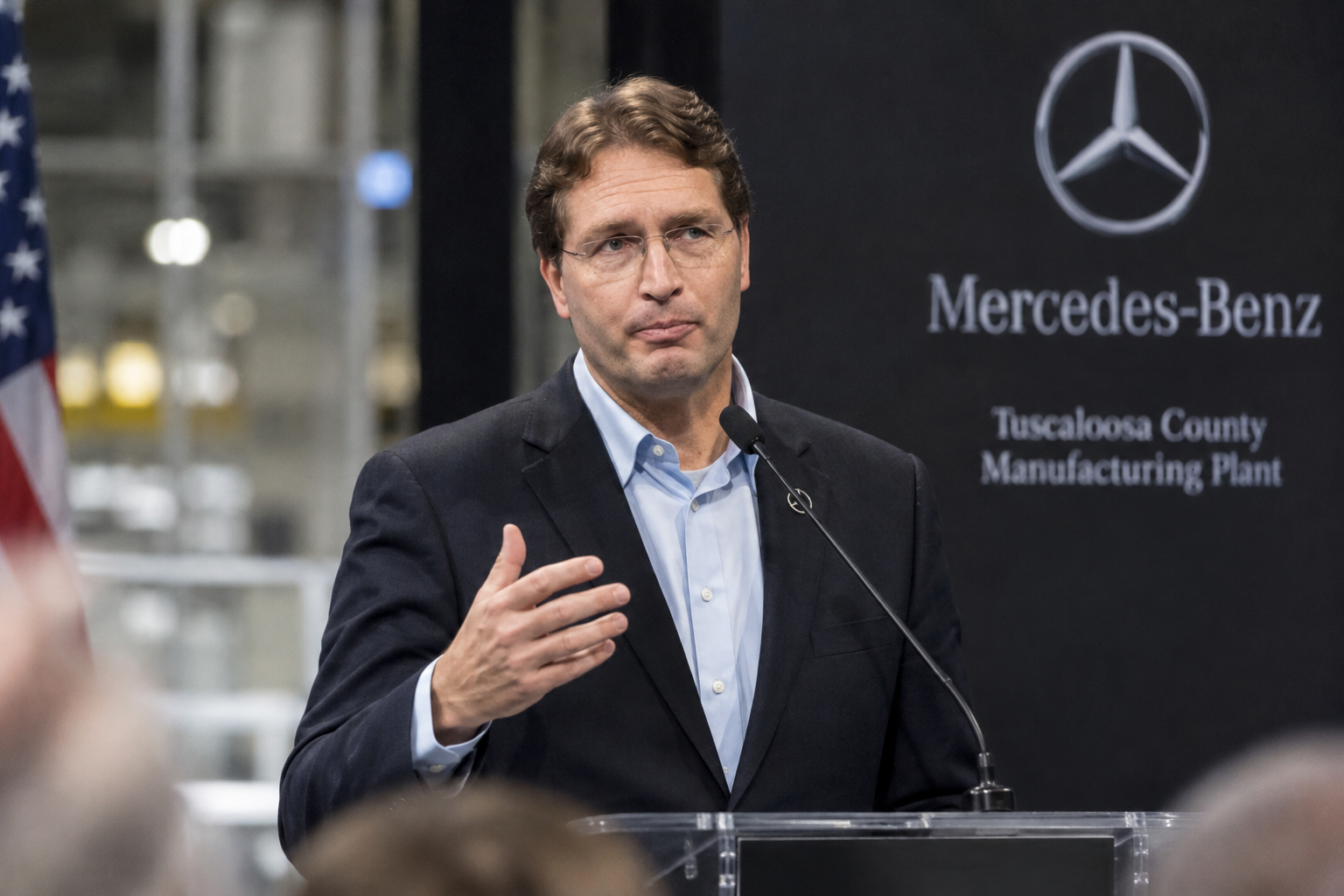
On March 31, 2026, a GLE rolled off the line at Mercedes-Benz's plant in Vance, Alabama, and the company stopped the assembly line long enough to call it a milestone. It was the five-millionth vehicle built at the site since 1997, the year Mercedes first proved that a German luxury brand could manufacture premium SUVs on American soil. Alongside the celebration came a number with far more weight than the anniversary itself: Mercedes-Benz would invest an additional $4 billion in the Tuscaloosa County plant through 2030, on top of a total U.S. commitment that now exceeds $7 billion.
For a company navigating the hardest stretch in its most important overseas market in years, that is not a small decision. It is a statement about where Mercedes-Benz believes its future has to be built, physically, and it says something about how the company's chief executive, Ola Källenius, is choosing to respond to a set of pressures that arrived almost simultaneously: a China business under severe and, by his own account, lasting pressure, new American tariffs, an uneven global shift to electric vehicles, and a product lineup larger than the company has ever tried to launch at once.
A Plant That Is Personal
Källenius did not arrive at Alabama as an outside observer looking at a spreadsheet. He was part of the original team that opened Mercedes-Benz's Tuscaloosa County operation in the 1990s, and he later served as head of Mercedes-Benz U.S. International, the entity that runs the plant. At the March ceremony, he made that connection explicit. "These vehicles don't just carry the Mercedes star," he told the assembled workforce and local officials. "They carry the passion, precision and pride of an entire region." He went further, calling the plant "one of the most important chapters" of his own career at the company.
That personal history matters for understanding the decision, but it is not the reason for it. Mercedes does not commit $4 billion to a single facility out of nostalgia. The Alabama investment is the physical, visible expression of a much larger repositioning that Källenius has been building toward since early 2025, one built on a blunt read of how global manufacturing economics have changed.
The Pressure Behind the Decision
The clearest evidence of that pressure sits in Mercedes-Benz's own second-quarter 2026 financial results, published in late July. Group revenue came in at €32.1 billion, down from €33.2 billion a year earlier. Mercedes-Benz Cars, the company's core passenger-vehicle division, posted a reported EBIT of just €49 million, compared with €783 million in the same quarter of 2025. That figure includes a €704 million impairment tied to Mercedes' Chinese equity-method investments, a non-cash charge that did not itself drain the company's coffers in the quarter but reflects a real and serious markdown in how Mercedes now values its position in China. Strip that impairment out, and adjusted EBIT was €909 million against €1.228 billion a year earlier, with an adjusted return on sales of 4.0 percent, at the low end of the company's own guidance range. The distinction matters: this was not a sudden operating collapse so much as Mercedes formally acknowledging, in accounting terms, what it had already been saying in public for months. China had changed, and the change was not temporary.
Global unit sales for Mercedes-Benz Cars fell 7.9 percent year-on-year to 417,765 vehicles in the quarter, driven almost entirely by a 30 percent sales decline in China. Excluding China, global sales were actually up 2 percent, with Europe growing 4 percent and the United States growing 10 percent. That single contrast, a market that used to anchor Mercedes' global growth now dragging the entire company's numbers down while everywhere else holds steady or improves, is the clearest evidence of why Källenius has been rethinking where Mercedes builds and sells its cars.
He has not been shy about describing what is happening in China. Speaking to reporters near Helsinki in late July, he said the intensity of Chinese competition, led by BYD and other domestic manufacturers now pushing aggressively into the luxury segment Mercedes has long dominated, was not a passing phase. "That competitive intensity in China, I don't believe it's going to go away anytime soon," he said. "It's a new reality." Chinese brands, led by BYD and other domestic manufacturers, are putting increasing pressure on the premium segments Mercedes has historically dominated. Mercedes says it still leads the very top of that market. Holding that lead, though, is proving expensive.
Why America, and Why Now
The United States side of the story has its own, separate driver: tariffs. Since early 2025, the Trump administration's tariffs on imported vehicles and automotive parts have materially changed the economics of building cars overseas and shipping them into the U.S. market. Mercedes said as much in its own February 2026 results, when it disclosed that group operating profit had more than halved to €5.8 billion, a decline the company attributed in part to roughly €1 billion in tariff-related costs. That is not an abstraction. It is a direct line from trade policy to Mercedes' bottom line, and it is the backdrop against which the Alabama announcement has to be read.
The most concrete evidence of that logic in action is the decision to localize production of the GLC, one of Mercedes' highest-volume SUVs, at Tuscaloosa for the North American market. Bremen, the German plant that has built the GLC for the world, continues to supply the rest of the globe; Mercedes has said it does not expect the change to meaningfully affect Bremen's overall output. But the North American volume will now be built closer to the customers buying it. Jason Hoff, head of Mercedes-Benz North America, told Reuters that localizing the company's biggest-volume products in the U.S. "just makes good business sense" given the tariff environment. This is not a company quietly absorbing new costs. It is a company reorganizing where cars are physically built so that fewer of the vehicles Americans actually buy have to cross a border that now carries a price tag.
The Alabama plant is not simply an American factory serving American buyers, either, which is what makes the investment more interesting than a routine capacity expansion. Roughly 60 percent of everything built at Tuscaloosa is exported, sent out to markets around the world from a facility that employs about 5,800 people. Mercedes is not just building cars for the U.S.; it is using a U.S. facility as a node in a global production network, with roughly 60 percent of the plant's output exported to markets around the world. Alongside the plant investment, Mercedes is consolidating up to 500 roles in a new Atlanta headquarters and research and development hub, further expanding its U.S. footprint.
Not a Retreat From Electric Vehicles
It would be easy, and wrong, to read the Alabama investment as Mercedes stepping back from electrification in favor of a safer, combustion-heavy bet on American manufacturing. The company's own numbers argue against that reading directly. Battery-electric vehicle sales rose 51 percent year-on-year in the second quarter, with European BEV sales up 87 percent. Mercedes raised its full-year guidance for the share of electrified vehicles in its lineup from a prior range of 21 to 23 percent up to 23 to 25 percent. The Tuscaloosa plant itself already builds electric SUVs, including the EQE SUV and EQS SUV, alongside combustion and hybrid models, and Källenius has said the future localized GLC production there will include electric variants as well.
That flexibility, not a retreat to gasoline, is the actual strategic bet. Mercedes has applied the same logic elsewhere in its production network. In Hungary, the company completed roughly a €1 billion expansion of its Kecskemét plant this year specifically to give it the flexibility to build combustion, plug-in hybrid, and fully electric models on the same lines, giving Mercedes more flexibility to adjust production as market demand changes. Källenius has also been openly critical of the regulatory assumptions behind the original all-electric plan. Speaking in Brussels in May, he said the EU's framework for phasing out new combustion-engine car sales by 2035 had "some flaws" and had not produced the acceleration in EV demand that regulators intended, arguing that policymakers "have to be pragmatic" and cannot ignore market forces. That is a pointed position for the CEO of one of Europe's flagship manufacturers to take publicly, and it reflects a company hedging its production capacity against genuine uncertainty about the pace of EV adoption, rather than uncertainty about whether EVs are the eventual destination.
The Trade-Off Nobody Can Fully Resolve Yet
None of this comes free. Mercedes is simultaneously cutting costs in Germany, where it has reduced fixed costs by roughly a quarter since 2019 and intensified productivity measures since June 2026, while committing billions to new capacity in the United States and continuing to invest heavily in a Chinese market it insists it is not abandoning. In April 2026, the company reiterated that China remains a strategic priority, framing its approach there as deepening localization and treating the country as an innovation hub whose technology can feed back into Mercedes' global product line, rather than a market to be scaled back. Running all three of these strategies simultaneously, cutting in Europe, building in America, and localizing in China, while also funding the largest new-model launch program in company history, more than 40 vehicles between 2025 and 2027, is an enormous amount to execute at once, and it leaves very little room for error in any single region.
The financial cushion for that risk currently exists. Mercedes ended the second quarter with net industrial liquidity of €30.4 billion, even after paying out €5 billion in dividends and share buybacks in the first half of the year, and free cash flow from the industrial business, while down from the prior year, remained positive at €1.1 billion for the quarter. The company has the balance sheet to fund a multi-year, multi-continent repositioning. What it does not have is certainty that the repositioning will pay off in the way it is betting. If U.S. tariffs ease, or if trade tensions shift again over the next four years, a manufacturing network built specifically around today's tariff structure could end up costing more than it saves. If Chinese competitors keep gaining share even in the segments Mercedes considers its core strength, no amount of American manufacturing flexibility solves that problem, because it is a demand problem, not a production problem.
What the Decision Is Really Betting On
The clearest way to understand the Alabama investment is not as a bet on America over China, or electric over combustion. It is a bet that Mercedes' existing global production network, already spread across more than thirty plants worldwide, now needs to become more localized, more flexible and more resilient than it was built to be, as trade policy, regulation and customer demand pull in different directions in different regions at the same time. Tariffs can appear with a presidential signature. Regulatory assumptions can also prove less predictable than policymakers expect, as Källenius' criticism of the EU's 2035 framework illustrates. Chinese domestic brands can go from marginal competitors to dominant ones inside a handful of years. A company that localizes its highest-volume models closer to the markets that actually buy them, while keeping production spread across multiple sites and able to build electric or combustion versions of the same vehicle on the same line depending on regional demand, has more options when the next shock arrives than one that does not.
Whether that flexibility is worth its cost is the open question the market will spend the next several years answering. Mercedes is not the only automaker facing this choice; BMW, Volkswagen's Audi, and Porsche are all navigating overlapping versions of the same China-pressure, tariff-exposure, EV-timing problem, and several are pursuing leaner, more centralized responses rather than Mercedes' more distributed one. Källenius is making the opposite wager: that resilience is worth building even before you know exactly which shock it will need to absorb next. For a CEO who was part of the small team that stood up the Alabama plant three decades ago, and who now oversees a $4 billion expansion of it, that wager carries a weight that goes beyond the balance sheet. It is a bet that the company's future will be built in more places, by more flexible means, than its past ever required.