Inside Masayoshi Son's AI Bet: How SoftBank Is Rebuilding Around AI
Masayoshi Son is rebuilding SoftBank around AI, from OpenAI and Arm to data centers, power and robotics. The strategy is moving from vision to massive capital commitments, financing and infrastructure projects — leaving investors to judge whether the bet can produce durable returns.
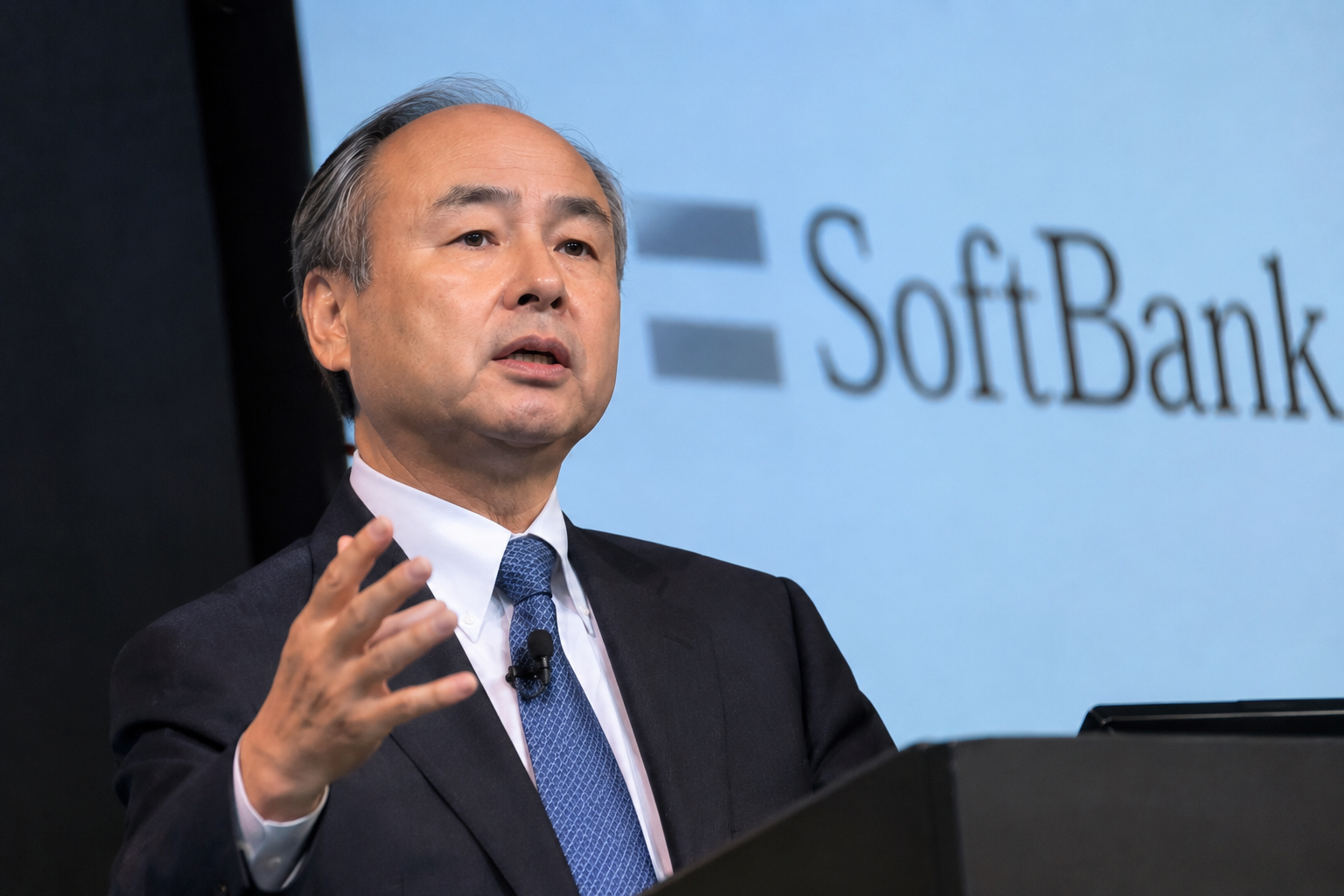
In June 2026, the stock market handed Masayoshi Son a symbolic milestone: SoftBank Group overtook Toyota to become Japan's most valuable publicly traded company, ending the automaker's 22-year run at the top. It was a startling reversal — a conglomerate best known for a legendary Alibaba bet and an equally legendary We Work write-off had, in the market's eyes, become worth more than the company that built Japan's postwar industrial identity. Three months later, the more interesting question isn't whether investors believe in Son's AI ambitions. It's how much capital, debt and physical infrastructure that belief now has to support.
Son's Four-Part Strategy
Son has been unusually explicit about what he's actually trying to build. In his 2026 shareholder message, he described a strategy organized around four areas he considers necessary for what he calls the "Artificial Super Intelligence," or ASI, era: frontier intelligence itself, semiconductor architecture, the physical infrastructure to run AI at scale, and robotics. In Son's own framing, SoftBank isn't simply investing in AI as a theme — it's trying to assemble the layers an ASI economy will need, positioned to be, in his words, the "No. 1 Platform Provider" across them.
Why OpenAI Became SoftBank's Biggest Capital Allocation Decision
The clearest layer is intelligence itself, through OpenAI. In February 2026, SoftBank committed to an additional $30 billion investment in OpenAI, structured in tranches: $10 billion funded in April, another $10 billion in July, with a final $10 billion scheduled for October 1. Upon completion of the full commitment, SoftBank is expected to hold roughly 13% of OpenAI on a pro-forma basis, according to Bloomberg, part of a total commitment approaching $65 billion.
To fund the OpenAI commitment specifically, SoftBank arranged a $40 billion bridge facility in March 2026, primarily to finance its follow-on investments in OpenAI, maturing March 25, 2027. That's a large, dated liability closely connected to SoftBank's decision to dramatically increase its exposure to OpenAI — a level of leverage most companies wouldn't take on for one equity position, let alone one in a company that has never turned an annual profit.
The Infrastructure Problem Son Is Trying to Solve
Son's own reasoning is that intelligence and chips alone don't answer the harder question: where does the actual computing happen, and what powers it. That's the case for the second and third layers — semiconductors, through SoftBank's controlling stake in Arm, and physical infrastructure, through a series of data-center and power commitments across multiple markets in 2026.
In May, SoftBank committed to develop and operate up to 5 gigawatts of AI data-center capacity in France, representing an investment of up to €75 billion, with an initial €45 billion phase targeting 3.1 gigawatts in the Hauts-de-France region by 2031. It's worth being precise about the phrase "up to" — this is a commitment tied to a multi-phase buildout, not €75 billion already spent. Separately, in July, SoftBank Group and SoftBank Corp. announced SB Neo, a jointly owned venture (51% SoftBank Corp., 49% SoftBank Group) aimed at building a U.S. neocloud business, with plans to scale toward 10-gigawatt-class AI infrastructure over time.
Ohio Is Where the Strategy Becomes Real
If France and SB Neo show the scale of Son's ambition, a project in Ohio shows what it actually costs to build. SB Energy — the SoftBank-backed infrastructure developer at the center of Son's third strategic layer — is building a data-center campus at the PORTS-Pike site in Pike County that the U.S. Department of Energy has described in connection with plans for 10 gigawatts of new power generation and a matching 10-gigawatt data-center development.
OpenAI has agreed to lease roughly 8 gigawatts of compute capacity at the site for up to 20 years. Nvidia is investing $1.5 billion directly in SB Energy and has extended credit support — covering defined portions of lease and power payments, plus a residual-value commitment — of up to $105 billion for the project's initial phase, with Nvidia also serving as the site's exclusive chip provider. Sam Altman called the campus a site with "enough computing power to help millions." Son described it as infrastructure for "the next era of intelligence." Those are the confident, forward-looking statements typical of 2026's AI announcements. What makes the arithmetic behind them worth scrutinizing is who's actually on the hook if the demand doesn't materialize as planned.
The Financing Behind the AI Expansion
Building at this scale requires financing at a scale most corporate treasuries have never had to manage simultaneously. On September 4, 2026, SoftBank priced a ¥1 trillion (roughly $6.3 billion) retail bond — the largest retail corporate bond ever issued by a Japanese company — carrying a 4.75% coupon, at the top of its guided range and more than double the 2.3% average coupon on yen-denominated retail corporate bonds issued in Japan this year. The bond matures September 16, 2033.
It would be inaccurate to describe this bond as funding the OpenAI investment directly — SoftBank's own disclosed use of proceeds ties it to domestic bond redemptions and partial funding of the company's $5.375 billion acquisition of ABB's robotics business, the fourth pillar of Son's strategy, expected to close in mid-to-late 2026. What the bond does illustrate is the broader financing environment Son is operating in: a company simultaneously carrying a $40 billion OpenAI-linked bridge facility, a record retail bond, and a pipeline of infrastructure commitments measured in tens of billions of dollars, all while its Arm stake — its single largest asset — represented roughly 60% of its adjusted holdings and 69% of net asset value as of a mid-2026 reporting date, an unusually concentrated bet for a company managing this much simultaneous financial complexity.
SB Energy's IPO Puts the Strategy in Front of Public Investors
The clearest test of whether Son's infrastructure bet can eventually generate real returns arrived on September 1, 2026, when SB Energy filed to go public on the Nasdaq under the ticker SBE. The filing is unusually revealing. For the six months ended June 30, 2026, SB Energy reported revenue of $138.7 million and a net loss of $3.21 billion — a loss more than 23 times its revenue over the same period. The company disclosed roughly $439 billion in backlog, primarily tied to data-center development, and 8.8 gigawatts of contracted capacity. None of that data-center capacity was operational as of the filing date; SB Energy's revenue to date has come almost entirely from its existing power business, not from AI data centers.
That distinction matters. A $439 billion backlog is a measure of contracted future business, not current revenue, assets, or proven demand — and SB Energy's own filing states that the company is "substantially dependent on OpenAI" as both a tenant and strategic investor.
The Circular-Financing Question
That dependency is precisely what has drawn scrutiny. SoftBank and OpenAI both hold equity stakes in SB Energy; Nvidia is investing directly in the same company while also extending credit support tied to OpenAI's lease at the site Nvidia's own investment helps build. Critics, including prominent short-seller Michael Burry, have raised the concern that this amounts to circular financing — a supplier effectively helping fund the customer that then buys its products, creating conditions that could unravel if any one link in the chain falters.
Nvidia CEO Jensen Huang has directly rejected that characterization on more than one occasion, including in an August 2026 CNBC interview and in public statements responding to the Ohio deal specifically. His position: "OpenAI will pay the lease," and Nvidia's support functions as a way to secure scarce infrastructure capacity where demand is already visible, not to manufacture demand that doesn't otherwise exist. Whether that argument holds is a live, unresolved debate among investors and analysts — not something either side has settled.
What Could Break the Model
Set aside the specific structure of any one deal, and several risks run through Son's broader strategy simultaneously. SoftBank's financing depends on continued access to debt and capital markets at manageable cost — and that cost is already climbing: the 4.75% coupon on its September retail bond was well above the 2.3% average for yen-denominated retail corporate bonds issued in Japan this year, according to Bloomberg data, underscoring the higher funding cost SoftBank is accepting as it raises capital. The company's exposure is heavily concentrated in a small number of enormous, interlinked positions — Arm, OpenAI, and the infrastructure built to serve OpenAI's compute needs — rather than diversified across independent bets. SB Energy's public filing shows a business with massive contracted backlog and essentially no current operating revenue from its core AI strategy, meaning its economics remain unproven until data centers actually come online, beginning with initial capacity targeted for 2028. And nearly every layer of Son's strategy — OpenAI's lease payments, Nvidia's credit exposure, SB Energy's revenue, SoftBank's own returns — ultimately depends on AI compute demand continuing to grow at something close to its current extraordinary pace.
What Son Is Actually Betting On
Strip away the individual transactions, and Son's wager isn't simply that AI will be large — nearly every technology executive believes that. It's a bet that owning stakes across intelligence, chips, physical infrastructure and robotics simultaneously, ahead of most competitors, creates durable platform economics once the ASI era matures — and that SoftBank can finance its way through years of massive capital outlay and thin-to-negative near-term returns to get there. That's a materially different, and riskier, proposition than simply holding shares in successful AI companies.
The Decision Has Not Been Proven Yet
The defining question for Son is no longer whether he believes the AI era will be enormous. He has already committed SoftBank's capital on that assumption, across multiple markets and at least four distinct layers of the AI stack. The harder question is whether the companies, infrastructure and financing structures he is assembling can turn that conviction into durable returns before the cost of the bet — in debt service, concentration risk and unproven infrastructure economics — catches up with it. The market gave SoftBank a symbolic crown in June. What happens between now and the first Ohio data centers coming online in 2028 will determine whether that crown reflects a strategy that worked or one that simply arrived early.
Sources
- 1.SoftBank Group Corp. — CEO Message, SoftBank Group Report 2026 ↗
- 2.SoftBank Group Corp. — Follow-on Investments in OpenAI ↗
- 3.SoftBank Group Corp. — Execution of Bridge Facility Agreement Primarily for the Follow-on Investments in OpenAI ↗
- 4.U.S. Securities and Exchange Commission — SB Energy, Inc. Form S-1 Registration Statement ↗
- 5.SoftBank Group Corp. — Determination of Terms and Conditions for the Issuance of the 70th Unsecured Straight Corporate Bond ↗