Brian Niccol's Starbucks Bet: Can a Better Customer Experience Become a Better Business?
Two years into "Back to Starbucks," customer traffic has returned and margins are showing early signs of following. The harder question — whether the recovery can hold without permanent extra spending — is still open.
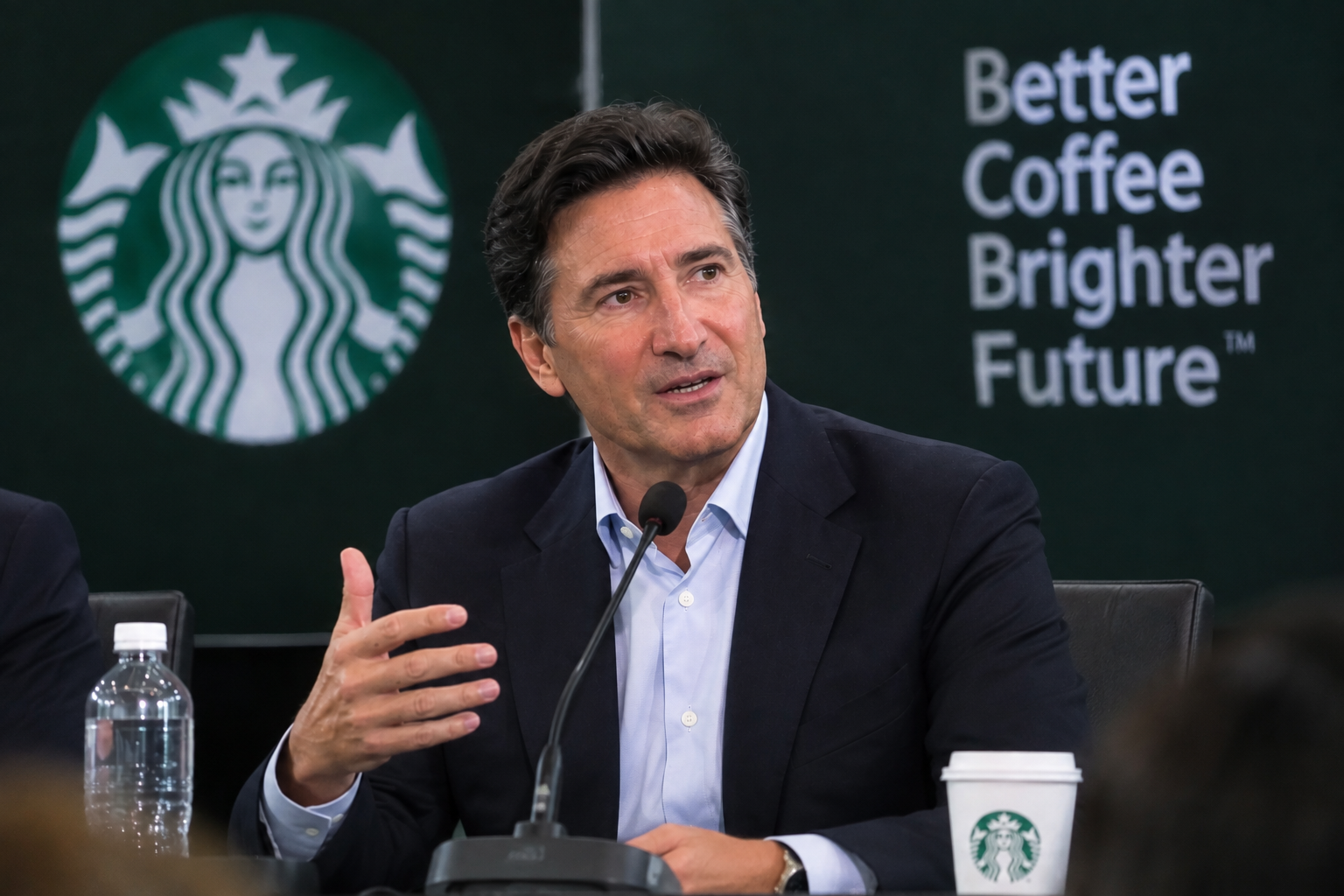
On September 10, 2024 — his second day as Starbucks' chairman and chief executive, having started the role on September 9 — Brian Niccol wrote a letter to the company's roughly 361,000 employees that read less like a corporate memo and more like a diagnosis. Starbucks, he said, had drifted from what made it Starbucks in the first place. Stores felt less welcoming. Mornings — historically the company's best hours — had become a source of friction rather than routine. The menu had grown so complex that making a drink correctly and quickly had become its own operational challenge. He called his plan to fix it "Back to Starbucks."
What followed was not a marketing campaign. It was a specific, expensive, and reversible-looking bet: that Starbucks' problem was experience, not price, and that the fix required spending more on stores and people before the company tried to make more money. Two years later, that bet has produced real, measurable results — and a genuinely unresolved question about whether they can last.
A Company That Had Stopped Feeling Like Itself
Niccol didn't arrive at a healthy company. Starbucks had reported comparable-sales declines for six straight quarters before his hiring was announced in August 2024, including drops driven by falling U.S. traffic and a steep slide in China, its second-largest market. The stock had lost roughly 40% of its value from its 2021 peak. His predecessor, Laxman Narasimhan, had been trying to fix the business through supply-chain and technology investment, an approach that hadn't moved traffic fast enough for a board under pressure from activist investors. Starbucks removed Narasimhan and named Niccol as his replacement. The stock jumped nearly 25% the day the move was announced — a market reaction that priced in confidence in Niccol before he had made a single operational decision.
Niccol wasn't a stranger to this kind of assignment. He had spent six years running Chipotle after joining in the wake of a food-safety crisis that had crushed the chain's sales and reputation, and Starbucks' own board cited that turnaround record directly when explaining the hire. That background mattered less for what Niccol knew about coffee than for what it told the board about his instincts: he had already shown a willingness to slow a business down operationally in order to rebuild trust with customers, rather than simply promoting his way past a bad year.
His diagnosis, once he started at Starbucks, was specific rather than sweeping. Self-serve condiment bars had disappeared. Handwritten names on cups, a small ritual that had signaled personal service, had faded from many stores. Digital ordering, meant to add convenience, had instead split the store into two uneven experiences — a fast lane for mobile orders and a slower, less prioritized one for people who walked in and waited at the counter. None of this showed up cleanly in an income statement. All of it showed up in whether people came back.
The Decision: Spend on the Store Before You Spend on the Balance Sheet
The conventional turnaround playbook starts with cost-cutting. Niccol's did not. His first major move was to commit more than $500 million in additional partner labor hours over a year, starting in mid-2025, through what Starbucks called Green Apron Service — a program built around larger store staffing rosters, an order-sequencing tool called Smart Queue, and a public benchmark of delivering a customized drink in four minutes or less. In an initial 1,500-store pilot, roughly 80% of in-café orders hit that four-minute target, and the company reported measurable gains in transactions and customer satisfaction scores before rolling the model out across North America.
This is the part of the decision that separates it from an ordinary rebrand: Niccol chose to increase costs at the exact moment the business needed to prove it could still make money. The bet was that a faster, more consistent, more human experience would draw customers back in numbers large enough to justify the expense — and that trying to cut the company's way back to health first would have made the underlying problem worse.
The Trade-Off: Investing in Stores While Shrinking the Company Around Them
Niccol did not fund this by simply spending more everywhere. He funded part of it by making the company smaller in places customers never see. Starbucks eliminated roughly 1,100 non-retail roles in February 2025, followed by a further 900 non-retail job cuts in September 2025 as part of a restructuring the company valued at roughly $1 billion, split between store-related charges and severance. A third, smaller round of corporate cuts and regional office consolidations followed in 2026. Alongside the layoffs, Starbucks closed several hundred underperforming North American cafes — including locations in its home city of Seattle — even as it kept investing in the stores it planned to keep.
The logic Niccol offered was consistent across all three rounds: too many organizational layers were slowing decisions down, and money spent maintaining that structure was money not spent on the floor where customers actually experience the brand. It is a real allocation trade-off, not a cost-cutting story dressed up as a customer-experience story — the company was increasing investment at the store level while simultaneously trying to reduce organizational complexity above the stores.
The bigger version of that same trade-off played out in China. In November 2025, Starbucks agreed to hand a controlling 60% stake in its roughly 8,000-store Chinese retail business to Boyu Capital, a private investment firm, valuing the operation at about $4 billion. Starbucks kept a 40% interest and retained ownership of the brand and its licensing economics, but gave up operating control of its second-largest market. The deal closed in the company's third fiscal quarter of 2026. It was a decision to reduce direct exposure to a market where Starbucks' own operating model had been losing ground to lower-priced domestic rivals, in exchange for a partner with a larger local operating role and a different approach to scaling the business in China — and for capital Starbucks could redirect elsewhere.
What the Numbers Actually Show
The clearest test of whether this was the right decision arrived in Starbucks' fiscal third-quarter 2026 results, reported on July 29, 2026. Global comparable sales rose 7.9%, the fourth consecutive quarter of growth, driven primarily by more transactions rather than higher prices — the harder number to move, and the one that most directly reflects whether customers are actually returning. North America, the company's largest and most closely watched segment, posted comparable sales growth of 8.1% and transaction growth of 4.5%. Adjusted earnings per share reached $0.85, up 70% year over year, with non-GAAP operating margin expanding 430 basis points to 14.4%.
The margin story, though, is more layered than either "the turnaround worked" or "the turnaround hurt profitability" — and the full sequence matters more than any single quarter. North America's operating margin fell to 11.9% in the first fiscal quarter of 2026, down 480 basis points from 16.7% a year earlier, as the company explicitly attributed the drop to Green Apron labor investment and rising coffee and tariff costs. It fell again in the second quarter, to 9.9% from 11.6%. Only in the third quarter did the trend turn, with North America margin reaching 13.6% against 13.3% a year earlier — a 30-basis-point improvement, and the first quarter in over a year in which the segment's margin grew instead of shrank. Consolidated net revenue was technically down 1% in the quarter, but that decline was a direct accounting consequence of moving China off Starbucks' books into the new joint venture, not a sign of weakening demand; the China transition alone reduced reported international revenue by 34%.
Read together, the data supports a specific and fairly narrow claim: North American traffic has turned, the turn is now more than a year old, and margin has only just begun to follow — barely, and for one quarter. That is meaningfully different from either version of the story getting repeated in the press. It is not "Niccol fixed sales and destroyed margins." It is not yet "Niccol fixed both." It is a company that spent over a year absorbing real financial pain to buy back customer trust, and is only now finding out whether that trust converts into profit. Independent analysis published around the two-year mark has framed the situation in similar terms: customers have clearly come back, but investors are now waiting to see whether that recovery can produce the kind of sustainable margin growth Starbucks has promised, rather than simply repeating that the worst is over.
What Niccol Is Betting the Company Can Become
Starbucks has, unusually, put a public scoreboard on the next phase. At its January 2026 Investor Day, the company laid out a financial framework through fiscal 2028: 5% or greater consolidated revenue growth, 3% or greater comparable sales growth in the U.S. and globally, a non-GAAP operating margin of 13.5% to 15%, and non-GAAP earnings per share of $3.35 to $4.00, alongside plans to add more than 2,000 net new coffeehouses. On the strength of the China joint venture, Starbucks and Boyu have also set a shared long-term aspiration to grow the country's roughly 8,000 stores toward as many as 20,000 over time — a target that assumes the licensed model can scale faster than Starbucks' own direct operations could.
By September 10, 2026 — exactly two years after Niccol's start date — the company was ready to say the first phase had worked. In materials marking the anniversary, Starbucks pointed to four straight quarters of comparable sales growth, the completed China transition, and more than 1,000 store "uplifts" completed ahead of schedule, with plans to accelerate renovations further into 2027. Niccol has framed the next stage around rebuilding Starbucks as a physical gathering place rather than only a transaction point — a bet that, in an era when much of retail is moving toward speed and digital convenience, the coffeehouse itself is still Starbucks' most defensible asset.
The Decision That Isn't Finished
Niccol's decision has already produced something Starbucks badly needed after six straight quarters of decline: customers are coming back, and they are coming back for reasons the company can point to and measure — faster service, simplified menus, a store experience it rebuilt on purpose rather than by accident. That part of the bet has paid off. It has also come at a real and disclosed cost: more than a year in which North America's operating margin fell well below where it stood before the turnaround began, three rounds of corporate layoffs, and the surrender of majority control over Starbucks' second-largest market.
The more consequential test is now financial rather than experiential. Starbucks has put its fiscal 2028 targets on the record — margin expansion, sustained comparable sales growth, thousands of new and renovated stores — giving investors and executives a specific, public way to judge whether the customer-experience investment can become a durable economic advantage rather than a permanent cost of staying competitive. The next phase of the turnaround will not be proved by one more strong quarter. It will be proved if Starbucks can keep customers coming back while steadily widening the economics of each store that serves them — the exact combination that eluded the company for most of the two years it took to get traffic back in the first place.
What Other Executives Can Take From It
The instructive part of Niccol's decision isn't that he chose experience over cost-cutting — plenty of turnaround leaders say that and mean something closer to a marketing refresh. It's that he was willing to let margins fall for more than a year as the visible, disclosed cost of testing a specific theory: that a large, mature retail brand had made itself harder to be a customer of, and that fixing it required spending money before asking for any back. He stayed with three separate rounds of layoffs and a loss of direct control over a major international market rather than reverse course when early margin data looked bad. The broader lesson for other executives is simple to state and hard to execute: a turnaround doesn't always have to start with cutting costs. Sometimes the harder decision is figuring out where to spend more first — and then rebuilding everything else around that choice.