Lip-Bu Tan Changed How Intel Bets on Its Future — Then Washington Bought In
Inside the capital-allocation reversal that reshaped Intel's approach to chipmaking investment — and the 9.9% government stake that now sits on top of it
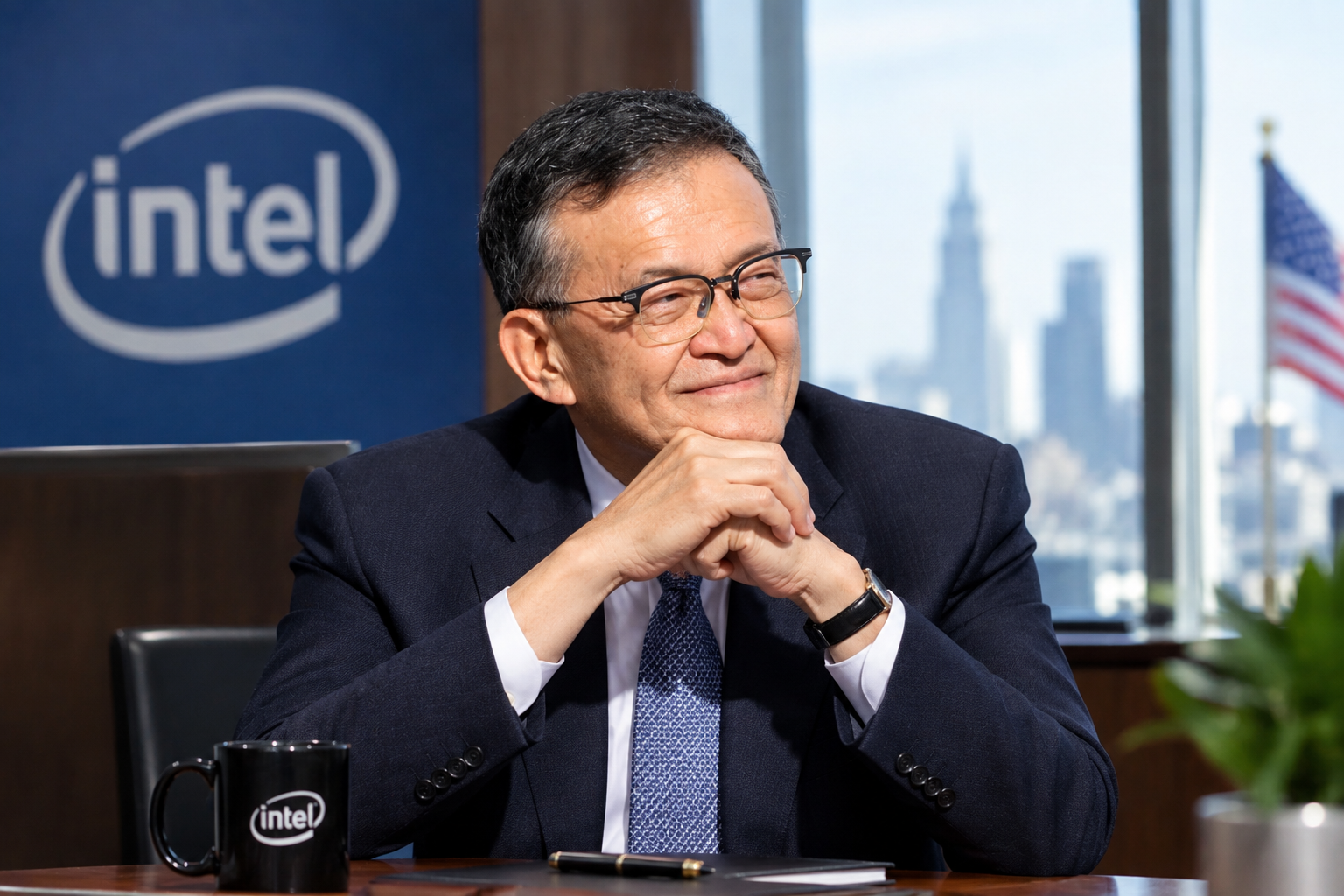
On August 11, 2026, Intel CEO Lip-Bu Tan bought 105,263 shares of his own company's stock through a family trust, at $95 a share — an investment of roughly $10 million, filed with the SEC on Form 4. The price matched the figure Intel had used that same day to price a newly upsized $20 billion stock offering, which closed within days. The purchase took Tan's combined Intel holdings above 1.3 million shares.
Eighteen months earlier, that kind of confidence would have looked misplaced. Intel had just reported an $18.8 billion net loss for 2024. Pat Gelsinger's multiyear manufacturing campaign had yet to produce the returns and customer scale the strategy required, and he departed the company at the end of 2024. When Tan took over as CEO in March 2025, he inherited a company that had spent years building capacity for a future that had not yet shown up — new fabs under construction in Germany and Poland, an expanding Ohio footprint, and a foundry division on its way to a $10.3 billion loss for the year.
Tan was not a Silicon Valley newcomer being handed an impossible job. He had run Cadence Design Systems for twelve years, a period in which the company's revenue more than doubled and its shareholder returns significantly outpaced the market, before he stepped back to executive chairman in 2021. Before that, he spent decades as a semiconductor investor through Walden International, the venture firm he founded in 1987. Intel's board was betting that an investor's instinct for capital discipline, applied to a company that had spent years doing the opposite, could do for Intel what a product roadmap alone had not.
Tan's response was not simply to cut. It was to rewrite the rule Intel had operated under for a decade, shifting from capacity expansion based heavily on projected demand toward investment backed by clearer customer commitments and expected returns. That decision, explained largely in a single employee memo, is arguably the most consequential thing Tan has done at Intel. It is also the decision now operating alongside a Trump administration equity stake that gives Washington a direct, structural interest in how far Intel can restructure its own manufacturing business.
The Situation Tan Inherited
Under Gelsinger, Intel had pursued a strategy built on building advanced manufacturing capacity and new process nodes ahead of confirmed demand, betting that both Intel's own product lines and outside chip designers would eventually fill that capacity. By the time Tan arrived, that bet had not paid off. Intel's factory footprint was, in Tan's own later description, fragmented and underutilized, and the company had spent heavily on technology development without the committed external customers needed to justify it.
Tan also arrived carrying his own controversy. Weeks after his appointment, Reuters reported that he had invested more than $200 million in hundreds of Chinese technology and advanced-manufacturing companies between 2012 and 2024, through his venture firm Walden International and two Hong Kong holding entities — including at least eight firms with reported ties to the People's Liberation Army, and an early stake in the sanctioned chip foundry SMIC. Republican Senator Tom Cotton wrote to Intel's board questioning the ties. On August 7, 2025, President Trump publicly called for Tan's resignation, describing him as "highly conflicted." Intel's board backed its CEO. Four days later, Tan met Trump at the White House.
The Decision: No More Blank Checks
Two weeks before that political standoff became public, Tan had already laid out, in writing, how he intended to run Intel differently. In a July 24, 2025 letter to all employees following Intel's second-quarter results, he announced a roughly 15% workforce reduction, a target of about 75,000 employees by year-end, and a set of manufacturing decisions that broke from Gelsinger's approach: Intel would not move forward with the previously planned Germany and Poland factory projects, would consolidate assembly and test operations from Costa Rica into larger sites in Vietnam and Malaysia, and would slow — not accelerate — construction in Ohio.
The diagnosis, in Tan's words, was that Intel had "invested too much, too soon," without adequate demand. His new standard for capital allocation, spelled out in the same letter, was direct: "There are no more blank checks." Future technology-development spending would need to be tied to confirmed customer commitments rather than projected ones.
That principle was aimed squarely at Intel 14A, the manufacturing process due after Intel's current flagship node, 18A. On Intel's Q2 2025 earnings call, Tan explained the thinking behind the shift by rejecting the assumption that had defined the Gelsinger years — that Intel could simply build capacity on the belief that, as the old saying goes, "if you build it, they will come."
Intel then converted that position into formal, disclosed policy. In its Q2 2025 10-Q filing with the SEC, the company stated that without securing a significant external customer and meeting associated development milestones for 14A, it might not be economical to continue developing that node or the leading-edge processes meant to follow it — and that Intel "may pause or discontinue" that pursuit. It was the first time Intel had told investors, in writing, that it might step back from leading-edge chip manufacturing and lean more heavily on outside foundries such as TSMC for its most advanced future products.
The Trade-Off
Intel's own disclosures make the tension in that policy explicit. Requiring proof of customer demand before deploying billions in capital protects Intel from repeating the mistake behind its $10.3 billion 2025 foundry loss. But semiconductor manufacturing is a business where capacity often has to be built years ahead of a product shipping, and competitors that commit capital earlier can lock in customers Intel loses by waiting. If 14A does not land a marquee external customer, Intel's own filings indicate it would keep building products in-house up to 18A-P through at least 2030, while its most advanced future chips could end up manufactured externally — ceding ground in the leading-edge race Intel has spent decades trying to win.
The external-customer question is more complicated than a simple yes-or-no. Since 2021, Intel has run a Defense Department-funded program called RAMP-C, through which Nvidia, Microsoft, IBM, Qualcomm, Boeing and Northrop Grumman all took part in designing and fabricating test chips on Intel's 18A process. RAMP-C was built around prototypes, tape-outs and production-readiness work for defense-industrial customers, funded to let participants work with early, immature versions of the process. Participation demonstrated real technical engagement with Intel Foundry, but it is not equivalent to a large, contracted, high-volume commercial 14A customer commitment. Intel completed RAMP-C in July 2026, folding its work into a follow-on defense program called Secure Enclave.
Even Intel's highest-profile 2025 tie-up illustrates the gap. In September 2025, Nvidia agreed to invest $5 billion in Intel common stock as part of a broader collaboration on custom x86 CPUs and Nvidia's RTX products — but the agreement carried no commitment for Nvidia to manufacture its silicon at Intel. It means Intel enters the 14A test with a roster of companies that know how to work with its technology, and in some cases have invested alongside it, but not yet a publicly named significant external customer with the kind of committed demand that Intel's own filings say is necessary to make the 14A investment economically viable.
Washington's Stake in the Answer
Three weeks after Tan's employee memo, that internal capital-discipline decision collided with a second, external one. On August 22, 2025, the U.S. government agreed to invest $8.9 billion in Intel common stock — 433.3 million shares at $20.47 apiece, a roughly 9.9% stake. Of the total, $5.7 billion came from CHIPS and Science Act grants Intel had already been awarded but not yet paid, and $3.2 billion came through the Defense Department's Secure Enclave program. Days earlier, Japan's SoftBank had separately invested $2 billion of its own.
The government's ownership was structured as passive: no board seat and no formal governance rights, with the government generally agreeing to vote its shares in line with the board's recommendations. The deal also included one condition relevant to the capital-allocation question Tan was already navigating: a five-year warrant, exercisable at $20 a share, for an additional 5% of Intel stock — but only if Intel's ownership of its own foundry business ever fell below 51%. Speaking at a Deutsche Bank technology conference weeks later, Intel CFO David Zinsner said the warrant reflected the government's wish that Intel not spin off or sell its foundry unit to an outside party, calling it "a little bit of friction" built into the deal for that purpose.
The government investment did not itself create a 14A customer commitment. Its significance is structural: the warrant gives the government a financial interest in Intel maintaining majority ownership of Intel Foundry. That narrows Tan's options as he weighs whether to keep funding leading-edge manufacturing internally, bring in outside capital or partners for the foundry, or restructure Intel's ownership of that business. The capital-discipline rule Tan imposed on his own organization now operates inside a second constraint he did not write.
What the Evidence Shows So Far
Intel's full-year 2025 net loss narrowed to $267 million, down from $18.8 billion the year before, even as operating losses remained at $2.2 billion and the foundry division alone lost $10.3 billion. In the second quarter of 2026, Intel reported revenue of $16.1 billion, up 25% year-over-year — its fastest quarterly growth in roughly fifteen years — with its data-center and AI segment surging 59% to $6.3 billion. Panther Lake, built on the 18A process, entered high-volume manufacturing at Intel's Fab 52 in Chandler, Arizona, and the company unveiled its next server chip, Clearwater Forest, in June 2026.
On that same Q2 2026 earnings call, Tan moved the 14A timeline forward by roughly a year from what Intel had been telling investors as recently as early 2026: risk production on internal products is now planned for the second half of 2027, with a full commitment to high-volume manufacturing in 2028, putting Intel roughly on pace with TSMC's competing A14 process. "I'm pleased to see the increasing momentum on customer engagements for Intel 14A, and I'm increasingly confident that 14A will be a highly competitive process," Tan told analysts.
By September 2026, Intel's account of that momentum had gotten more specific without crossing into a named deal. Speaking at a Deutsche Bank technology conference, CFO David Zinsner said external engagement had "significantly increased," that Tan and his team were meeting prospective customers weekly, and that those conversations had shifted from reviewing technical data toward questions of available capacity and supply. Intel now had "conviction" around securing external 14A customers, Zinsner said — while stopping short of announcing a formal customer win. Zinsner also said 14A's defect density was improving faster than any Intel node since 22-nanometer in the early 2010s, one of the company's most successful processes.
Intel's shares rose roughly 175% to 184% over the course of 2026, close to five times their level a year earlier. That rally coincided with a stock offering that was first announced at $15 billion, then upsized to $20 billion, before underwriters fully exercised their option for additional shares, taking the total proceeds to roughly $23 billion — 242.1 million shares priced at $95 apiece, drawing more than $100 billion in investor demand, according to people familiar with the deal cited by Bloomberg. The offering gave Tan additional financial room at precisely the point Intel was preparing to commit capital toward its next manufacturing cycle. Tan's own purchase, at that identical $95 price, came within days of the offering closing.
The Unresolved Bet
Intel still has not publicly identified the kind of committed, high-volume external 14A customer that would definitively prove its capital-discipline rule works rather than simply delay a retreat from leading-edge manufacturing. The company's SEC disclosures still carry the caveat that 14A could be paused or discontinued if that commitment does not materialize on schedule. And the government's foundry-ownership warrant means Tan has less room than his predecessor to solve any capital shortfall by selling down Intel's stake in its own factories.
What Tan has demonstrated, a year and a half into the job, is a specific kind of executive discipline that is easier to describe than to practice: capital discipline is not the same thing as spending less. It is changing the conditions under which a company is willing to spend at all — shifting the burden of proof from the balance sheet onto the customer, and accepting the risk that comes with insisting on proof before commitment, in an industry where waiting can be its own kind of losing.
Whether that bet pays off will not be visible in this quarter's numbers or the next. It will be visible in 2027 and 2028, when Intel either reaches 14A high-volume manufacturing with enough internal and external demand to justify the capital it has committed, or explains, again, why a leading-edge process it once promised the market did not happen the way it said it would.
The lesson extends beyond one chipmaker. Any capital-intensive business — airlines ordering aircraft, utilities building power plants, cloud providers laying down data centers — faces the same underlying choice Tan made explicit at Intel: build ahead of demand and risk stranded capital, or wait for demand and risk losing the market to a competitor who didn't. Tan's contribution was not inventing that trade-off. It was refusing to let Intel keep pretending the trade-off didn't exist.