When Salesforce Came Under Pressure, Marc Benioff Made a Hard Choice
In January 2023, Salesforce cut a tenth of its workforce as two activist investors circled and the company's stock had lost more than half its value. Three years later, the numbers show how far Salesforce's profitability had moved — and Benioff is now fighting a different argument about whether software companies like his have a future at all.
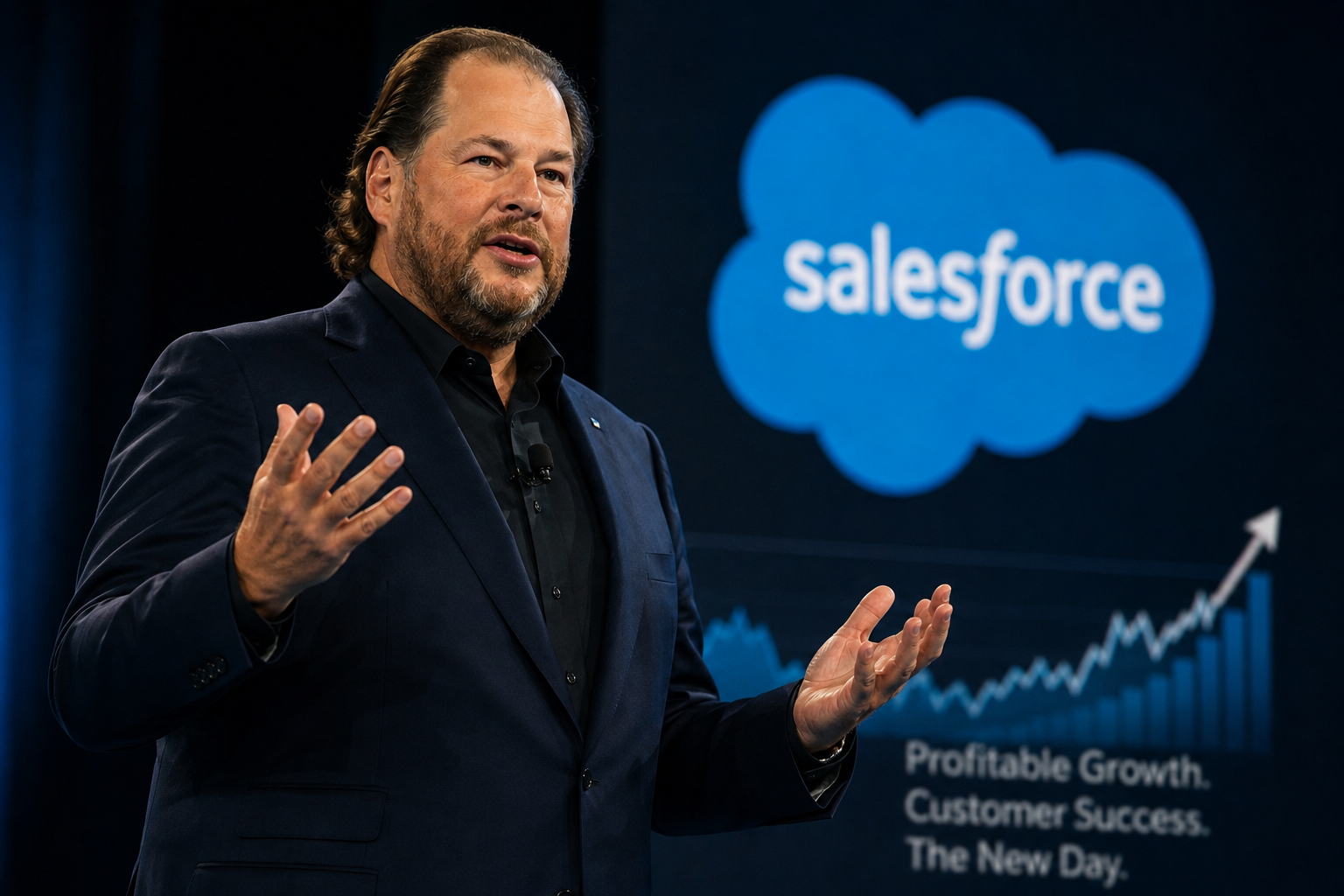
The Pressure
Salesforce entered 2023 under mounting pressure. The company that had spent the pandemic years hiring aggressively — its headcount grew by more than a third in the twelve months leading into August 2022 — was now facing a slowdown in enterprise software spending and a stock that had fallen further than most of its peers, down from more than $300 billion in market capitalization at its 2021 peak to roughly $151 billion by late January 2023. The boardroom was looking unstable too: Bret Taylor, who had been named co-CEO alongside Benioff less than a year earlier, announced he was leaving. Benioff later described the departure as a "gut punch."
Investors noticed the gap between Salesforce's growth and its profitability. In October 2022, Starboard Value disclosed a stake in the company and began pushing publicly for better margins. In January 2023, around the same time Salesforce's market value had fallen to that $151 billion level, Elliott Investment Management — one of the largest and most experienced activist funds in the world — disclosed a multibillion-dollar position of its own. Elliott's managing partner, Jesse Cohn, said in a statement that the firm had "developed a deep respect for Marc Benioff and what he has built" over nearly two decades of following the company, and that Elliott looked forward to "working constructively with Salesforce to realize the value befitting a company of its stature." It was a polite statement. It was also, by the standards of activist investing, a serious signal: two funds with track records of pushing for board seats and strategic overhauls were now both positioned inside a single company at the same time.
The Decision
On January 4, 2023, Benioff sent a letter to Salesforce's roughly 80,000 employees. "As our revenue accelerated through the pandemic, we hired too many people leading into this economic downturn we're now facing, and I take responsibility for that," he wrote. The company was cutting its workforce by about 10 percent — close to 8,000 jobs — and reducing its office footprint in several markets. Employees in the U.S. affected by the cuts would receive a minimum of nearly five months of pay, along with health insurance and career-transition support, the letter said. Salesforce estimated in a subsequent SEC filing that the restructuring would cost between $1.4 billion and $2.1 billion, and stated the plan's purpose directly: to reduce operating costs, improve operating margins, and advance the company's commitment to profitable growth.
It's worth being precise about the sequence here, because it's easy to compress into a cleaner story than the record supports. Salesforce's own explanation for the layoffs was internal — pandemic-era over-hiring meeting a slower economy — not a response to activist demands. Starboard and Elliott were applying pressure in the same window, pushing specifically on margins and capital discipline, but neither fund is on record as having demanded the layoffs themselves. What can be said with confidence is narrower: a company under simultaneous internal cost pressure and external investor pressure made a decision, in January 2023, to prioritize operating discipline over the headcount growth that had defined its pandemic years.
The Standoff
Layoffs alone don't typically end an activist campaign, and Salesforce's didn't immediately. Through the first months of 2023, Elliott moved toward a proxy fight, positioning itself to nominate directors to Salesforce's board ahead of the company's annual meeting — a step that, had it gone forward, would have forced a public vote among shareholders over Salesforce's strategy and leadership. Benioff, for his part, began stating a target in blunt terms. "Improving profitability is our highest priority," he said in early 2023, as Salesforce set out to reach a 27 percent operating margin for the fiscal year — an acceleration of a roadmap that had previously aimed for 25 percent by 2026.
The company gave this effort a name: the "New Day" framework, a multi-year commitment to profitable growth that Salesforce began referencing in its investor communications through early 2023.
On March 1, 2023, Salesforce reported its fiscal fourth-quarter and full-year results. Fourth-quarter revenue came in at $8.38 billion, up 14 percent year over year, ahead of analyst expectations on both revenue and adjusted earnings. Full-year fiscal 2023 revenue reached $31.4 billion, up 18 percent, though the year's GAAP operating margin — after absorbing the cost of the restructuring — was a comparatively thin 3.3 percent, with a non-GAAP margin of 22.5 percent and operating cash flow of $7.1 billion.
Three and a half weeks later, on March 27, 2023, Salesforce and Elliott issued a joint statement. Elliott, the statement said, had decided not to proceed with its director nominations. The reasoning it cited wasn't a single earnings beat — it was the combination of the "New Day" framework, the fiscal 2023 results, planned fiscal 2024 "transformation initiatives," and what the statement called board and management actions and a clear focus on value creation. "I have great respect for Marc and his team, and I have become deeply impressed by their strong ongoing commitment to profitable growth, responsible capital return and an ambitious shareholder value creation plan," Cohn said. Benioff, in the same release, said he'd enjoyed getting to know Cohn and was grateful for what he called Elliott's "mindful and constructive ideas." Starboard did not pursue a competing slate of directors either. Whatever the private negotiations behind the statement looked like, the public record shows an activist standoff resolved through a documented shift in financial targets and results, not through boardroom votes.
The Evidence
What happened over the following three fiscal years is where the story stops being a matter of interpretation and starts being a matter of arithmetic. Salesforce's own SEC filings lay out the trajectory in specific terms.
Fiscal 2023, the year of the reset, closed with $31.4 billion in revenue, a 3.3 percent GAAP operating margin, and $7.1 billion in operating cash flow. Fiscal 2026, the most recent full year on record, closed with $41.5 billion in revenue, a GAAP operating margin of 20.1 percent, a non-GAAP operating margin of 34.1 percent, operating cash flow of $15.0 billion, and free cash flow of $14.4 billion. In its own proxy filing, Salesforce described the operating margin gain as a 1,680-basis-point increase over three years on a GAAP basis, and 1,160 basis points on a non-GAAP basis — company-reported figures, not outside estimates.
Revenue grew by roughly 32 percent across those three years. Operating cash flow roughly doubled. The margin expansion is the more striking number, because it shows how substantially Salesforce's profitability had improved after the company made operating discipline a central priority in the aftermath of the January 2023 letter and the targets it set publicly a few months later.
None of this proves that the 2023 restructuring alone produced the 2026 numbers. Three years of results reflect dozens of decisions beyond a single workforce reduction — pricing changes, product mix shifts, the 2023 launch of generative-AI products across Salesforce's portfolio, and macroeconomic conditions the company didn't control. What the filings do support is narrower and still meaningful: Salesforce set explicit, numerical profitability targets in the aftermath of the 2023 pressure campaign, and its subsequent results moved substantially in the direction of those targets — evidence consistent with the strategy having achieved important parts of what it was designed to achieve, though not proof that the 2023 decision was the sole cause.
A Second Test
By 2026, the pressure on Salesforce had changed shape entirely. Where 2023's threat came from activist investors questioning Salesforce's spending discipline, 2026's came from a market narrative questioning whether companies like Salesforce would still have a business model at all. As AI tools grew capable of handling tasks that used to require dedicated software licenses, a theory took hold among some investors and commentators — sometimes shorthanded as the "SaaSpocalypse" — that AI agents would erode demand for the per-seat subscription software that had built Salesforce's fortune.
Benioff pushed back publicly and directly. "This is not the SaaSpocalypse," he said in comments reported in August 2026, arguing the opposite case: that AI would run on top of platforms like Salesforce's, not replace them, because enterprises still needed a trusted, secure system of record for their data and workflows. He made a similar case in a televised interview alongside Anthropic CEO Dario Amodei that same week.
Salesforce's fiscal second-quarter 2027 results, reported on August 26, 2026, gave that argument a numerical anchor: revenue of $11.35 billion, up 11 percent year over year and above the top end of the company's own guidance range. Current remaining performance obligations — a measure of contracted future revenue — rose 14 percent in constant currency to $33.5 billion, and CFO Robin Washington said net new annual order value growth, a separate booking metric, was "the strongest it's been in four years." Management raised its full-year revenue outlook by $300 million. The same week, Salesforce and Anthropic announced Claudeforce, a partnership integrating Claude directly into Salesforce's data, applications and workflows — the first time, according to contemporary reporting, that Salesforce had put another company's product name into one of its own branded offerings.
The 2026 story is not fully written. Days before those results, the company disclosed plans to eliminate 133 roles across San Francisco, Seattle and Bellevue, its third round of workforce reductions for the year, scheduled to take effect October 5 with no stated reason given in the filings. The announcement came alongside a leadership reshuffle promoting longtime revenue chief Miguel Milano to chief operating officer, while Srini Tallapragada stepped down from his role as president and chief engineering and customer success officer, transitioning to a special-advisor position to Benioff for approximately a year. Whether the cuts reflect AI-driven efficiency or ordinary restructuring, Salesforce hasn't said — and they came during a quarter of accelerating growth, not a downturn, which makes them harder to read than the 2023 round.
What the Sequence Suggests
Whether AI ultimately validates or undermines Salesforce's business model is a question this article can't settle, and neither, yet, can the market — Salesforce's stock had a difficult stretch earlier in 2026 even as the company kept raising guidance, a split between sentiment and results that Benioff has spent much of the year publicly trying to close.
What the documented record does support is a narrower claim about Benioff's decision-making under pressure. Facing a specific, quantifiable problem in 2022 and 2023 — a cost structure that had outgrown the company's revenue growth, with two activist funds positioned to force the issue — Salesforce set explicit financial targets, took a costly and disruptive restructuring step to move toward them, and then met or exceeded those targets over the following three years, with the results documented in the company's SEC filings. That is a different thing than simply weathering a downturn or waiting out an activist campaign. It's a case of a company converting outside pressure into a specific operating commitment, and then being held to it — first by Elliott and Starboard, and after March 2023, by its own stated numbers.
Whether the same discipline carries Salesforce through the AI-driven test now underway is a question the fiscal 2026 restructuring rounds suggest Benioff is still actively managing, not one he's treated as settled.
FAQ
Why did Salesforce lay off about 10 percent of its workforce in January 2023?
Salesforce's stated reason, in CEO Marc Benioff's letter to employees, was that the company had hired too aggressively during the pandemic and needed to reduce costs as economic conditions slowed. The move came during a period of separate pressure from activist investors Starboard Value and Elliott Management, though Salesforce did not attribute the layoffs directly to activist demands.
What did Elliott Management want from Salesforce?
Elliott, which disclosed a multibillion-dollar stake in January 2023, was positioning to nominate directors to Salesforce's board. In March 2023, it dropped those plans, citing Salesforce's "New Day" profitable-growth framework, strong fiscal 2023 results, and planned transformation initiatives.
How much did Salesforce's profitability actually improve?
According to the company's own SEC filings, GAAP operating margin rose from 3.3% in fiscal 2023 to 20.1% in fiscal 2026 — a 1,680-basis-point increase over three years. Operating cash flow grew from $7.1 billion to $15.0 billion over the same period.
What is the "SaaSpocalypse" Benioff has been pushing back against?
It's a market narrative suggesting AI agents could replace the need for traditional per-seat software subscriptions, threatening companies like Salesforce. Benioff has argued the opposite — that AI will run on top of trusted enterprise platforms rather than eliminate the need for them — a case Salesforce backed with an 11% revenue increase in its most recent quarter and its new Claudeforce partnership with Anthropic.
Did the 2023 restructuring cause Salesforce's later financial improvement?
The public record doesn't establish a direct, isolated cause-and-effect relationship — three years of results reflect many decisions beyond the 2023 layoffs. What's documented is that Salesforce set specific profitability targets in the aftermath of the 2023 pressure campaign and subsequently met or exceeded most of them, a pattern reflected in the company's own financial filings.