The Discipline Bet: Kevin Plank's Wager That a Smaller Under Armour Is a Stronger One
In April 2024, Under Armour's founder came back to run the company he built, and chose to make it smaller. More than two years later — and after 13 consecutive quarters of declining revenue — the bet has made Under Armour more disciplined, but it has not yet restored growth, and Plank just doubled down on it anyway.
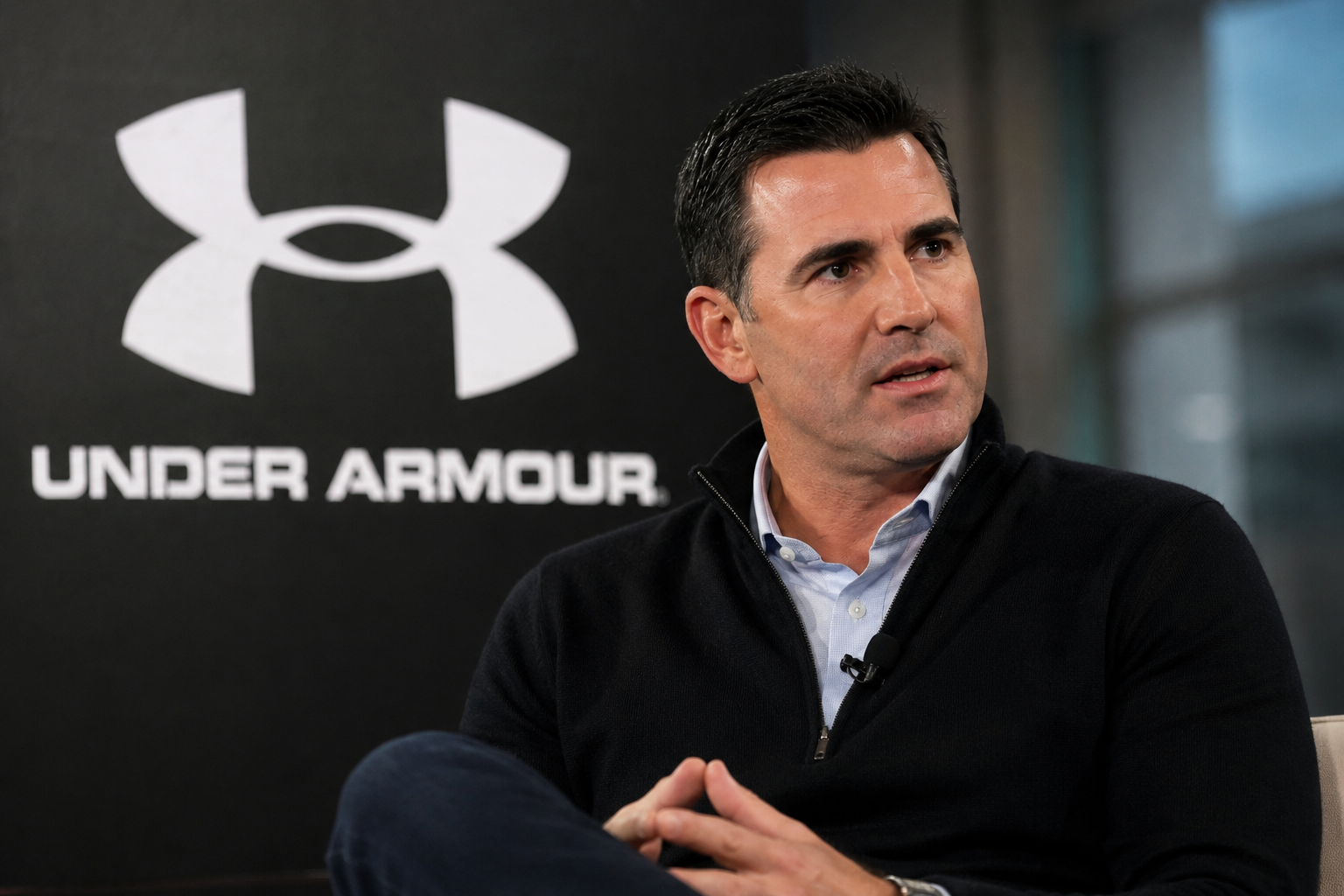
Most turnaround stories eventually resolve. The company either grows again or it doesn't, and a reporter can write the ending. Under Armour hasn't gotten there. Kevin Plank came back as CEO on April 1, 2024, diagnosed the company as too broad, too complex, and too reliant on promotions, and set out to shrink it on purpose — fewer products, fewer markdowns, a smaller organization behind it. That decision has now run long enough to produce real evidence, and the evidence points in two directions at once: the business is more disciplined than it was, and it is still not growing. In August 2026, instead of declaring victory, Plank announced a second round of the same medicine.
The diagnosis
Plank had left the CEO role once before, stepping back in early 2020 after a stretch in which Under Armour's growth had stalled and its brand had lost sharpness. He returned to a company that had spent the intervening years cycling through leadership — Patrik Frisk, then Stephanie Linnartz, who lasted 13 months before the board replaced her with Plank on March 13, 2024, effective that April 1.
His diagnosis, laid out repeatedly on earnings calls since, was specific: Under Armour had let itself grow too complicated. "A few years ago, we were too often managing for quantity, more products, more complexity and volume that did not always strengthen the brand," he told analysts in August 2026. The company had also leaned hard on discounting to move that volume, making promotion too often the reason consumers came to shop rather than the product itself. Plank's argument was that both habits were corroding the thing that had made Under Armour valuable in the first place — a premium, performance-driven brand identity — in exchange for top-line numbers that were declining anyway.
That diagnosis is worth taking at face value rather than as an inevitability. Under Armour's assortment had grown for understandable commercial reasons over years of expansion; the company was not obviously reckless in getting there. What matters for this story is that Plank, on returning, treated the size and promotional habits of the business as the problem to solve first, ahead of demand generation.
The cut
The remedy started fast. Within his first earnings call back, in May 2024, Under Armour unveiled a restructuring plan then estimated at $140 million to $160 million, alongside a stated goal: cut the company's SKU count by 25% within 18 months. By August 2026, Plank confirmed that first reduction was complete — a 25% cut to the Fall/Winter 2026 assortment compared with two years earlier — describing it not as doing less but as "giving our teams room to build products that matter."
Alongside the SKU cuts came organizational changes meant to reinforce the same logic: Under Armour began winding down its Portland footwear design offices in mid-2026, shifting that work into its Baltimore headquarters and New York offices, a move intended to tighten the connection between product decisions and the rest of the company rather than leave footwear design at arm's length. Marketing spend, which the company had at one point planned to increase to help rebuild demand, was instead held at the lower end of its 10%–11%-of-revenue target range — a decision Plank framed explicitly as reallocation rather than retreat: "This is not a retreat from the brand. It's a reset in how we invest."
The clearest public example of the same instinct applied to partnerships came in August 2026, when Under Armour ended its ten-year Project Rock collaboration with Dwayne Johnson. The company's stated reason was consistent with everything else in the reset: "sharpen[ing] our focus" and building "a more unified expression" within its training category, rather than running a marquee athlete partnership alongside its own competing product line. It is one visible instance of a broader pattern rather than a defining one, and the article treats it that way — as evidence the simplification extended beyond the product line into how Under Armour spends its marketing dollars, not as a story in its own right.
The price of discipline
None of this was free, and Plank did not pretend otherwise. Fiscal 2025, his first full year back, closed with revenue down 9% to $5.2 billion and a net loss for both the fourth quarter and the year, a period that included restructuring charges. Fiscal 2026 brought revenue down another 4%, to $5.0 billion, and a full-year net loss of $495.6 million — a number that requires a caveat Under Armour itself disclosed: roughly $247 million of that loss was a non-cash valuation allowance against U.S. deferred tax assets, an accounting adjustment rather than a cash cost of running the business. The restructuring itself has also grown more expensive than first estimated. As of the quarter ended June 30, 2026, Under Armour had incurred $266 million in cumulative restructuring and transformation costs against a plan whose total cost is now projected at approximately $305 million — a forecast, not a completed bill, and one that has grown well beyond the plan's original 2024 estimate of $140 million to $160 million.
North America, Under Armour's largest and most important market, absorbed the sharpest pain. Revenue there fell 14% in one fiscal 2025 quarter (the three months ended September 2024), and by the quarter ended December 2025 had narrowed to an 8% decline from a 13% decline the prior quarter — a real, if uneven, improvement over that stretch. It didn't hold. In the quarter ended June 2026, North America revenue fell 9% again, to $610 million, as the company said demand had softened further heading into summer.
What improved
The clearest wins are on the cost and margin side of the business, not the top line. Gross margin in the quarter ended June 2026 expanded 590 basis points year over year, to 54.1% — though the company was direct that a large share of that gain came from a one-time source: refunds tied to tariff costs the company had expensed the previous fiscal year under the International Emergency Economic Powers Act, not from pricing power alone. Operating income in that same quarter came to $46.7 million, against $3.3 million a year earlier; adjusted operating income was $52.4 million versus $24.4 million. The company swung from a small net loss to a small net profit in the quarter, and adjusted earnings per share beat analyst estimates.
There is also evidence, though limited, that the "sell less, sell it fuller-price" logic works at the product level. Plank pointed to the Bouncy Tee, a new performance T-shirt that, in his words, "has exceeded expectations while selling at its full $65." He also acknowledged the opposite case in the same breath: the Tech Tee, one of Under Armour's highest-volume programs, is "discounted too often," and the company is redesigning it around a new $35 version it hopes will justify holding the price. Both examples are useful precisely because Plank offered them together — Under Armour is not claiming every product has made the transition to full-price demand.
What didn't
The number that matters most is the one that framed the entire August 2026 call: Under Armour has now posted thirteen consecutive quarters of revenue decline, a streak that stretches back well before Plank's April 2024 return and has continued through his entire second tenure as CEO. Plank himself acknowledged the company had struggled to translate its new discipline into actual demand, telling analysts, "That brings us to the central question: How do we turn a healthier business into stronger consumer demand?" Whatever the margin and cost story shows, Under Armour has not yet found a way to grow again. In August 2026, instead of guiding toward a turn, the company cut its full-year outlook — from an expected "slight decline" to a "mid-single-digit percentage" decline — citing softer demand specifically in North America and Asia-Pacific. Investors read the announcement as a setback rather than a confirmation: shares fell 35 cents, or 5.6%, to $5.92 that day.
Independent analysts have made a related point using a longer lens. GlobalData managing director Neil Saunders has noted repeatedly that Under Armour's sales remain down more than 14% from 2022 — a steeper decline than the sports-apparel category overall — even as the pace of decline has eased. Commenting on the same August 2026 results, Saunders was blunt about what that means for judging the strategy: "As much as we recognize that the company is trying to be more disciplined with its assortment and distribution, we still find the offer to be somewhat jumbled and confused." Asked directly whether the turnaround is working, his answer has been consistent: partly.
The second cut
Rather than pause to see how the first round of cuts settled, Plank used the August 2026 call to announce a second: an additional 25% reduction to the assortment over the following 18 months, layered on top of the first. It is worth being precise about what that means and doesn't. It is not "half the SKUs" — two sequential 25% cuts compound rather than add, and the company has not published a cumulative percentage. It is a second, separate reduction, on top of a first one that took two years to execute.
Plank's framing for the second round matched the first almost exactly: focus investment behind franchises like HeatGear, Velociti, and StealthForm, where he says the brand has "the strongest potential to create separation," and continue walking away from "lower quality volume." Whether that reasoning holds up depends on whether the first cut actually produced the sharper, more distinctive product Plank promised in 2024 — a question the sales data, so far, answers ambiguously at best.
The unanswered question
Two years in, Under Armour is a more disciplined company by almost every internal measure Plank controls: lower SKU count, a stronger full-price focus, tighter marketing spend, better gross margin. It is not yet a growing one. The company's own most recent guidance points to a mid-single-digit revenue decline for fiscal 2027 as a whole — meaning, on the company's own numbers, the streak of quarterly declines is set to continue rather than end.
Whether Plank's bet is validated will not be settled by the metrics currently available. It depends on something the last two years of data cannot yet answer: whether an Under Armour that will, as Plank put it, "sell so much more of so many less products" at higher prices, can eventually generate more revenue than the sprawling, promotional version of the company he inherited — or whether it settles into a smaller, steadier business that never returns to its previous scale. Plank retains majority voting control through Under Armour's super-voting Class B shares — a structure that has kept him in the mid-60% range of voting power for years, most recently around 65% per a 2026 disclosure tied to a separate share sale — and so does not face the kind of shareholder pressure that might force an earlier verdict. That gives him time the market's patience might not otherwise allow. Whether it is enough time remains, honestly, the open question.
Sources
- 1.Under Armour — "Announces Leadership Transition" (Mar 13, 2024) ↗
- 2.Under Armour — Q4 FY2025 Results (PRNewswire) ↗
- 3.SGB Media — "Kevin Plank Won't Take Shortcuts in Premiumization Efforts" ↗
- 4.World Footwear — "Lowers full-year revenue outlook" ↗
- 5.CNBC — "Plank returns as CEO, El-Erian named board chair" ↗