The Decision Behind SpaceX's Next Phase: Why Elon Musk Is Building More Than Rockets
SpaceX's first earnings as a public company reveal a business increasingly built on Starlink and AI, not just rockets — and a decision to build the chip-making infrastructure behind it.
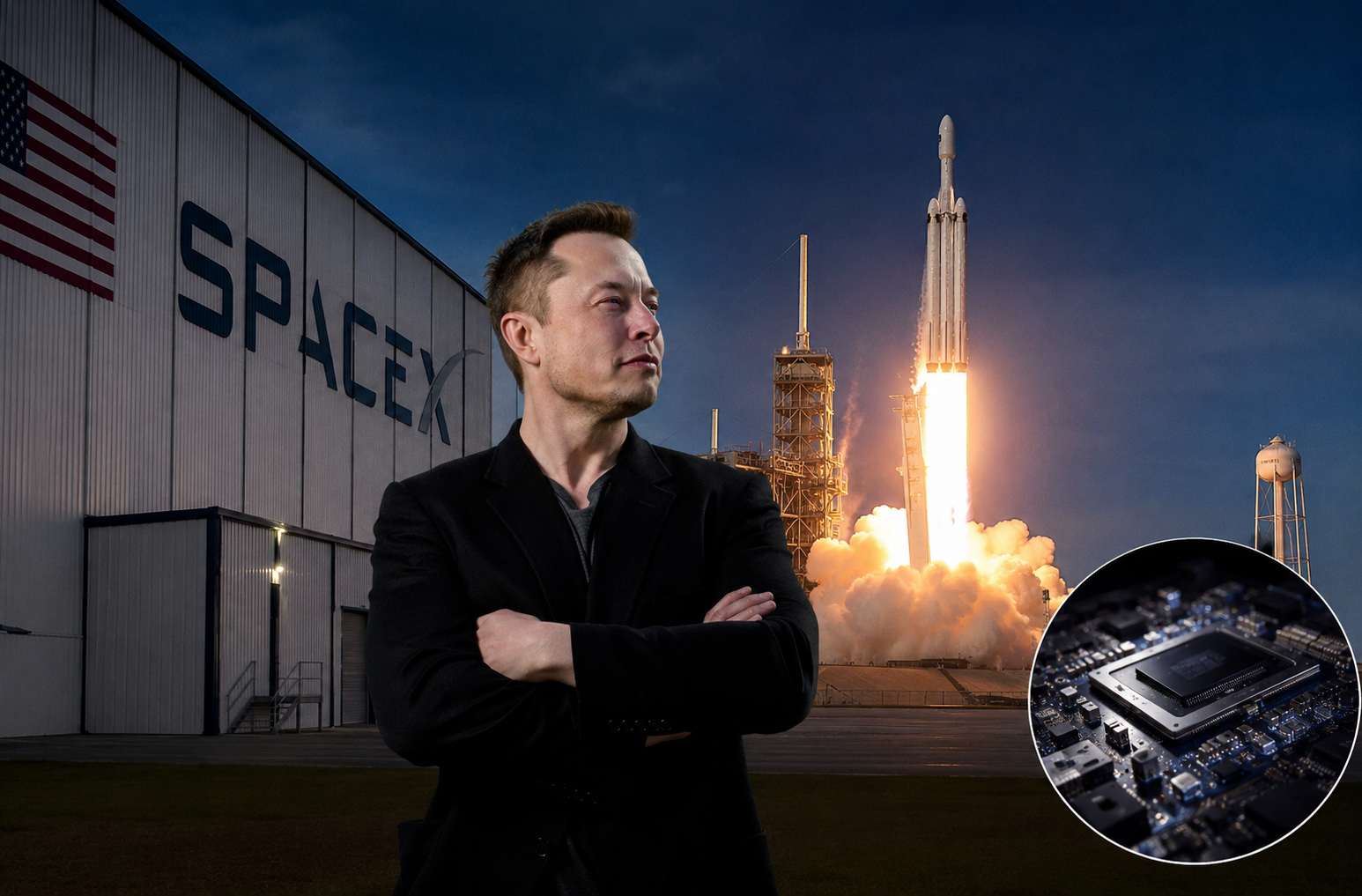
For much of its history, SpaceX was known primarily as a launch company. Its first earnings report as a public company tells a different story about where its money actually comes from — and behind that shift sits a broader decision about how much of its own infrastructure SpaceX wants to control, from satellites to computing capacity to, now, the chips that power both.
The Situation: What SpaceX's First Public Earnings Actually Showed
SpaceX listed on the Nasdaq in June 2026, raising $85.7 billion in net proceeds in what was, by several accounts, the largest IPO on record. Its first quarterly report as a public company, covering the quarter ended June 30, 2026, gave outside investors a detailed look at a business that had operated privately for more than two decades.
The company reports its results across three segments: Space (launch services and related space operations), Connectivity (Starlink), and AI (which SpaceX's own securities filings describe as spanning its Grok AI model, the X platform, enterprise AI services, and AI computing infrastructure). Total revenue came in at $7.81 billion for the quarter, up 92% from $4.07 billion a year earlier, beating Wall Street's consensus estimate of roughly $6.9 billion.
The segment breakdown is the more telling part. Connectivity generated $4.29 billion in revenue, up 66% year over year, with operating income of $1.66 billion — the only one of SpaceX's three segments to turn a profit. The Space segment brought in $962 million, up 29%, but posted an operating loss of $542 million. The AI segment grew fastest in percentage terms, with revenue up 247% to $2.56 billion, but it also ran the largest loss of the three: an operating loss of $1.26 billion, even as its adjusted EBITDA turned positive at $1.15 billion for the quarter.
Combined, SpaceX's operating loss narrowed to $143 million from $970 million a year earlier, and its net loss came in at $541 million, down from roughly $1 billion. The company ended the quarter with about $100 billion in cash, cash equivalents and marketable securities, along with a $47.5 billion contracted backlog — a financial position built substantially from IPO proceeds and a separate $25 billion bond offering completed the same quarter. Capital expenditure for the quarter reached $18.37 billion, of which $15.83 billion went specifically toward AI infrastructure — roughly six times the revenue the AI segment generated in the same three months.
Investors did not treat the results as an unqualified win. SpaceX shares fell after the report, and by some accounts more than $1 trillion had been erased from the company's market capitalization since its mid-June peak, as the market weighed strong revenue growth against the scale of AI-related spending and an approaching lockup expiration that would free hundreds of millions of insider shares for sale.
The Decision: Building Toward Greater Control Over Critical Infrastructure
Three moves, taken together, point to the same underlying choice. SpaceX is expanding Starlink into a larger share of global connectivity. It is scaling a computing and AI business fast enough that AI revenue nearly quadrupled year over year. And on August 6, 2026, SpaceX and Tesla jointly confirmed Terafab, a semiconductor manufacturing project with a confirmed first-phase investment of $16.8 billion, to be built in Grimes County, Texas.
Terafab's scope, as described in the companies' own announcements, is a facility exceeding 100 million square feet that would combine chip design, fabrication, memory production, and advanced packaging in one location — bringing together, under one roof, steps that are normally split across specialized companies around the world. Intel is a named partner, contributing its upcoming 14A manufacturing process, though Intel has disclosed few specifics about the financial terms of its role. SpaceX's own IPO filing is notably more cautious than the public announcements: it describes the Terafab arrangement as a "general framework" that carries no binding commitments, with no finalized split of intellectual property and no obligation for either party to continue participating, according to Electrek's reporting on the filing.
It's also worth being precise about what Terafab is intended to produce. Company statements describe the facility as targeting chips for edge computing and inference — the kind used in Tesla's Optimus robots and Cybercab autonomous vehicles, and in SpaceX's own data center hardware — rather than the large-scale AI training hardware SpaceX currently sources elsewhere. On the same earnings call where Terafab's financing was discussed, Musk said Nvidia would remain the exclusive supplier of chips for SpaceX's AI computing needs, and the company separately announced a partnership with Nvidia to build a satellite-based AI payload using Nvidia's Rubin GPUs. Terafab, in other words, is not a plan to replace SpaceX's most important current chip supplier — it is a bet on controlling a different, complementary slice of future chip demand that the company says existing suppliers cannot fully meet.
Tesla's own chip sourcing shows the same pattern of managed reliance rather than full independence. According to Electrek's reporting, Samsung's Taylor, Texas fab already produces Tesla's current AI4 chip and is contracted, under a $16.5 billion deal, to build Tesla's next-generation AI6 chip, with TSMC covering additional supply. Terafab, on this evidence, looks less like a replacement for these relationships and more like an attempt to build a further, dedicated layer of capacity on top of them.
Why the Strategy Makes Business Sense
The logic for building rather than buying additional infrastructure rests on a specific bet: that SpaceX and Tesla's combined future demand for computing chips will outgrow what existing semiconductor capacity can supply. The companies say their combined future computing demand could exceed one terawatt, a scale they argue would outstrip current global capacity. The precise comparison is difficult to independently verify, since the estimate concerns future computing demand rather than a directly comparable measure of current semiconductor production.
If that premise holds, then a captive facility isn't primarily about cutting costs — it's about guaranteeing supply on a timeline the companies control, rather than one set by chipmakers serving many other large customers simultaneously. The tradeoff, as SpaceX's own S-1 language makes clear, is that the arrangement remains legally non-binding and enormously capital-intensive, in an industry where neither SpaceX nor Tesla has direct manufacturing experience.
The same logic extends to Starlink and AI compute more broadly: both give SpaceX recurring revenue streams that don't depend on individual launch contracts, and both are already large enough to provide substantial recurring revenue alongside the company's access to external capital, including its IPO proceeds and a separate bond offering.
The Consequences Are Already Visible
Some results here are measurable and already in hand. Starlink's operating margin of roughly 38.6% and its subscriber base — which doubled to 12 million in a year — make it the only segment that reported operating income in Q2, and the clearest established profit engine in the current business. The AI segment's revenue growth of 247% reflects genuine, current customer demand, including $14.1 billion in new cloud-computing service agreements signed during the quarter. SpaceX has since completed its $60 billion all-stock acquisition of AI coding startup Cursor, which closed on August 14, 2026, folding the company into the SpaceXAI division alongside Grok and X.
Other results are still spending rather than proven return. The AI segment's $15.83 billion in quarterly capital expenditure was roughly six times its own quarterly revenue, and the segment posted a $1.26 billion operating loss even as its adjusted EBITDA turned positive — a sign of real underlying demand, but not yet a demonstrated path to segment-level profitability. Terafab, meanwhile, has produced a confirmed site and an initial budget, but no completed facility, no finalized ownership structure, and no chips shipped.
What Remains a Target, Not a Result
SpaceX's management has been explicit on several forward-looking numbers, and it is worth keeping them clearly separate from what the company has already achieved.
CFO Bret Johnsen told analysts the company is on pace to reach a $100 billion annualized revenue run rate by the end of 2026 — a projected pace of revenue based on current contracts and growth trends, not revenue SpaceX has already earned. On the same call, Musk said the company's internal projections for reaching $1 trillion in annual revenue had "moved up from 2031 to 2030," adding there was "a non-zero chance" of reaching it in 2029 — a target he described as an internal projection, not a formal financial forecast; SpaceX has stated it does not currently provide formal financial guidance.
Musk has also said SpaceX is aiming for more than 30 Starship launches per day by 2030 — roughly 10,000 launches annualized — a figure he has called "still tiny" next to daily commercial air travel, though it would represent a vast increase over SpaceX's current launch cadence. The company has not published a detailed operational plan for reaching that rate.
Terafab's full scope sits in the same category. The $16.8 billion figure is the confirmed first phase; the companies have said a complete, multi-phase buildout could reach as much as $119 billion, according to SpaceX's IPO filing, but that figure describes a possible ceiling for a project still being defined rather than committed spending.
Where Musk's Timelines Have Already Shifted
SpaceX's Starship program offers a concrete, recent example of the gap between stated ambition and delivery timing. On the August earnings call, Musk indicated SpaceX would likely attempt to catch a returning Starship upper stage with the launch tower on the vehicle's next test flight, barring problems found in post-mission data review. Roughly two and a half weeks later, in a post on X, Musk said the company would "probably" attempt that catch "in a few months" instead — a narrower, later timeline than the one he had described weeks earlier, though not an abandonment of the goal. SpaceX had continued making progress on Starship's test program in the roughly 90 days before the earnings call, so the shift reflects the specific catch maneuver's timeline slipping, not a broader program failure.
The Business Lesson
The pattern across Starlink, AI infrastructure, and Terafab is the same: SpaceX is trying to bring a growing share of its critical supply chain — connectivity, computing capacity, and now certain categories of chips — under its own control, while still relying on outside partners, including Nvidia and Intel, for the pieces that would be most difficult or slow to replace. That is a more selective form of vertical integration than "build everything in-house," and the evidence suggests SpaceX is applying it deliberately rather than universally.
The broader lesson for other business leaders is not that vertical integration always works, or that ambition alone is a strategy. It's that a company's competitive position can depend as much on which parts of its supply chain it chooses to own — and which parts it deliberately continues to buy from specialists — as on how well it executes its core product. SpaceX's own numbers show both sides of that bet clearly: a genuinely profitable, proven Starlink business funding a fast-growing but still loss-making AI segment, and a semiconductor plan that remains, by the company's own legal filings, non-binding and years from completion.
FAQ
Is SpaceX profitable? Not overall. SpaceX's Q2 2026 net loss was $541 million, though narrower than the prior year. Its Connectivity (Starlink) segment is profitable, with an operating margin of roughly 38.6%. Its Space and AI segments both ran operating losses that quarter.
What is Terafab, and is it already operating? Terafab is a semiconductor manufacturing project announced by SpaceX and Tesla, with Intel as a technology partner. The companies confirmed a $16.8 billion first-phase investment and a Texas site location in August 2026. It is not yet an operating facility, and SpaceX's own IPO filing describes the arrangement between the parties as a non-binding general framework.
Will Terafab replace SpaceX's current chip suppliers? Not entirely, based on company statements to date. Musk said on SpaceX's Q2 2026 earnings call that Nvidia remains the exclusive supplier of SpaceX's AI computing chips. Terafab has been described as targeting edge-computing and inference chips for products like Tesla's Optimus and Cybercab, and SpaceX's own space-based data centers — a different category from the AI training hardware Nvidia currently supplies.
Is SpaceX really targeting $1 trillion in annual revenue? Musk told analysts on the Q2 2026 earnings call that SpaceX's internal projections for reaching $1 trillion in annual revenue had moved up to 2030, with a "non-zero chance" of 2029. He described this as an internal projection rather than formal guidance; SpaceX has said it does not currently issue formal financial guidance.
What are the biggest risks to this strategy? Terafab's financial and legal structure remains unsettled, per SpaceX's own filings, and neither SpaceX nor Tesla has prior experience in semiconductor manufacturing. SpaceX's AI segment is growing quickly but remains loss-making, with quarterly capital spending running well ahead of segment revenue. Starship's own recent timeline for a specific technical milestone has already slipped once.