The Dangote Refinery Bet: Why Aliko Dangote Is Bringing Investors into His Biggest Project
Aliko Dangote built Africa's largest refinery almost entirely under his own control. Now, with Nigeria's SEC approving a public listing, he's giving up a small slice of ownership to fund a plan that would nearly double the plant's capacity — while crude supply and a $47 billion valuation remain unresolved questions.
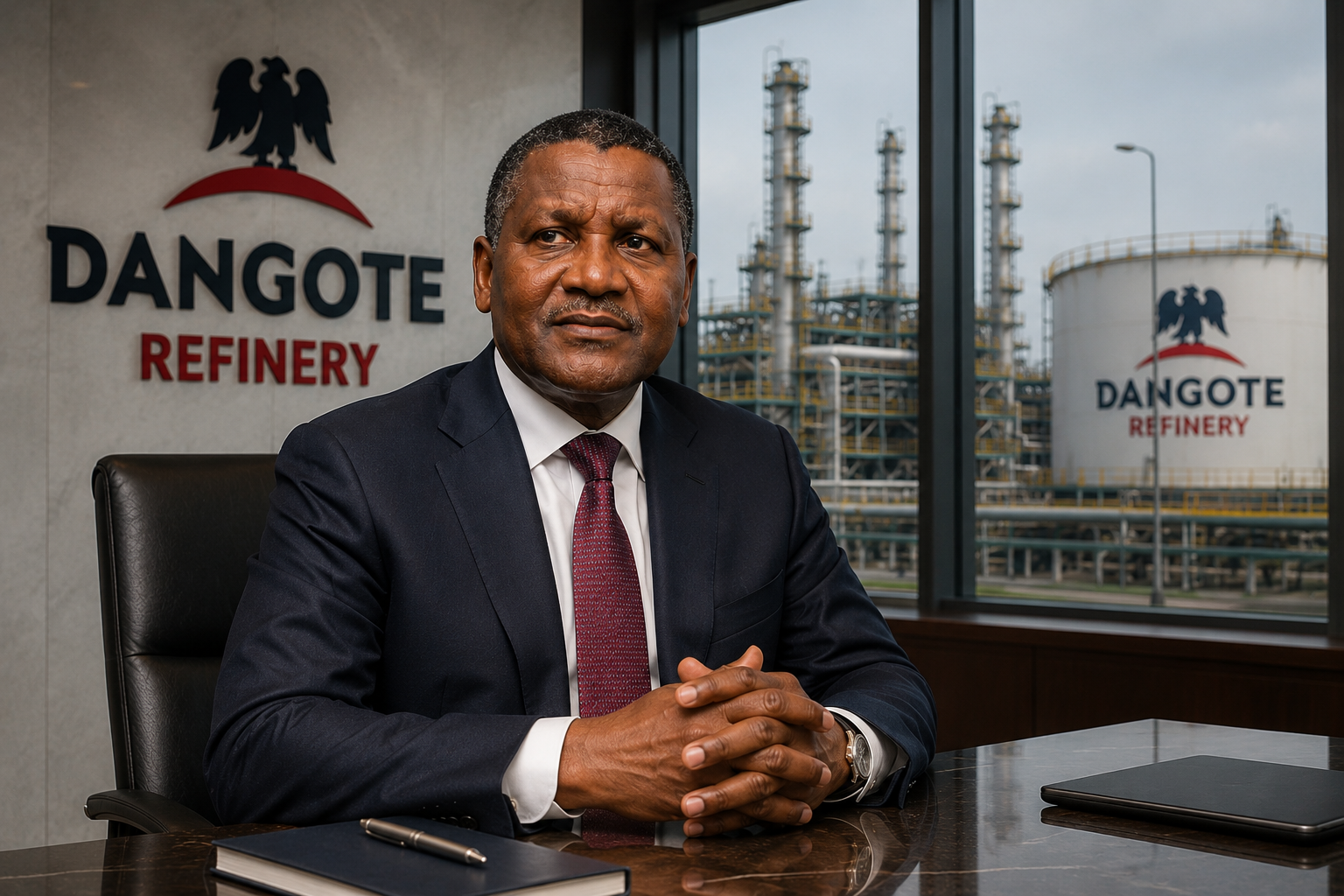
On September 4, Nigeria's Securities and Exchange Commission cleared the Dangote Petroleum Refinery to sell shares to the public for the first time. The approved offer is modest by the standards of what had been rumored: 4.1 billion shares at ₦525 apiece, raising somewhere in the range of $1.6 billion. A day earlier, speaking to investors in Botswana, Aliko Dangote had described a much bigger number — an offering worth roughly $5 billion. The gap between what he said out loud and what the regulator actually approved is more than a footnote. It shows how dramatically the size and structure of a transaction like this can shift between an executive's fundraising ambition and a regulator-approved public offering. The more important question is why Dangote wants outside investors in the refinery at this stage at all.
For more than a decade, the refinery in Lekki, on the outskirts of Lagos, has been almost entirely Dangote's own creation: his balance sheet, his risk, his control. Now, in the space of a few months, he has raised private equity, arranged an underwriting facility, and secured regulatory approval for a public listing — all while preparing to nearly double the plant's capacity. The interesting question isn't whether the IPO happens. It's why a man who has spent decades building an empire around concentrated ownership is choosing, right now, to open the crown jewel of that empire to public shareholders.
At its core, the decision is simple to state, if not simple to evaluate. Dangote is exchanging a small amount of ownership for a much broader pool of capital. The SEC-approved offer would raise about $1.6 billion, against a refinery whose valuation at the offer price works out to roughly $47 billion. The proceeds are meant to help finance the next phase of an expansion toward 1.4 million barrels a day — nearly double what the plant produces today.
The asset he built almost entirely alone
The scale of what Dangote built is not really in dispute. First announced in 2013, delayed for years by financing and construction setbacks, the refinery was formally inaugurated in Lekki in May 2023 by then-president Muhammadu Buhari. It took until December that year for the first crude cargo to arrive, and until January 2024 for the plant to begin producing diesel and jet fuel. At 650,000 barrels a day of original nameplate capacity — later increased to 700,000 after maintenance work in February 2026 — it became, by a wide margin, the world's largest single-train refinery.
Dangote kept ownership of the project concentrated in his own hands, but he did not finance it alone. In September 2013, his group signed a $3.3 billion syndicated loan with a consortium of 12 banks to help fund the roughly $8 billion original construction budget, alongside equity he supplied himself. Over the years that followed, the project layered in more debt — commercial loans, development-finance support, and eventually a crude-backed prepayment facility involving NNPC and Afreximbank. Dangote combined his own capital with that borrowed money, but kept voting control tightly in his own hands throughout. That is still an unusual structure for a refinery this size — most large refining projects globally lean far more heavily on external debt from the start — but it was not, as sometimes described, a project built almost entirely off Dangote's personal or group cash. Today he holds roughly 92.3% of the refinery. Nigeria's state oil company, NNPC, was supposed to be his partner at a much larger scale: in September 2021, NNPC agreed to buy a 20% stake for $2.76 billion, financed through a forward-sale arrangement in which it pledged 35,000 barrels of crude a day to help repay a $1.036 billion loan, of which $1 billion actually reached the refinery. NNPC never completed the rest of the payment. By the end of 2023, its stake had settled at 7.25%, not 20%. Dangote was openly unhappy about that outcome — in a 2024 television interview he called NNPC's reduced stake a mistake on the state company's part — but the practical effect was that he ended up owning even more of the refinery than originally planned, not less.
That history matters for understanding what's happening now. This is a founder who has spent years absorbing capital risk that a government partner was supposed to share, and who has generally preferred to keep control tight rather than dilute it. The IPO is a departure from that instinct, even if the departure is smaller than the early headlines suggested.
Why bring in outside money at all
The refinery's finances have not always been comfortable. In August 2024, Fitch downgraded Dangote Industries' national long-term rating from AA(nga) all the way to B+(nga), placing it on Rating Watch Negative. The agency's reasoning was specific: weaker-than-expected proceeds from asset sales, a refinery running at only around half its nameplate capacity through the first half of 2024, a large foreign-exchange loss tied to the naira's 2023 devaluation, and no backup financing lined up for debt coming due that August. It was not a token demotion — six full notches on Fitch's national scale, and a rating agency explicitly worried about default risk on refinery-linked debt. By February 2025, Fitch withdrew its ratings on Dangote Industries altogether, citing commercial reasons. That sequence is important context, but it is not evidence that the 2026 IPO is a rescue financing. By August 2025, the group had already refinanced roughly $4 billion of refinery-related construction debt through an Afreximbank-led syndicated facility, well before any of this year's equity raises or the IPO were on the table. The credit history matters mainly because it shows this project has not been financially effortless, even as it has become an industrial success story.
Feedstock has been its own recurring headache. In October 2024, Nigeria launched a naira-for-crude programmed meant to let domestic refiners buy Nigerian crude in local currency rather than dollars, easing pressure on both the refinery's costs and the country's foreign-exchange market. In practice, the volumes never matched the plan. By July 2026, Dangote's own executives were saying the refinery needed 13 to 15 crude cargoes a month to run efficiently; NNPC's allocation had crept up to only seven, from about five earlier in the year, leaving the refinery to source the remaining barrels internationally at dollar-denominated prices while still selling much of its output in naira. Group vice president Devakumar Edwin described the resulting currency mismatch as unsustainable, and that month the refinery switched its domestic pricing for petrol, diesel and jet fuel to dollars outright — a move that shifted exchange-rate risk onto the marketers who buy from it. The underlying problem was straightforward: the naira-for-crude arrangement, as designed, was not delivering enough domestic feedstock to eliminate the refinery's dependence on the international crude market.
Set against that backdrop, the sequence that led to September's IPO looks less like an isolated fundraising event and more like a staged transition. Over the summer, the refinery raised a $2.5 billion equity placement led by Africa Finance Corporation, oversubscribed close to 3.7 times over — genuine, tested demand from sovereign-linked investors and other institutions, though the exact stake sold and resulting valuation were not disclosed by the company itself. Of that placement, $600 million was specifically underwritten and funded through Pan-African Refinery Investment, a vehicle tied to Lilium Capital, in a deal arranged by advisers Marob Strategies and Lilium Capital; the same vehicle separately committed a further $400 million to support the IPO once it launched. That $1 billion in underwriting and the $2.5 billion placement are not two separate capital raises stacked on top of each other — they overlap, with the underwriting programme built specifically around funding and de-risking the placement and preparing the ground for the public offering. Then, in September, came the IPO itself. Three financing steps in three months are not simply the mechanics of a listing. They show a company deliberately building a broader institutional capital base around an asset that was previously dominated by its founding owner.
What the money is actually for
The refinery Dangote built is not the refinery he says he wants to end up with. The current facility processes up to 700,000 barrels a day. The plan is to add a second crude distillation unit, roughly 750,000 barrels a day of additional capacity, pushing the total toward 1.4 million barrels a day by 2028 — which would make it, again, comfortably the largest single-site refinery on earth. That expansion is expensive, and it is the primary justification the company has given for wanting a larger, more permanent capital base than one founder's balance sheet and a handful of private investors can easily provide.
There is real evidence that the first phase of the bet has already produced a measurable industrial and trade impact. The U.S. Energy Information Administration reported in August that Nigeria's seaborne petroleum-product shipments averaged 561,000 barrels a day in the second quarter of 2026, up from an annual average of just 79,000 barrels a day in 2023 — a sevenfold increase that the agency attributes almost entirely to the refinery coming online. Exports to Europe alone rose to 130,000 barrels a day, up from 15,000 in 2023, helped along by supply disruptions elsewhere tied to tensions in the Strait of Hormuz. Domestically, Nigeria's seaborne imports of refined products fell from nearly 400,000 barrels a day in 2023 to under 130,000 by the second quarter of this year. However, the IPO turns out, that underlying shift in Nigeria's fuel trade — from persistent importer toward exporter — is not a projection. It has already happened, and the EIA's own data is the evidence, not a company talking point.
The valuation the market is being asked to accept
The number attached to all of this has moved fast. Bloomberg's wealth index has generally carried the refinery near its roughly $20 billion construction cost, the standard approach for a private company with no traded share price. Reuters reported that the summer's private placement implied a valuation closer to $40 billion. By the time the SEC approved the IPO structure in September, the pricing — ₦525 a share across an enlarged base of about 124 billion shares — implied a valuation near $47 billion. That is more than double the construction-cost estimate within a matter of months, and it is a genuinely open question whether it reflects what the refinery has already proven or what Dangote believes it can eventually become. Investors buying into the IPO are not simply pricing a working refinery; they are pricing an expansion plan that has not yet been built, a crude-supply problem that has not yet been solved, and a valuation gap between construction cost and market price that outside observers have flagged as demanding rather than conservative.
Dangote's own ownership sits at the center of that math. He currently controls about 92.3% of the refinery; the public offering, sized as approved, would take that down to roughly 89.25%. That is a striking detail, because the headlines around a multi-billion-dollar IPO tend to suggest a company handing over meaningful control. This one barely moves the needle on ownership at all — which makes the earlier $5 billion figure Dangote was citing only a day before approval even more puzzling. The public record does not yet explain why the fundraising ambition he described was so much larger than the offer that was ultimately approved. The answer may become clearer once the final offer documents are published and the order book opens on September 14, or once Dangote's subsequent capital-raising plans, including the 15% greenshoe option, come into focus.
The wider pattern
The refinery is not the only place Dangote is inviting outside capital and outside partners into a project he would once have built alone. In Kenya, his group has offered East African governments a combined 30% stake in a planned $16-to-20-billion refinery at Lamu, designed to process 700,000 barrels a day — slightly more than the original Lagos plant. Kenya's presidential economic adviser, David Ndii, has said Nairobi is considering a 10% share worth about $500 million, with Ethiopia and Rwanda also in discussions for the remaining allocation. None of that is signed or funded yet; groundbreaking has been set for the end of September, and the government stakes remain proposals rather than commitments. But the pattern is the same one playing out in Lagos: build the asset, prove it works, then bring in outside capital and outside partners to fund the next stage, rather than shouldering all of it privately again.
There are early signs, too, that Dangote is thinking about succession. A family office based in Dubai, led by his daughter Halima Dangote, is expected to become fully operational in early 2027, focused on governance, capital allocation and philanthropy, with a stated goal of keeping the business intact across eight to ten generations. It's a supporting detail rather than the main story here, but it fits the same broader shift — from a founder making one-off calls to something closer to an institutionalized platform built to outlast him.
The open question
None of these reads as a company in crisis reluctantly selling shares to survive. Demand for the private placement was strong, and the underwriting programmed provides additional institutional support heading into the public offering. But it also doesn't read as a triumphant victory lap disguised as an IPO. It reads as a founder making a calculated trade: giving up a small, carefully bounded slice of ownership in exchange for a capital base broad enough to fund an expansion that his own balance sheet, however large, can't easily carry alone.
Whether that trade pays off depends on questions the IPO itself won't answer. Can the refinery secure enough crude, at a price that makes sense, to run a plant twice today's size? Can a $47 billion valuation survive contact with a public market that will scrutinize quarterly numbers the way private investors never had to? And does bringing in tens of thousands of new shareholders change how the business is actually run, or is it simply a more efficient way to fund the same founder-driven vision that built the refinery in the first place?
Dangote has already answered the harder version of this question once: whether a privately financed, founder-controlled African industrial project could compete on a global scale. The refinery's production and export footprint suggest that the industrial premise has moved well beyond the planning stage. The question in front of him now is different, and less within his control. It's whether that same project can absorb public capital, public scrutiny and a much larger footprint without the risks that have already shown up once — in a credit downgrade, in a currency mismatch, in a crude-supply shortfall — resurfacing at a scale that a $47 billion valuation has little room to forgive.