The Bet Beneath the AI Boom: What Bruce Flatt Is Actually Building
Bruce Flatt is betting that AI's biggest bottleneck is not models or chips, but the physical infrastructure behind them. Brookfield's Naver and Paducah projects show how that strategy is being built — and what remains unproven.
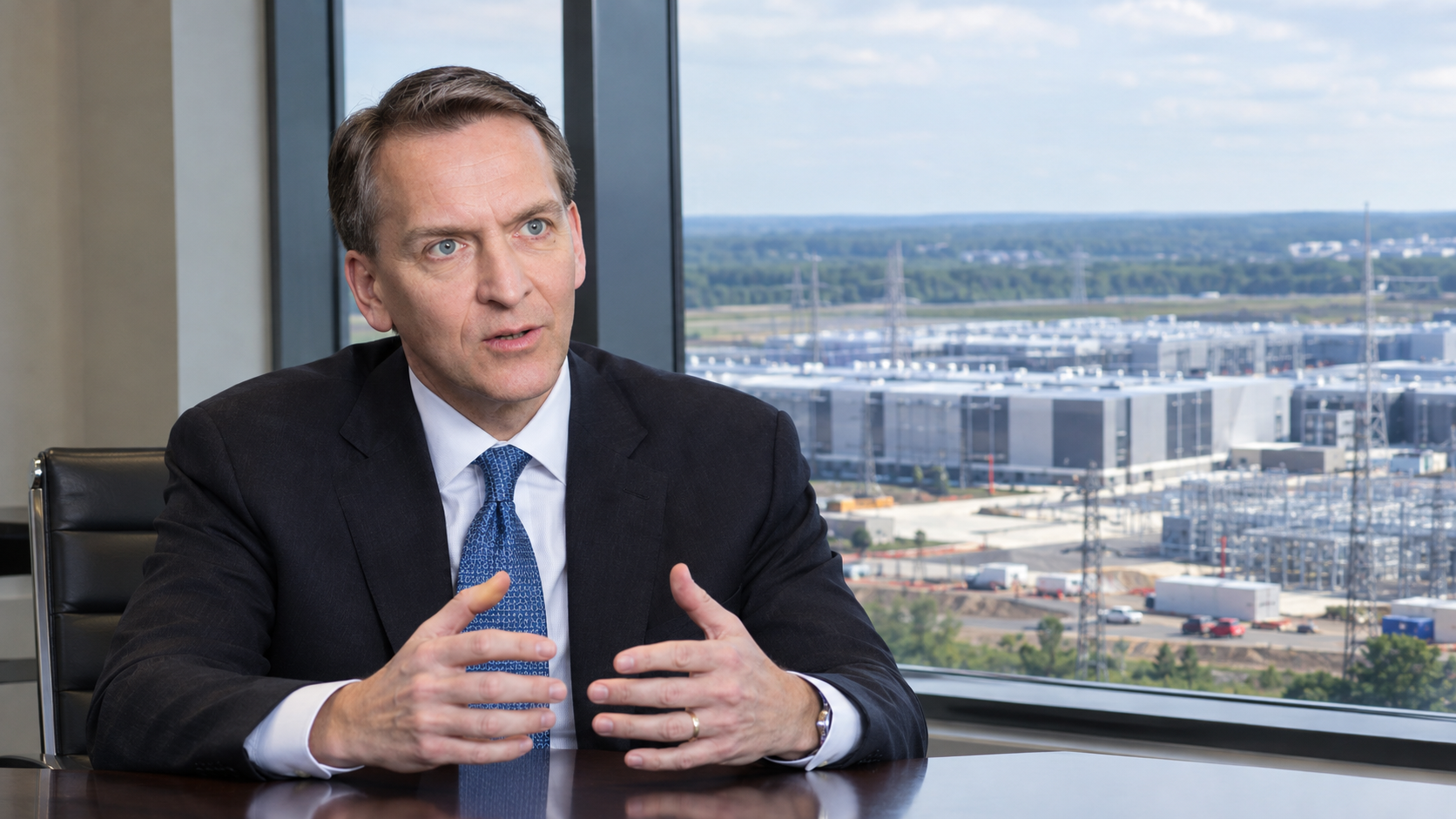
Everyone can name the companies winning the AI race — the model builders, the chipmakers, the hyperscalers announcing another round of eye-watering capital spending. Fewer people are watching who owns the ground underneath all of it: the land, the power plants, the data centers, the physical infrastructure that has to exist before any of those companies can run a single additional model. Bruce Flatt, CEO of Brookfield Corporation, is betting that this second, less visible layer is where some of the most durable value in the AI buildout will actually sit.
The Bet Beneath the AI Boom
Brookfield's public commentary on this has been consistent for over a year: the constraint on AI's growth isn't primarily a shortage of capital or ideas, but a shortage of physical capacity — power generation, transmission, land entitlements, and the data centers to house it all. Flatt has framed Brookfield's advantage as its ability to combine several capabilities that AI infrastructure projects need simultaneously: financing, power development, land, construction and operating experience, brought together under one roof rather than assembled piecemeal by each customer.
Two projects announced in 2026 make that thesis concrete in very different ways. One is a South Korean data center partnership with Naver, the country's largest internet company, and NVIDIA. The other is a Kentucky campus built on the site of a former Cold War uranium enrichment plant. Together, they show what Flatt's infrastructure bet actually looks like in practice — and where its biggest open question sits.
Naver Shows the Architecture
In South Korea, Naver is building what it calls an AI Factory at its GAK Sejong data center, aiming eventually for a facility with 1 gigawatt of capacity — roughly the output of a large nuclear power plant. That 1GW figure is a long-term ambition, not a confirmed build; the actual near-term plan is a first phase of 200 megawatts, expanding from an initial 55-megawatt deployment.
The financing behind it is structured, not simple. NVIDIA has said it plans to invest $1 billion directly into Naver Corp. Brookfield's role is different and, as of this writing, not yet finalized: the company has entered a non-binding term sheet to fund up to $9 billion toward the first phase, with Naver providing the remaining financing. Brookfield has not invested $9 billion in the project; its current commitment is a non-binding term sheet to fund up to that amount.
What makes the deal structurally interesting is the split between ownership and operation. According to Naver's own disclosures and Korean media reporting, Naver will establish a wholly owned subsidiary to operate the AI Factory, while Brookfield sets up a separate special-purpose vehicle intended to hold the physical infrastructure — the data-center buildings and equipment. Naver's operating company would then lease or procure computing capacity from that vehicle and sell access to outside customers. It's a model that keeps the physical asset and the operating business in separate legal structures, with Brookfield positioned as the capital and infrastructure partner behind the asset rather than a shareholder in Naver's AI business itself.
Bruce Flatt visited Naver's headquarters in Seongnam on September 3, 2026, meeting with chairman Lee Hae-jin for follow-up discussions on the 1GW-class AI factory project. Naver said Flatt described Brookfield as more than a financial investor, with the firm expected to support equipment and infrastructure procurement and customer acquisition as the project develops. Whether that broader involvement becomes standard practice across Brookfield's other AI infrastructure deals, or remains specific to this one, isn't yet established.
Brookfield Wants More Than a Financial Role
That instinct — to be an operating partner rather than a passive financier — runs through how Brookfield describes its broader AI infrastructure strategy, which the company has organized around four areas: AI factories themselves, power and transmission, compute infrastructure, and what it calls strategic adjacencies. The Naver deal touches at least the first three. It's one example of an approach Brookfield had already been building before this specific transaction, not the beginning of a new one.
That distinction matters for how much weight to put on any single project. Naver is a useful case study precisely because its structure — infrastructure ownership separated from the operating business — is unusually well documented. Not every Brookfield AI investment necessarily follows an identical template, but the underlying logic, positioning Brookfield's capital alongside its power and infrastructure development capabilities rather than simply as a lender, appears consistently across the company's stated strategy. Brookfield's positioning also sits inside a wider institutional shift: in August 2026, NVIDIA announced memorandums of understanding with six major financial firms, including Brookfield, aiming to mobilize more than $500 billion in third-party capital for AI infrastructure over time. That figure spans all six firms combined, remains subject to definitive agreements, and is not capital Brookfield alone is committing — but it signals that Brookfield's approach is part of a broader pattern among large capital allocators, not an isolated strategy of one firm.
Paducah Tests the Bigger Idea
If Naver shows the architecture at a relatively contained scale, a project in western Kentucky shows what happens when Brookfield applies the same instinct at a much larger one. In July 2026, the U.S. Department of Energy announced that Brookfield had been selected to lease, develop and operate a data center campus on the site of its former Paducah Gaseous Diffusion Plant — a shuttered Cold War-era uranium enrichment facility. NextEra Energy was separately selected to build and own dedicated power generation for the site.
The scale is substantial: a campus targeted to eventually support more than 1.2 gigawatts of compute capacity, backed by up to 1.8 gigawatts of utility capacity, 2 gigawatts of new grid-connected natural-gas generation and up to 2.6 gigawatts of battery energy storage. The companies have described the investment as exceeding $100 billion, privately funded, with construction expected to be completed in 2031. Flatt called the site "the seed of our plan to invest $100 billion in AI infrastructure," framing Paducah not as an isolated project but as the flagship of Brookfield's broader infrastructure commitment.
The Harder Question Is Who Follows the Infrastructure
Here is the detail that matters most for judging how the bet is going: when the Paducah project was announced, no anchor tenant had been publicly identified. Commercial discussions were reportedly ongoing, while the project itself remained subject to definitive documentation and regulatory approvals, including sign-off from Kentucky's Public Service Commission on the power arrangements. At the time of the announcement, no anchor tenant had been publicly identified, while discussions with potential commercial partners continued.
That is not, on its own, evidence the bet is misjudged — building ahead of demand is close to the definition of infrastructure investing, and Brookfield's underlying wager is that AI compute demand will continue outstripping supply for years. But it does mean the real test of the Kentucky project isn't the groundbreaking; it's whether customers actually show up once the capacity exists, at prices that make the economics work. Whether Brookfield's ability to assemble land, power and capital ahead of time creates enough of an advantage to attract those customers, or whether it's simply a large bet that demand keeps growing at its current pace, is a genuinely open question rather than something the record currently answers.
What Flatt Is Actually Betting On
Strip away the individual project details, and Flatt's wager isn't really about which AI company or model wins. It's a bet that owning and financing the bottleneck layer — power, land, physical infrastructure — creates value that persists regardless of which specific AI companies succeed. If that premise holds, Brookfield's return doesn't depend on picking the right chatbot or foundation model; it depends on AI compute demand broadly continuing to outstrip the physical capacity available to serve it.
It's worth noting that Bruce Flatt's own role in this strategy sits within a broader leadership structure at Brookfield. The distinction matters because Flatt remains CEO of Brookfield Corporation, the parent company, while Connor Teskey became CEO of Brookfield Asset Management — the publicly listed asset management arm — in February 2026, with Flatt continuing as that entity's board chair.
What Remains Unproven
Several things about this bet are established fact. Several others are targets, proposals, or open questions that shouldn't be mistaken for settled outcomes.
Confirmed: Brookfield's role in both the Naver and Paducah projects, the broader four-part AI infrastructure strategy Brookfield has publicly described, and the September 2026 meeting between Flatt and Lee Hae-jin.
Still unresolved: the $9 billion Naver commitment remains a non-binding term sheet, not a completed investment. The 1-gigawatt Naver facility is a long-term target built on top of a much smaller confirmed first phase. Paducah's full build-out is a multi-year plan targeted for the early 2030s, dependent on regulatory approvals and definitive contracts not yet finalized. Most significantly, Paducah had no publicly named anchor customer at the time of its announcement — meaning the single largest project in this story is, for now, an infrastructure bet made ahead of confirmed demand.
The Broader Lesson
The instructive part of Flatt's approach isn't a specific number. It's the underlying discipline: identifying where a boom's real physical bottleneck sits, then positioning capital and operating capability around that bottleneck before the eventual winners of the boom itself are fully known. That's a different kind of conviction than betting directly on a technology or a company — it's a bet that whoever wins, they'll need what you've already built. Whether that conviction pays off at Brookfield's scale, across a portfolio spanning South Korea to Kentucky, is still being written.