Fernando Fernández's Bet on a Smaller, Sharper Unilever
Fernando Fernández is reshaping Unilever around fewer, more focused businesses. His strategy is already showing early signs of progress, but the biggest test of his tenure has yet to be completed.
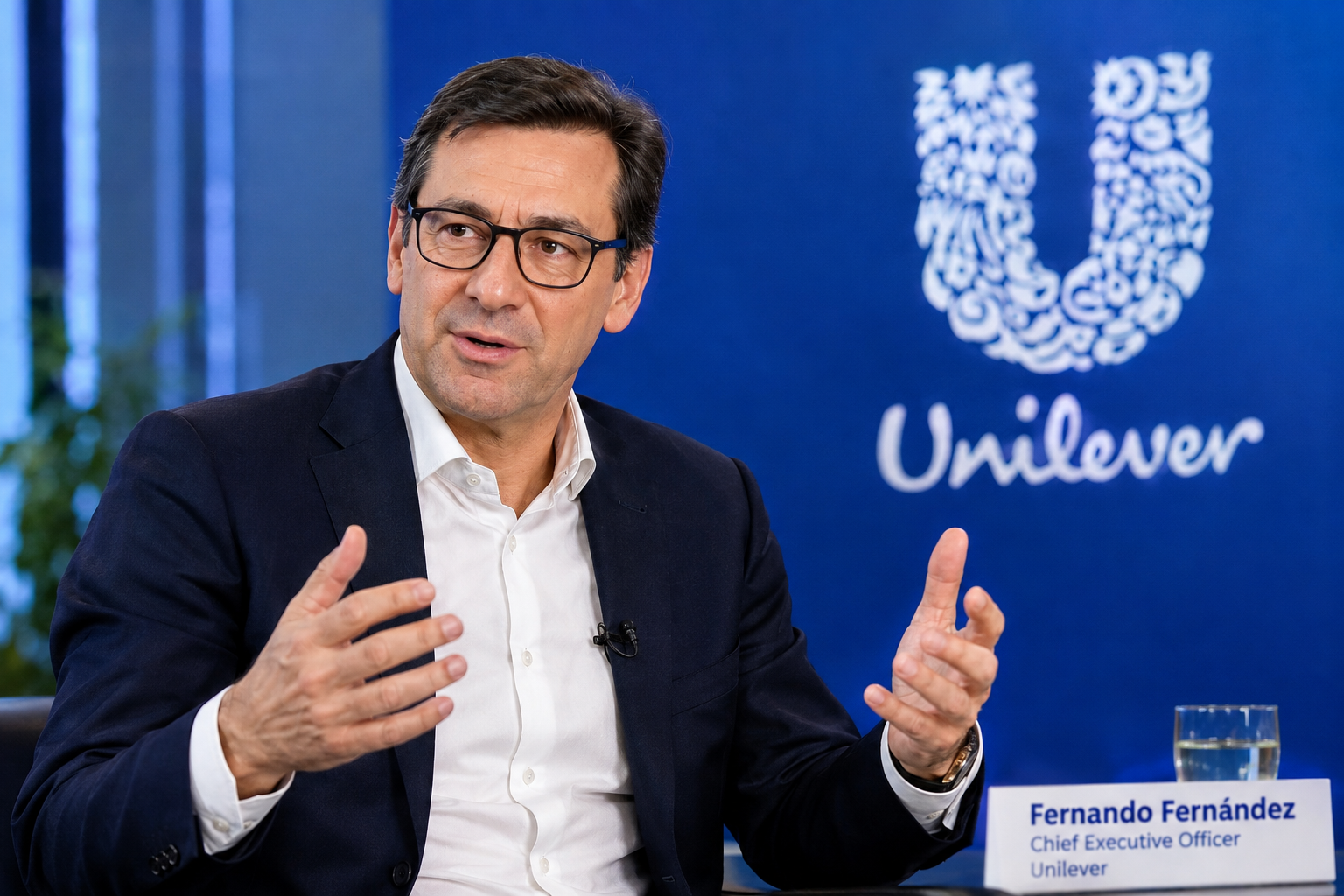
In March 2026, Unilever's chief executive explained to investors why he was making one of the world's largest consumer-goods companies smaller. Fernando Fernández was not presenting the move as a retreat. He was outlining a strategy to separate Foods and leave Unilever more focused on Beauty & Wellbeing, Personal Care and Home Care. The question his strategy raises is straightforward: can a company with a long history of operating across categories become stronger by concentrating on fewer of them?
The Mandate Was Not to Start Over
Fernández did not arrive at Unilever as an outsider brought in to reinvent the company. He had spent decades at Unilever, most recently as Chief Financial Officer and, before that, as president of the company's Beauty & Wellbeing business. When Hein Schumacher stepped down as CEO in February 2025, Unilever said the change was made by mutual agreement. The company credited Schumacher with resetting its strategy and starting a major productivity programmed, while saying it wanted to accelerate execution. Chairman Ian Meakins said the board had been "impressed with Fernando's decisive and results-oriented approach and his ability to drive change at speed."
Fernández became CEO on March 1, 2025. In announcing the appointment, he said he wanted to build a "future-fit portfolio" around Unilever's Power Brands. That emphasis on focus and execution would become increasingly visible in the company's portfolio decisions that followed.
The First Lesson Was What to Let Go
The first major portfolio change under Fernández was not one he originated. Unilever had announced its intention to separate its Ice Cream business in March 2024, before Fernández became CEO. What changed under Fernández was that he inherited the separation process and oversaw its completion.
The demerger was completed on December 6, 2025, creating The Magnum Ice Cream Company as a standalone listed business. Unilever retained a minority stake in the new company.
That distinction matters. Fernández's early record was not simply about announcing a new direction; it also involved executing a major separation that had already been approved.
Then He Made the Harder Choice
The much bigger decision came on March 31, 2026, when Unilever announced that its Foods business would be combined with McCormick, subject to regulatory and other conditions. The transaction covers Unilever's Foods business with certain exclusions, including businesses in India, Nepal and Portugal.
The structure is unusually complex. The transaction is designed as a Reverse Morris Trust. Unilever will receive a one-time cash payment of $15.7 billion, subject to closing adjustments, while Unilever and its shareholders are expected to receive 65% of the fully diluted equity of the combined company. That 65% is expected to consist of 55.1% for existing Unilever shareholders and 9.9% retained by Unilever. McCormick shareholders are expected to own the remaining 35%.
The transaction implies an enterprise value of approximately $44.8 billion for Unilever Foods and approximately $21 billion for McCormick, while the combined company is expected to have a value of roughly $65 billion. Completion is expected by mid-2027, subject to shareholder, regulatory and other closing conditions.
Fernández has framed the transaction as a way to create two more focused businesses. On the Unilever side, the goal is a focused home and personal care company; on the Foods side, McCormick would provide a global platform for the brands moving out of Unilever.
The argument is not that Foods was a failed business. Instead, Unilever has increasingly emphasized Beauty & Wellbeing, Personal Care and Home Care as strategic growth priorities, alongside the United States and India.
The Argument Against His Own Strategy
The strategy is not without risk.
The McCormick transaction separates Unilever from a substantial Foods operation while requiring a complicated separation and combination process. The deal will also take time to complete, meaning the full financial and strategic consequences cannot yet be measured.
Recent reporting has highlighted the same tension: investors have welcomed aspects of Unilever's stronger operating performance while continuing to question whether the Foods separation will ultimately create more value than the business would have generated inside the larger group.
That is an important distinction. The McCormick transaction is a strategic decision, not a result that has already been proven. Its long-term success remains to be demonstrated.
Simplifying the Portfolio Was Only Half the Change
While portfolio restructuring has attracted the most attention, Fernández has also pushed a significant change in how Unilever markets its brands.
In 2025, Fernández said Unilever planned to work with roughly 20 times as many influencers and creators as it had previously. He also said the company wanted to move toward a social-first approach to marketing. Contemporary reporting at the time described a plan to direct about 50% of advertising spend toward social media while expanding the company's creator partnerships.
The scale of the programmed has since increased sharply. In a June 2026 Unilever investor conference, Fernández said the company had grown from about 10,000 content creators two years earlier to around 300,000. Unilever's own website now describes its creator network as nearly 300,000 worldwide.
Independent reporting has also confirmed the growth from roughly 10,000 to about 300,000 creators and described the operational challenge of managing a network at that scale.
From Broadcast to Recommendation
Fernández has described the marketing shift as more than simply hiring more influencers. His argument is that consumers increasingly encounter brands through people, communities and creator content rather than only through traditional corporate advertising.
At a 2025 Barclays discussion, he described the ambition in highly local terms, saying he wanted an influencer presence across communities, including one for each of India's roughly 19,000 postal codes and Brazil's more than 5,700 municipalities.
The strategy was put to a much larger test during the 2026 FIFA World Cup. Unilever activated more than 50,000 creators across the tournament, working across more than 120 markets and 35 brands. The company said the creators had a combined audience of more than 600 million people.
That makes the World Cup more than a marketing campaign. It is also an early test of whether a creator-led model can operate consistently at the scale required by one of the world's largest consumer-goods companies.
India Shows Where the Bet Gets Tested
India is one of the markets where Fernández's strategy is being tested most visibly.
Unilever has identified India as one of its priority geographies alongside the United States, and Fernández has explicitly said the company intends to make disproportionate investment in both markets.
The country's importance is also visible in Unilever's latest results. In the first half of 2026, India delivered 8% underlying sales growth and 6% volume growth. In the second quarter, underlying sales growth accelerated to 10%, with both Home Care and hair care reaching their highest-ever market shares according to Unilever.
India therefore provides a useful test of the broader strategy: whether stronger investment in priority categories and a more locally distributed approach to marketing can translate into sustained growth.
What the Numbers Say So Far
The evidence so far is encouraging, but still incomplete.
Unilever reported underlying sales growth of 4.8% in the first half of 2026, including 4.2% volume growth. In the second quarter, underlying sales growth accelerated to 5.8%, with volume growth of 5.5%. Power Brands, which account for 78% of turnover, delivered 6.0% underlying sales growth and 5.4% volume growth.
Performance was particularly strong across the categories that will form the core of the more focused Unilever. Beauty & Wellbeing delivered 5.9% underlying sales growth in the first half, Personal Care 4.8%, and Home Care 7.6%. Foods also grew, recording 1.2% underlying sales and volume growth in the first half.
Those figures show that Unilever's continuing businesses are performing well. They do not, however, prove that separating Foods was the right long-term decision. That question depends on what happens after the transaction closes and how the remaining company performs over time.
The Unfinished Test
The McCormick transaction is expected to close by mid-2027 at the earliest, subject to the required approvals and other conditions. As of September 2026, the deal remains unfinished.
That makes the timing important. Fernández was appointed with a mandate emphasizing execution and speed, but his most consequential portfolio decision requires a lengthy separation and transaction process.
The deal being announced is only one stage. It still has to close, the businesses have to separate successfully, and the resulting companies have to demonstrate that the new structure creates greater value.
Smaller Is Not the Same as Better
Fernández has made a clear public bet: that a more focused Unilever, concentrated on Beauty & Wellbeing, Personal Care and Home Care, can perform better than the broader company he inherited.
The early operating evidence is encouraging. The creator strategy has expanded dramatically, and the company's continuing business groups have delivered strong volume-led growth in the first half of 2026.
But the biggest part of the strategy remains unresolved.
The Foods combination with McCormick has not yet closed. Until it does, and until the resulting Unilever demonstrates that greater focus translates into stronger long-term performance, the case for "smaller" remains a thesis rather than a verdict.
That unresolved question is the real test of Fernando Fernández's leadership at Unilever.
FAQ
What is the McCormick deal, and has it closed?
In March 2026, Unilever agreed to combine its Foods business with McCormick in a transaction expected to create a combined company valued at roughly $65 billion. Unilever is expected to receive $15.7 billion in cash and, together with its shareholders, 65% of the combined company's fully diluted equity. Completion is expected by mid-2027, subject to required approvals and other conditions.
Did Fernando Fernández originate Unilever's Ice Cream separation?
No. Unilever announced the intention to separate its Ice Cream business in March 2024, before Fernández became CEO. Fernández inherited the process after becoming CEO in March 2025 and oversaw its completion in December 2025.
How large is Unilever's creator network?
Fernández said in June 2026 that Unilever had grown its creator network from roughly 10,000 people two years earlier to about 300,000. Unilever's own website now describes the network as nearly 300,000 worldwide.
Is Unilever's new strategy working?
The early operating evidence is positive. Unilever reported 4.8% underlying sales growth and 4.2% volume growth in the first half of 2026, with second-quarter growth accelerating to 5.8% and volume growth to 5.5%. However, the McCormick transaction has not yet closed, so the most important part of the portfolio strategy remains unproven.