Brian Chesky's Bigger Bet: Airbnb Wants to Own the Trip, Not Just the Stay
Airbnb spent a decade positioning itself as the alternative to hotels. Now it's adding hotels, car rentals, grocery delivery and airport pickups — and betting that owning more of the trip, not just the stay, is what makes the business more valuable.
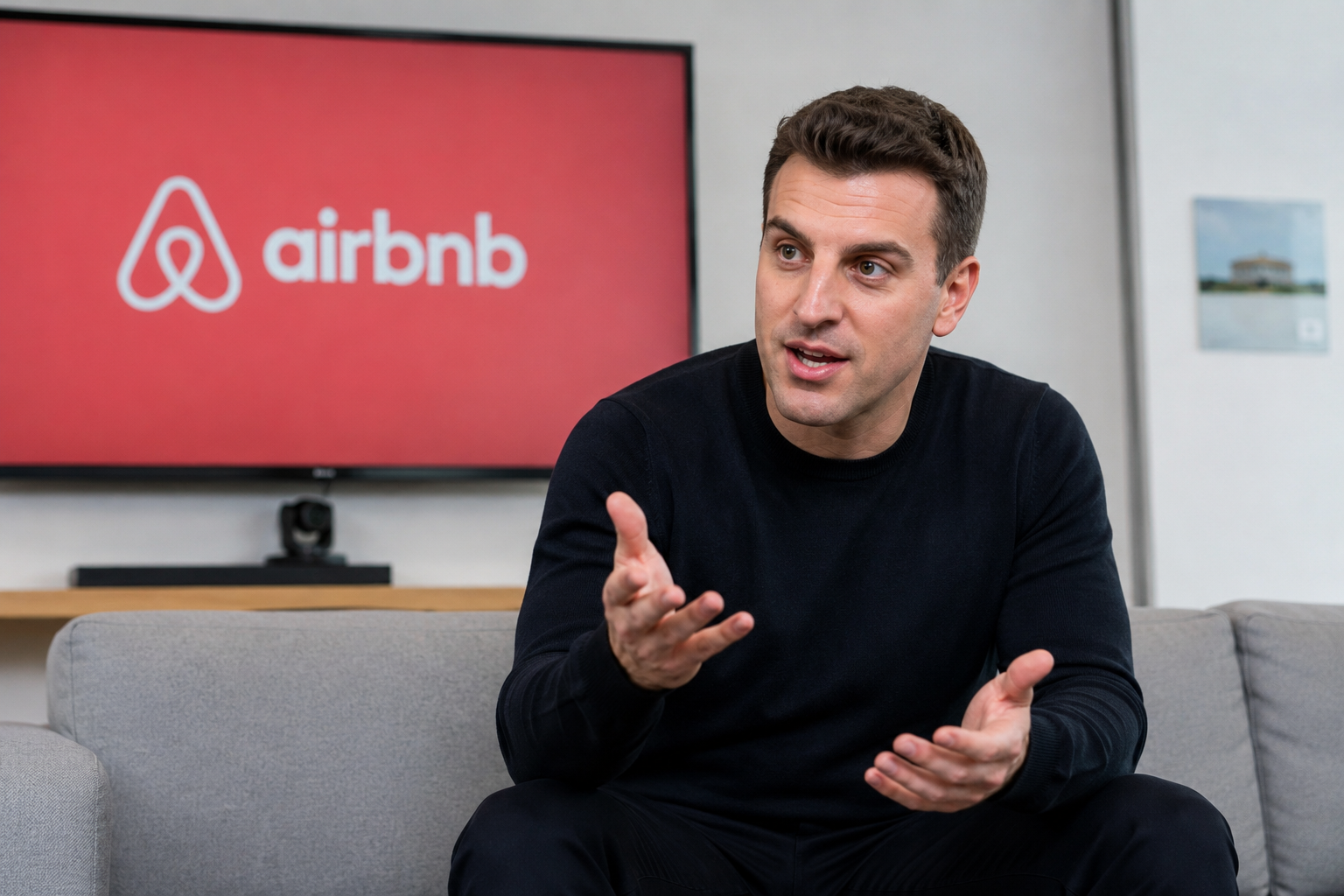
Airbnb built its name on a simple promise: a place to sleep that felt more like belonging than lodging. For most of the company's life, that was the whole business. Now Brian Chesky is trying to turn Airbnb into something that touches almost every part of a traveler's trip — the hotel, the rental car, the groceries in the fridge, the ride from the airport, even the afternoon spent with a local guide.
The interesting question isn't what Airbnb has added. Product launches happen at every company, every year. The interesting question is why Chesky decided that owning the stay was no longer enough, and whether stretching Airbnb's brand across so many new categories strengthens the company or dilutes the thing that made it valuable in the first place.
What made the original model work
Airbnb's early advantage was structural. It didn't own real estate the way a hotel chain does, and it wasn't simply reselling hotel inventory the way an online travel agency does. It built a marketplace connecting people with spare space to people who wanted something a hotel couldn't offer — a kitchen, a neighborhood, more room for a family, a lower price for a longer stay. That asset-light model let Airbnb scale quickly without the capital burden of owning property, and gave it a category almost entirely to itself for years.
But a marketplace for stays has a ceiling. However often someone books an Airbnb, the stay is only one leg of a trip. The flight, the transportation, the meals, the local activities — all of that has historically happened somewhere else, on someone else's app.
The limitation Chesky is trying to solve
That gap is the strategic opening Chesky has been talking about publicly for the past two years. A traveler might book a home on Airbnb and then quietly hand the rest of their spending to Expedia, Uber, Instacart, Viator and a dozen other apps during the same trip. Historically, much of the spending that happens around an Airbnb stay has taken place outside the platform.
That's a real limitation, not a hypothetical one. Every dollar spent on a rental car, a grocery run or a guided tour during an Airbnb stay is a dollar the company never sees. It's also an engagement problem: a company a customer opens once every few months, to book one thing, has a weaker relationship with that customer than one that shows up throughout the trip.
The first step: Experiences and Services
Airbnb's answer began in 2025 with two new product lines, Airbnb Experiences and Airbnb Services. For the first time, a guest could book a place to stay, join a local-led activity, and hire something like a private chef, all inside the same app. Airbnb has said that in the months since, millions of people did exactly that.
That was the test case. It showed travelers were willing to book more than a room through Airbnb, and it gave the company a template: bring in outside providers, wrap them in Airbnb's interface and trust systems, and let the categories build on one another.
The 2026 escalation
This year, Airbnb pushed the idea much further. In its 2026 Summer Release, unveiled on May 20, the company introduced car rentals, grocery delivery, airport pickups, exclusive FIFA World Cup 2026 experiences, and boutique and independent hotels, describing the update as a way to improve "every part of your trip," in the company's own framing, from arrival to departure.
The specifics show this isn't cosmetic. Grocery delivery runs through a partnership with Instacart, live in more than 25 U.S. cities, with a delivery discount for Airbnb guests. Airport pickups run through Welcome Pickups and are available in more than 160 cities worldwide, with guests getting a discount on every ride. Luggage storage runs through Bounce. Car rentals followed later in the summer. Boutique and independent hotels launched in 20 major destinations, including New York, Paris, London, Madrid, Rome and Singapore, with more markets planned through the year.
None of these categories is something Airbnb built from scratch. The company is licensing and partnering its way into travel logistics rather than operating car fleets or grocery warehouses itself — the same asset-light instinct that defined the original homes marketplace, applied to a much wider set of services.
Chesky has been direct about how far he thinks this can go. Speaking to CNBC around the Summer Release, he said Airbnb could become something like an "Amazon for services," at least for travel and everyday living, and suggested the company could eventually operate dozens or even hundreds of categories the way Amazon does. He pointed to a highly fragmented travel and living market as the opportunity, and mentioned future categories such as surf and ski equipment rentals or gym passes as directions Airbnb might explore later. At the same event, he framed the shift in more human terms, saying travel should be meaningful rather than merely convenient — and that meaningfulness was the goal behind the expansion.
Why hotels are the most interesting piece
Of all the additions, hotels carry the most tension. Airbnb spent its first decade positioning itself as the alternative to hotels — the reason someone might skip the chain lobby for a real apartment with a kitchen. Adding hotels back into the app looks, on the surface, like abandoning that identity.
The logic behind it is narrower than it first appears. Airbnb isn't building generic hotel inventory to compete room-for-room with Marriott or Hilton. It's adding boutique and independent properties, the kind of hotel that already looks and feels closer to an Airbnb listing than to a chain property. The pitch to travelers is a wider set of stay options without leaving the app; the pitch to those independent hotels is distribution they otherwise struggle to get, since they lack the marketing budgets of the big chains or global booking sites.
There's early evidence the category is gaining traction. Reuters reported that Airbnb's hotel nights booked grew nearly three times faster than homes in the second quarter of 2026, though the company said hotels still represent only a single-digit percentage of total nights booked. That's a meaningful growth signal, but it says nothing about scale on its own — a small category can post fast percentage growth for a long time before it becomes material to overall revenue. Chesky was more specific about why on the earnings call, telling analysts the hotel push was going "significantly better than I expected" and that Airbnb now believes it has built the best hotel booking product online, while CFO Ellie Mertz noted the category is still early in its lifecycle. He also declined to credit any single driver for the quarter's broader results, saying there was no silver bullet and no single product or partnership behind the acceleration, even as he argued separately that "hotels are making homes stronger." That's a more measured claim than "hotels are transforming Airbnb," and the distinction matters. It's a bet that the categories reinforce each other, not proof that they already do.
Is there a flywheel, or just more products?
The stronger version of Chesky's argument is that these categories don't just sit next to each other — they feed each other. A guest who tries an Experience for the first time might come back later to book a home. A hotel guest unfamiliar with Airbnb might become a repeat user who eventually books an apartment instead.
There's early data suggesting that pattern is at least partly real. On the second-quarter 2026 earnings call, Airbnb management said roughly 35% of first-time hotel guests come back later to book a home — the clearest concrete number the company has offered for the cross-category conversion it's counting on. Airbnb's own investor materials this year also pointed to a meaningful share of new Experience bookers going on to book a stay or a service afterward, and the company has described new categories explicitly as low-commitment entry points meant to convert first-time users into repeat ones. That fits with what Airbnb reported about new users broadly: growth among first-time bookers accelerated to an 11% rate in the second quarter of 2026, the fastest pace in four years, according to the company.
Still, calling this an established flywheel gets ahead of the evidence. Airbnb hasn't disclosed enough granular data, over enough years, to prove that hotel or service customers reliably convert into long-term home bookers at scale. What exists so far is early and directional. It is not proof of a durable mechanism.
What the numbers show right now
The financial backdrop for this bet is strong. Airbnb's revenue reached $3.61 billion in the second quarter of 2026, up 17% year-over-year, with gross booking value up 16% to $27.2 billion and nights and seats booked up 10%, an acceleration from the first quarter, according to the company's shareholder letter and earnings filing. Results beat Wall Street's expectations on both revenue and earnings per share, and the stock jumped roughly 9% to 11% in after-hours trading on the news, based on reporting from CNBC and other outlets. Mobile adoption also picked up: nights booked through Airbnb's app rose 23% year-over-year and represented 64% of total nights booked, up from 59% a year earlier.
That momentum gives Chesky room to keep investing in the broader strategy. But it's worth being precise about what the numbers actually prove: they show Airbnb's core business accelerating and new categories showing early traction, not that the "own the whole trip" strategy has already become a large, independently profitable business. Airbnb has not broken out exactly how much revenue the new services and hotel categories generate on their own, which makes it hard to know how much of the current strength comes from the expansion versus the underlying home-rental business simply having a strong year.
What could go wrong
The risks here aren't exotic. They're the standard ones that come with any company trying to become a platform rather than a single product, and they deserve to be treated seriously rather than as an afterthought.
The most direct risk is competitive. Reaching further into hotels, car rentals and trip logistics puts Airbnb in more direct contact with Booking Holdings and Expedia, both established players with deeper roots in hotel distribution and years of experience bundling travel services. Airbnb is a relative newcomer to hotels, and building "the best hotel booking product online," as Chesky has described his own ambition, is a different challenge than building the best marketplace for spare rooms and apartments.
There's also a brand risk specific to Airbnb. The company's identity was built on being distinct from the standardized, corporate feel of hotel chains and travel agencies. Stacking on car rentals, grocery delivery and hotel bookings pulls the app closer to looking like exactly that kind of everything-store, and it isn't obvious the "belong anywhere" ethos survives that shift unscathed.
Execution is a separate concern. Airbnb doesn't operate any of the new categories directly; it routes bookings to Instacart, Welcome Pickups, Bounce and independent hotel operators. That keeps the model asset-light, but it also means service quality depends on partners Airbnb doesn't fully control, at exactly the moment the company is asking guests to trust its judgment across more of their trip. Some investors are also questioning whether the stock's valuation has run ahead of what the expansion has actually delivered. Airbnb has traded at a higher earnings multiple than Booking Holdings and Expedia for much of the past year, a premium that assumes the broader strategy pays off in a way that hasn't been fully demonstrated yet.
The bet underneath the products
Put together, the individual launches — hotels, car rentals, grocery delivery, airport pickups, a growing Experiences catalog — start to look less like a scattered list of features and more like a single wager: that Airbnb can become more valuable by becoming part of more moments in a trip, not just the moment someone chooses where to sleep. That's Chesky's stated ambition, not an outcome that has been proven. The evidence so far — accelerating bookings, faster-growing hotel nights, a rising share of first-time users — is consistent with the bet paying off. It isn't confirmation that it has.
The harder leadership question underneath all of this isn't whether a company can expand. Almost any company with enough capital and attention can add new product lines. The harder question is knowing which adjacent categories reinforce what made the original business valuable, and which ones quietly erode it while looking like growth. Chesky is currently running that experiment in public, one product release at a time, with a brand that took nearly two decades to build sitting on the other side of the bet.