The Growth Trap: Why Scaling Revenue Without Strengthening Operations Can Damage a Business
Revenue growth does not always mean a business is becoming stronger. This article explores why companies can struggle when expansion outpaces operational capacity and introduces five practical pillars that CEOs and founders can use to build sustainable, profitable growth.
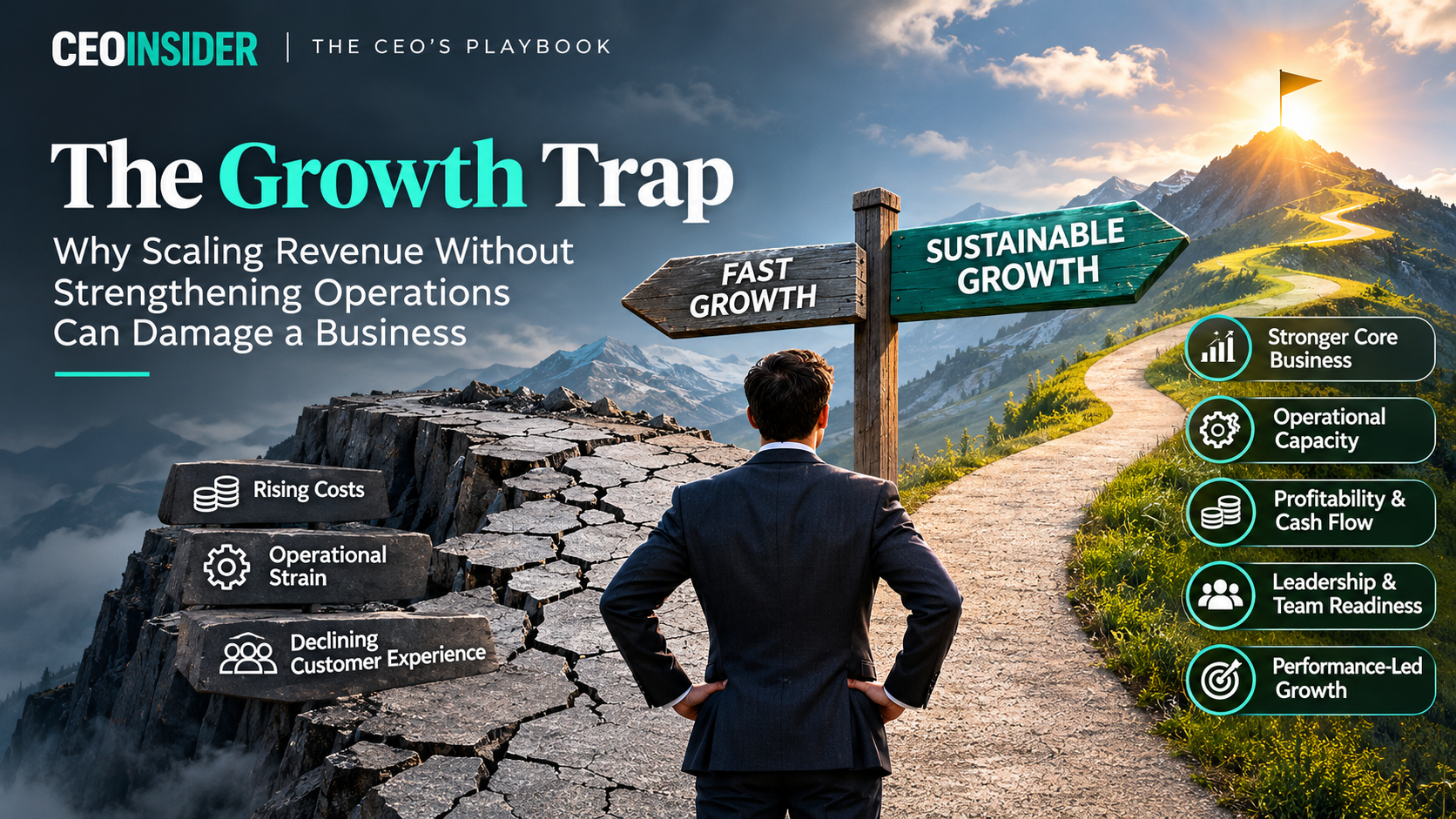
Subtitle: A practical framework for balancing business expansion, profitability and operational capacity.
Growth is one of the most celebrated indicators of business success. Increasing revenue, entering new markets, acquiring customers and expanding teams are often viewed as signs that a company is moving in the right direction.
But growth can create a problem that many businesses recognize too late: the organization becomes larger without becoming stronger.
Customer demand increases, but operational processes remain unchanged. Sales teams bring in more business, but delivery teams struggle to keep up. Hiring accelerates, but management structures fail to evolve. Revenue rises, yet costs, inefficiencies and pressure on working capital grow alongside it.
This is the growth trap: expanding the business faster than its ability to operate effectively.
For CEOs and founders, the challenge is not simply to achieve growth. It is to build an organization capable of sustaining it.
The Difference Between Growth and Scalable Growth
Revenue growth and business scalability are not the same thing.
Revenue growth measures how much a company increases its sales. Scalability examines whether the organization can support additional demand without experiencing a disproportionate increase in costs, complexity or operational problems.
A company might double its customer base but require significantly more employees, management attention and infrastructure to serve those customers. While revenue increases, profitability and operational efficiency may deteriorate.
In its research on sustainable growth, McKinsey emphasizes the importance of combining a strong core business with expansion into new markets and opportunities. Its analysis highlights that successful growth requires deliberate strategic choices rather than expansion for its own sake.
The message for business leaders is straightforward: expansion should strengthen the underlying business model, not expose its weaknesses.
Five Pillars of Sustainable Business Growth
To avoid the growth trap, CEOs can evaluate their organizations through five interconnected pillars.
1. Strengthen the Core Before Expanding
Before entering new markets or launching additional products, leaders should understand whether the existing business model is performing effectively.
This means examining customer retention, product quality, operational consistency, margins and the company's competitive advantage.
McKinsey's research on growth strategies emphasizes the importance of strengthening the core business. Its analysis indicates that the core has historically contributed more than 80 percent of total revenue growth on average among the companies studied.
This makes the existing business an important starting point for expansion.
For example, a company experiencing strong demand should first determine whether its current delivery processes, customer support and product quality can handle additional customers.
Expanding a weak operational model simply multiplies existing problems.
CEO action: Identify the three operational or commercial strengths that make your existing business competitive. Protect and improve them before committing substantial resources to expansion.
2. Build Operational Capacity Before Demand Outpaces It
Growth creates pressure across the organization.
More customers require stronger delivery capabilities. More transactions require reliable financial systems. More employees require effective management structures. Without preparation, the organization begins relying on temporary solutions to solve permanent operational challenges.
An article in Harvard Business Review, How Fast Should Your Company Really Grow?, published in March 2024, discusses how rapidly growing companies can underestimate the gaps between demand and their staffing, management capabilities and operating processes.
These gaps can create quality problems, employee burnout, excessive infrastructure spending and declining customer confidence.
The lesson is that operational readiness should develop alongside commercial ambition.
CEO action: Before launching a major growth initiative, assess whether your technology, workforce, supply chain, customer service and management systems can support the expected increase in demand.
3. Protect Profitability and Cash Flow
Revenue growth can create an attractive picture while hiding financial pressure.
A business may report higher sales but face increasing acquisition costs, inventory requirements, delayed customer payments and rising operating expenses.
For this reason, executives should evaluate growth through more than revenue alone.
A useful financial scorecard should include:
Revenue growth: Is the business generating additional sales?
Gross margin: Is the company retaining sufficient value from each sale?
Operating margin: Are operating costs growing faster than revenue?
Customer acquisition cost: How much does it cost to win new customers?
Customer lifetime value: Does the long-term customer relationship justify acquisition expenditure?
Cash conversion: How efficiently is reported revenue becoming available cash?
These indicators help leadership identify whether growth is creating financial strength or simply increasing the scale of operations.
Consider a company that increases revenue by 30 percent but experiences a significant decline in operating margin because it relies heavily on discounts and expensive customer acquisition campaigns.
The company is growing, but its underlying economics may be weakening.
CEO action: Establish financial performance thresholds for every major growth initiative. Evaluate expected profitability and cash requirements before approving expansion.
4. Develop Leadership and Organizational Capacity
A growing company cannot depend indefinitely on the same management structure that supported it during its early stages.
In smaller businesses, founders often oversee sales, operations, recruitment, customer relationships and important strategic decisions. As the organization expands, this approach becomes difficult to sustain.
McKinsey's research on scaling founder-led businesses identifies several important capabilities, including organizational structure, effective ways of working, talent development, culture and leadership capabilities.
This highlights an important transition: founders must gradually move from personally managing activities to building teams and systems that can manage them effectively.
Delegation becomes essential, but delegation without clear accountability can create another layer of complexity.
Senior leaders need defined responsibilities, measurable objectives and the authority to make decisions within their areas of ownership.
CEO action: Identify operational responsibilities that still depend heavily on the founder or CEO. Develop capable leaders, establish clear accountability and delegate decisions to the appropriate level.
5. Measure Growth Through Performance, Not Activity
Organizations often become busier as they grow. More meetings, additional employees, larger customer pipelines and new projects can create the impression of progress.
But activity is not the same as performance.
CEOs need a consistent system for evaluating whether expansion is producing meaningful business results.
A practical growth dashboard should monitor five areas:
Financial health: Revenue, margins, cash flow and operating costs.
Customer performance: Retention, satisfaction, repeat purchases and complaints.
Operational efficiency: Delivery times, productivity, quality and process reliability.
People and leadership: Employee retention, management effectiveness and workforce capacity.
Strategic progress: Market expansion, product performance and achievement of major business objectives.
These indicators should be reviewed regularly, with clear ownership for addressing performance gaps.
The objective is not to measure everything. It is to identify the indicators that reveal whether the organization is becoming stronger as it grows.
CEO action: Select a small set of meaningful performance indicators and review them through a consistent monthly leadership process.
Putting the Framework Into Practice
Consider a growing consumer brand experiencing increasing demand across multiple markets.
Its leadership team is considering expanding distribution into additional regions.
Instead of approving expansion based solely on sales opportunities, the CEO applies the five pillars.
First, the company evaluates whether its existing products and customer relationships provide a strong foundation. Next, it assesses manufacturing capacity, inventory management, distribution and customer support.
The finance team examines the expected investment, cash requirements and potential margins. Leadership then evaluates whether the current management team has the capacity to oversee additional markets.
Finally, the company establishes performance indicators and milestones to determine whether the expansion is delivering the expected results.
This approach does not eliminate business risk. It makes expansion more deliberate, measurable and accountable.
Rather than pursuing every available opportunity, the company can prioritize the opportunities that fit its capabilities and long-term objectives.
The CEO's Sustainable Growth Checklist
Before approving the next major expansion, ask:
Is our existing business model strong enough to support further growth?
Can our operational systems handle increased demand without compromising quality?
Will the expansion improve profitability and cash generation?
Do we have the right leadership and talent to manage a larger organization?
Are we measuring business performance beyond revenue?
What operational or financial risks could prevent us from achieving our objectives?
If these questions cannot be answered clearly, the organization may need to strengthen its foundations before expanding further.
Growth Should Strengthen the Business, Not Strain It
Ambitious growth is important, but ambition without operational discipline can create problems that become increasingly expensive to solve.
The strongest businesses understand that sustainable expansion requires more than customer acquisition and higher sales. It requires capable leadership, reliable systems, financial discipline and an organization that can consistently deliver value.
For CEOs and founders, the real objective should not be to build the largest business as quickly as possible. It should be to build a business that can grow without losing the strengths that made it successful.
Because sustainable growth is not measured only by how much a business expands, but by how effectively it can support that expansion over time.