Canva’s Restructuring Is a Bet on Speed. Is Speed the Real Problem?
Melanie Perkins has merged Product, Growth and Platform into a single organization, affecting 1,271 people. Her memo blames handovers and fragmented ownership. The reporting around it points to AI costs and a shifting market as well
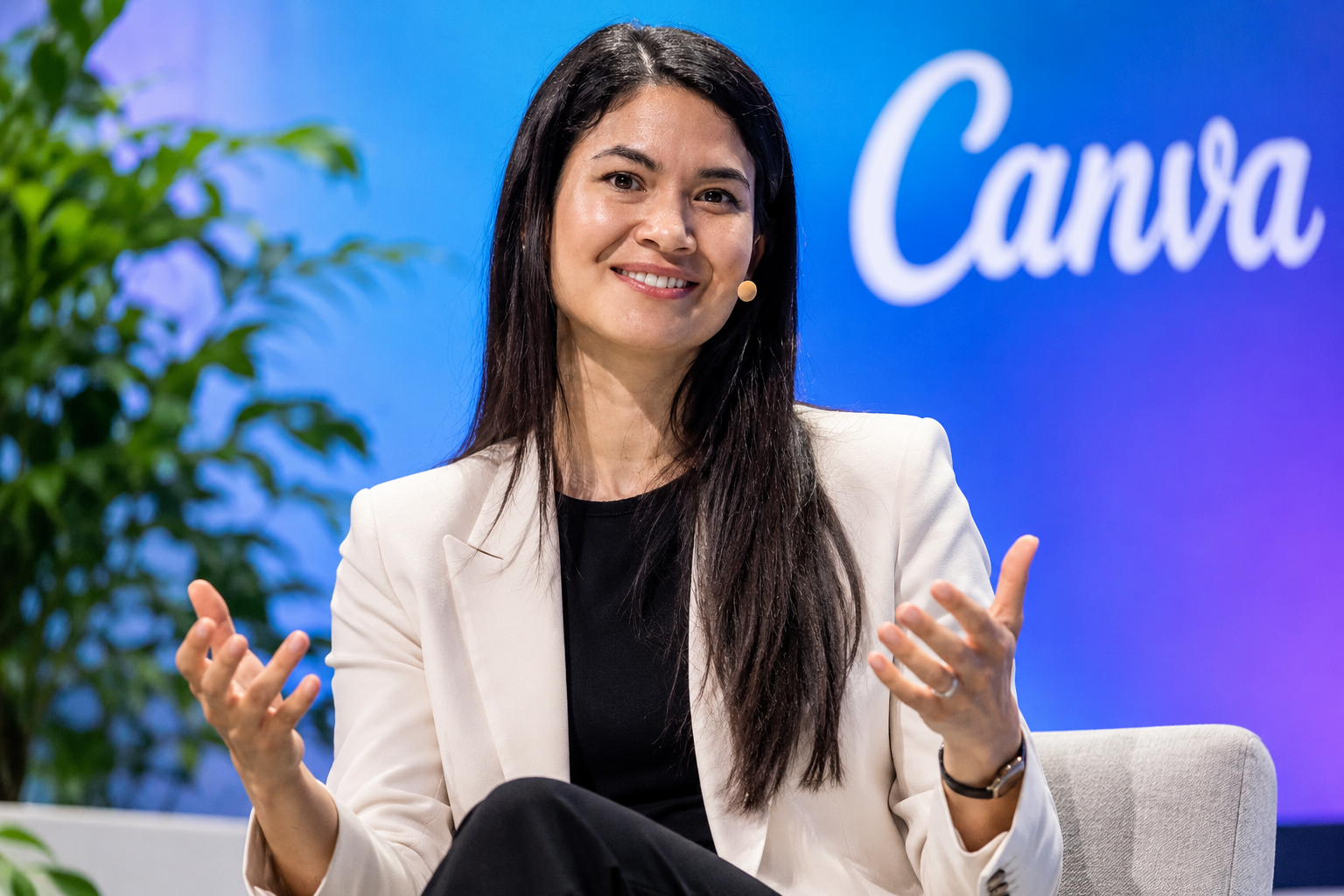
For thirteen years Canva has sold users one idea, that making something should take fewer steps. In a memo published on its newsroom on 3 November 2026, co-founder and CEO Melanie Perkins described the opposite problem inside the company. Improving one part of the product, she wrote, often meant navigating between three groups, Product, Growth and Platform, with “more handovers and coordination than necessary.”
Her answer is to put the three into one Product Org, fold narrow specialisms into broader roles, remove layers of management and make Sydney the primary home for more product teams. The restructuring affects 1,271 people, or 22% of Canva. The company says that figure includes people whose roles change, people asked to relocate and people leaving, and it has not said how many fall into each group.
The decision rests on a clear belief that Canva slowed down because of how it was organized. The evidence supports part of that belief. It also points to pressures no organization chart can remove, among them the cost of serving AI features to a very large user base and a market where other AI tools can now do some of what customers once opened Canva to do. That gap is the real subject here. Either Perkins has found the bottleneck, or she is using organizational design to answer a wider technological and economic problem.
A simple product inside a more complicated company
Canva ended 2025 with more than 265 million monthly active users, over 31 million paying users and $4 billion in annual recurring revenue, according to figures co-founder Cliff Obrecht gave TechCrunch in February. In the same interview he described the direction plainly, saying Canva was becoming “an AI platform with a bunch of design tools.” In April the company launched Canva AI 2.0, a rebuild of the platform around conversational design.
The organization that has to deliver this is far bigger than the one Canva described a few years ago. In March 2023 Fortune reported that Canva had about 3,500 employees and that its global head of people, Jennie Rogerson, had said the company had no plans to lay anyone off. She credited a mantra introduced in January 2022, “Fewer Things Well,” which meant fewer goals, fewer meetings and fewer hires. AAP now puts headcount at about 5,700 across 37 countries. A workforce that grew by roughly 60% in under four years, while the product widened into a platform, is the kind of company where narrow ownership and layered coordination pile up.
Perkins concedes the point. Her memo says Canva tried many ways over the years to fix the handover problem before concluding that the underlying structure had to change, which frames the reset less as a sudden break than as the end of a long attempt to repair the old design.
What Perkins decided
The memo sets out three changes. The first is the merger of Product, Growth and Platform. The second reduces subspecialisation, so that narrower specialties become part of broader roles and teams own goals from start to finish, while layers are simplified and overlapping responsibilities consolidated. The third brings closely connected teams together. Sydney becomes the primary home for more product teams and for some roles in other specialties, and from January most hybrid employees are expected in an office two to three days a week, depending on location.
Perkins also described the order of her thinking. Canva began with its mission and future goals, then looked at the structures, skills and locations needed to reach them, and only afterwards at what that meant for individual roles. Outsiders cannot test that sequence, because Canva has not published how many of the 1,271 people are leaving. It is still a fair standard to hold the company to. If structure came first and headcount second, the eventual breakdown should show it.
Departing employees receive at least six months' salary including statutory entitlements, 12 months of healthcare where Canva provides it, career support, and the chance to register interest by 14 December for a US$10,000 Canva Collective Fund grant, with Canva taking no equity. The package drew public praise, but it does not answer the business question of what the reorganization is supposed to fix.
What the memo leaves out
The memo points to new technology and says growth has slowed for the first time in a decade. It does not name AI, and it does not cite financial pressure. Reporting fills in the rest.
In August, Fortune reported that Canva had cut its expected 2026 revenue growth from 30% to 20%. That is slower growth, not shrinking revenue, and Canva remains a very large business. Perkins told Fortune that demand for new AI features had “significantly exceeded” the company's expectations. The trouble was cost. Every AI task carries a compute bill, and Canva slowed the rollout while it rebuilt its architecture and reduced unit costs, rather than release products before the economics worked. Obrecht has said that creating a design once cost Canva essentially nothing. A PitchBook analyst told Fortune that AI is eroding the near-zero marginal cost that made software so profitable, and pointed to Figma, whose free-cash-flow margin fell to 14% from 27% in a single quarter.
Perkins says cost per task has fallen by nearly 90% since Canva AI 2.0 launched in April. That figure is Canva's own, and it describes unit cost. Users also created three times as many designs as with the previous version. What Canva has not disclosed is the combined effect on total AI spending. Lower costs per task and rising usage pull in opposite directions, so the overall economics are hard to judge from the figures available.
Investors reacted. Blackbird and AirTree marked their Canva holdings at US$34.9 billion in August, 17% below the US$42 billion of the 2025 employee share sale. T. Rowe Price's filings implied a value of about US$30.4 billion at the end of that month. These are investor marks, not transactions, but they suggest that people close to the numbers saw more than a coordination problem.
Competition is the third pressure. Fortune's analysis described a double hit, the cost of the AI features users now expect and users' ability to produce visuals with other AI tools instead. An adviser quoted by AAP called AI an existential threat to Canva's core model, while Blackbird, its largest venture backer, said it remained optimistic.
The concern about speed is nonetheless real, and it came from the top. Capital Brief reported that Obrecht compared Canva's pace of product development with that of Anthropic and warned that the company had to move faster to stay competitive. A leadership team that believes rivals ship at a different tempo will look hard at handoffs.
The cost problem sits outside the org chart
Canva's most direct answer to AI economics so far has been technical. In October it released Craft, its first image foundation model. Forbes Australia reported that Canva's 160-person research team built it from scratch in about six months, and that it ranked fourth on the DesignArena benchmark at the time, behind three OpenAI models. That is a snapshot, not a verdict. Obrecht's reasoning was about volume. Canva's AI tools have been used more than 38 billion times, and at that scale a fraction of a cent saved on each generation adds up.
On 29 October Canva announced Brush, a vision-language model built to edit designs rather than generate them. The company says that in its own testing Brush is up to 69% faster on general editing tasks and 46% cheaper per edit task than its previous design agent. Those figures compare Brush with an earlier Canva system, not with outside models, and “up to” describes a ceiling rather than an average.
Neither release shows that Canva has solved its AI economics. They show where much of the cost work is happening, in model choice and architecture, which a merged product organization does not decide simply by existing.
One reading connects the two. In an AI product, cost is a product decision. How many free generations a user gets, which model handles which request, how pricing is tiered and what the architecture can sustain all touch Growth, Platform and Product at once, and under the old structure those choices crossed three groups. Bringing them under one roof may be a precondition for managing AI economics well, even if it is not the cure. That is analysis, not something Canva has said, but it describes the strongest version of the case for the reset.
Trade-offs inside the new design
Broader roles cut handoffs and give people ownership of whole problems. They also ask individuals to cover more ground, and the specialist depth that Perkins's own memo credits as valuable can thin out. That matters at a moment when Canva is building its own models.
Fewer layers shorten the path between a decision and the team that acts on it. They also remove the people who coach, coordinate and remember why earlier choices were made. The gain shows up quickly on a diagram, while the loss shows up slowly in the work.
A single Product Org removes the boundaries between functions, and it can also become a single queue. Unless decision rights are explicit, the bottleneck moves rather than disappears.
Sydney is where Canva began, and gathering connected teams there offers a shared context that distance makes hard to build. It also asks people across 37 countries to relocate or leave, even as Canva says it will keep investing globally where proximity to customers matters. Where the company draws that line will decide which talent it keeps.
People, promises and accountability
In 2023 Canva's people leaders presented avoiding layoffs as both a point of pride and a strategy built on internal mobility. That was the company's publicly described approach at the time, not a binding promise, and conditions have changed. The contrast is still part of what employees are weighing. Canva had made smaller cuts before November, including most of its technical writers in 2025 and some finance staff earlier this year, so this is its first company-wide restructuring rather than its first job losses.
Professionals Australia pressed Canva to be honest about the role AI plays in job losses. A spokesperson told AAP that AI is shaping the products Canva builds, but that the changes are not about using AI to do the work of people who are leaving. The union still welcomed the exit entitlements. In a year when other Australian technology employers, including Atlassian and WiseTech, tied cuts to AI, the distinction Canva draws will be judged by what it hires for next.
According to Forbes Australia, which reported from a transcript it had seen, an employee asked at the 10 November all-hands whether the founders were the right people to lead the reset. Obrecht said they ask themselves that question regularly and would “happily stand aside” if the answer were no. Board member Bob Iger backed the leadership while urging resolve and empathy. Canva has not published a transcript, so the account rests on Forbes Australia's reporting. A founder inviting that test is notable. It also sets a standard that the evidence will have to meet.
How Canva will know whether it worked
Canva has not published any measure of product speed, so the first test is whether it will. Useful evidence includes how quickly AI features now ship across the old team boundaries, and whether Canva AI 2.0 scales without another delay. Cost per task matters alongside total AI cost as a share of revenue, since the first can fall while the second rises. So do growth against the 20% outlook, paid conversion, business customers and whether Craft and Brush hold up under independent testing. Attrition and hiring after the relocations and the January office rule will show how much expertise the company kept. The next investor valuation marks will show how outsiders read the progress.
What the decision is really betting on
Perkins is betting that Canva's constraint was the shape of its organization, and that a flatter structure with broader ownership will let it ship AI products that customers keep using at a cost the business can carry. Parts of that bet are well supported. Handoffs are expensive, and AI turns cost into a problem that spans functions.
The weaker part is the assumption that speed is the binding constraint. If the larger threat is that general-purpose AI tools absorb the tasks Canva exists for, a faster Canva still needs something customers cannot get elsewhere. Canva's technical strategy, training Craft on millions of human-made design templates and hoping other companies will build the model into their own platforms, suggests it knows this.
For other leaders, the lesson is to pull apart three questions that restructurings tend to bundle. Where do decisions stall? What do the unit economics allow? What will customers keep paying for? A reorganization answers only the first. The sequence Perkins described, goals before structure before roles, is a useful discipline only if the results can be checked afterwards, which means publishing measures that can show the plan failing as well as working.
The outcome is not yet knowable. It will come from product speed, AI unit economics, customer adoption and whether Canva keeps the people who can build what comes next.