Why Jaguar Phased Out Its Old Model Range Before Its Electric Replacement Was Ready
Jaguar ended its old model range before the Type 01 existed, betting that a clean break was the only route to a profitable brand. The £130,000 electric GT now has to prove the gap was worth it.
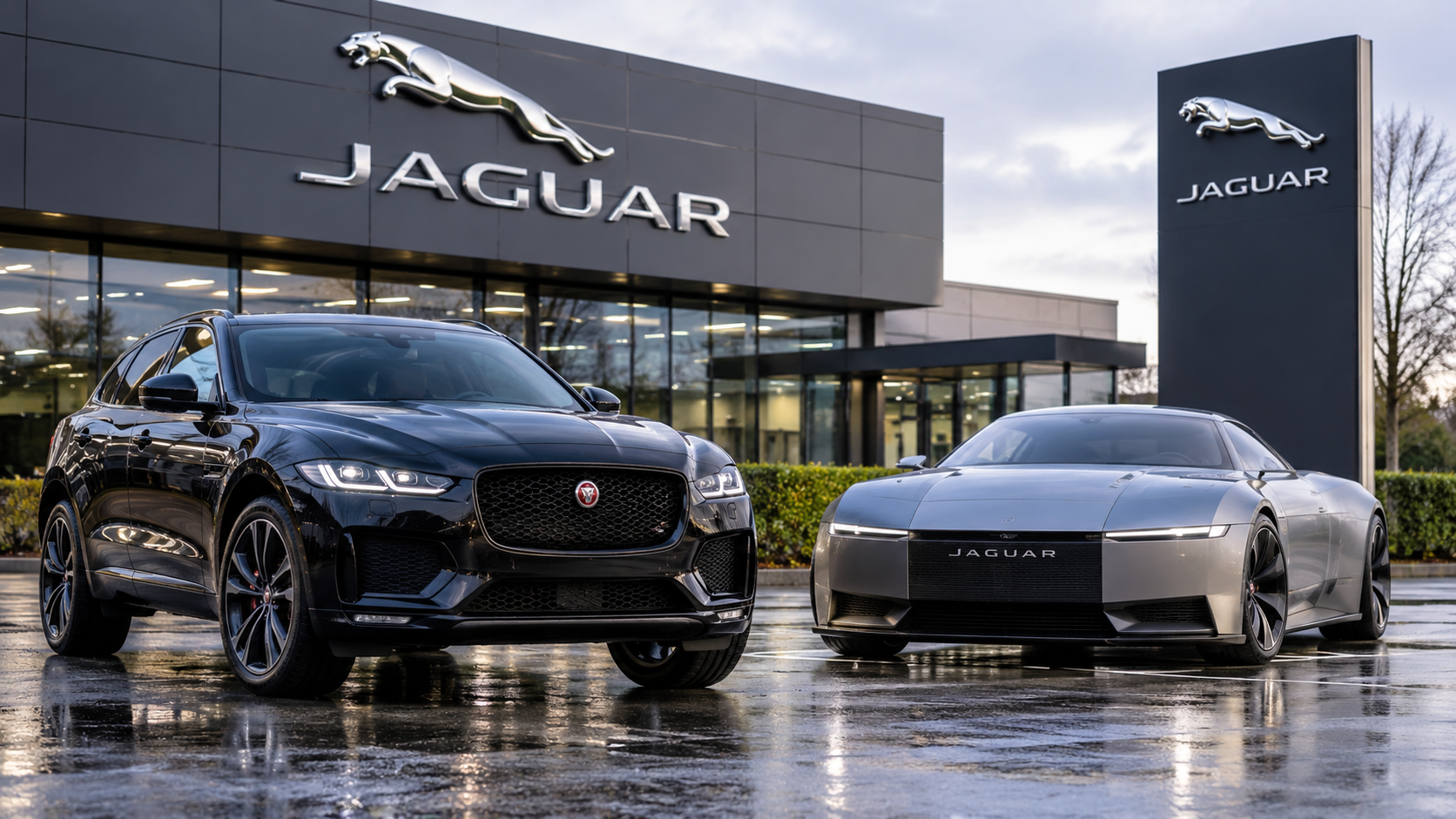
The last Jaguar F-Pace rolled off the line at Solihull on 19 December 2025. It was not destined for a showroom. With it, production of Jaguar’s outgoing internal-combustion range came to an end, closing an era that began with the SS Jaguar in 1935. As Robb Report noted at the time, citing Autocar, the brand was no longer building a car for sale anywhere in the world.
Less than ten months later, on 6 October 2026, Jaguar unveiled its next-generation car in New York. The Type 01, an electric four-door grand tourer priced from £130,000, opens for orders in early 2027, with first client deliveries expected in the second half of that year. In the UK, Jaguar had stopped allocating its existing model range to retailers in November 2024. The gap before customers receive the new car will therefore have lasted years, not months.
Carmakers rarely make this kind of break. They usually run old models down while replacements are being developed, because empty showrooms cost money and customers can drift to rivals. Jaguar chose a different sequence: phase out the old range first, then introduce a new identity and product. The decision raises a difficult business question. Was the old model range so unprofitable that stopping it was worth the risk of having little new to sell?
Why Jaguar Phased Out Its Old Range
The short answer, from the people who made the call, is that the old business was not working.
Rawdon Glover, Jaguar’s managing director, told Motor1 that the brand’s model had stopped being profitable, had stopped growing and relied on an ageing customer base while losing cultural relevance. Speaking to Top Gear, he said Jaguar “didn’t work commercially” in the volume-premium space dominated by BMW, Mercedes-Benz and Audi. Those are management’s own assessments. The claim about the age of its customer base, in particular, has not been accompanied by public demographic data that would allow it to be independently tested.
The sales figures show the scale of the challenge. According to JLR’s annual report, as reported by B&T, Jaguar sold 66,866 vehicles in the year to March 2024. Fortune noted that Land Rover’s Defender alone sold about 115,000 in that same period. Auto Express put Jaguar’s record year, 2018, at around 181,000 cars. Over roughly six years, Jaguar’s annual volume had fallen by more than half. A single model from its sister brand was outselling Jaguar’s entire range.
Adrian Mardell, then JLR’s chief executive, had been equally direct before the shutdown. None of the Jaguar models on sale, he said, made the company any money, which was why they were being replaced with new vehicles on new architectures. Glover supplied the strategic logic: JLR’s business model worked better at the high end, where distinctive products could support higher prices. Simply updating the existing cars would not have been enough. Jaguar needed a clean break, he said, and that meant stopping the old programmes and starting again.
Put plainly, Jaguar was choosing between continuing to sell cars that management said were unprofitable and selling very few new cars while it built replacements it hoped would be profitable.
What Jaguar Switched Off, and When
The decision was not a single announcement, and it is often described incorrectly.
The strategy dates to 2021, when JLR announced its Reimagine plan under then-chief executive Thierry Bolloré. The plan said Jaguar would become an all-electric luxury brand from 2025. That timetable was missed. Jaguar unveiled the Type 01, the first model of its new generation, in October 2026, with orders opening in early 2027 and first deliveries expected in the second half of that year.
In November 2024, Jaguar stopped allocating its existing models to UK retailers. That did not mean the brand had disappeared worldwide. The F-Pace remained on sale in markets such as the United States, Australia and China until production ended, according to reporting by Tyrepress. Autocar noted that the XE, XF and F-Type had already left the Castle Bromwich production line earlier, while the E-Pace and I-Pace, built in Graz, Austria, were due to follow by the end of 2024.
So the answer to “did Jaguar stop selling cars in November 2024?” depends on the market. The UK retail wind-down began that month, but the F-Pace continued to be sold in other markets. Production of the outgoing range was phased out across 2024 and 2025, with the final F-Pace leaving Solihull in December 2025.
The effect on volume was severe. Autocar reported that the gradual “sun-setting” of the old range pushed Jaguar’s global sales to about 33,000 cars in 2024. Some of that decline reflected the brand’s underlying commercial problems; some was the direct result of removing products from sale. Motor1 made the second point clearly: when a company withdraws nearly its entire line-up, sales will fall regardless of what buyers think about the brand. A falling sales line during the transition, in other words, cannot by itself be treated as a verdict on the new strategy.
The Price of a Clean Break
Jaguar paid for the reset in three ways, and the company was unusually open about the biggest one.
The first was its existing customers. Auto Express reported in March 2025 that the new line-up’s expected pricing of £110,000 to £130,000 would exclude about 85 per cent of current Jaguar customers. Motor1 later reported Glover’s estimate that only a minority of existing buyers would return. The distinction matters: the figure describes the customers likely to be priced out of the new range, not a measured count of owners who have already rejected the brand.
Jaguar’s plan was to attract a different group of buyers while retaining as many existing owners as possible. Some high-end F-Type and SVR drivers might be willing to move up to the new cars, but the company would also need customers who had never owned a Jaguar. That is a significant change in the economics of the brand. It is not enough to persuade people that the new design is distinctive; Jaguar must persuade them that the product and ownership experience justify a much higher price.
The second cost was revenue. A brand with no new product has little to sell, and Jaguar’s retailers had fewer cars to put in showrooms. Auto Express reported that the new retail network would be about a quarter the size of the old one. What made the transition more survivable was the rest of JLR. Land Rover carries much of the group’s business, and the Defender’s sales alone were larger than Jaguar’s entire range. JLR’s wider portfolio therefore gave Jaguar room to rebuild without the whole company depending on the brand’s short-term sales.
That cushion is not available to every business. A single-brand manufacturer attempting the same strategy would have to fund the product gap from its own cash flow or find another source of support. Jaguar’s decision was risky, but it was made inside a group with other established brands and revenue streams.
The third cost was reputation, and Jaguar made that part of the transition more difficult than it needed to be. On 19 November 2024, the company launched its “Copy Nothing” identity with a film featuring bright clothing, bold slogans and no car. Fortune described the response as a rebrand that had backfired and was being widely mocked. Glover defended the campaign as a deliberate break from conventional automotive advertising, one that was always likely to attract debate. Jaguar showed the Type 00 concept at Miami Art Week the following month.
The campaign generated attention, but attention is not the same as demand. A bold identity can help a brand stand apart, yet it also raises expectations for the product that follows. When there is no new car available to buy, the company has to wait for the product to turn curiosity into confidence. A loud launch without a car to sell spends reputation that the eventual product must earn back.
A Bad Stretch for Reasons Beyond the Strategy
Jaguar made this transition while its parent company was dealing with other shocks, making the financial record harder to interpret.
A cyber incident shut JLR’s UK factories for about five weeks from 1 September 2025. In the quarter to September, JLR reported a loss before tax and exceptional items of £485 million. That figure is sometimes mistaken for the cost of the cyberattack. It is not. JLR booked cyber-related costs of £196 million separately as exceptional items. Its results statement also pointed to US tariffs and the planned wind-down of legacy Jaguar models as pressures on revenue, which fell 24 per cent.
For the full year to March 2026, JLR’s revenue fell 20.9 per cent to £22.9 billion. Profit before tax and exceptional items dropped from £2.5 billion to £14 million, while the group recorded a loss after tax of £244 million and negative free cash flow of £2.2 billion. JLR identified the cyber incident, US tariffs, competition in China and the Jaguar wind-down among the pressures on its performance.
In September 2026, the company opened a voluntary redundancy programme. JLR said it was targeting a reduction of around 4,000 roles across its global workforce over two years. The programme sits within a wider Enterprise Missions plan, which targets £1.7 billion in savings over the same period and aims to reduce break-even volume towards 300,000 vehicles. These are group-wide targets, not savings attributed solely to Jaguar. By 13 November, JLR said about 3,000 employees had signed up to leave during the remainder of the financial year, with most expected to depart by the end of November.
A caution is essential. These are JLR group figures. They show the financial pressure surrounding Jaguar’s transition, but they cannot isolate what the Jaguar product gap alone cost. The cyber incident, tariffs, market conditions in China and other business decisions all affected the results. Anyone who attributes the group’s profit collapse or workforce reductions solely to Jaguar’s strategy is claiming more than the evidence supports.
What the Type 01 Evidence Shows So Far
JLR’s launch announcement describes a car built in the UK on a new Jaguar Electric Architecture. The Type 01 has an 850-volt electrical system, a 118kWh usable battery and a manufacturer-estimated EPA range of up to 400 miles. JLR says it can add 200 miles of range in as little as 13 minutes using a 350kW charger. The company also quotes output of up to 1,030PS and a UK starting price of £130,000. These are manufacturer figures and estimates; real-world range and charging times will depend on conditions and use.
Interest looks healthy at first glance. Jaguar says more than 50,000 people registered interest before orders opened, and Motor1 reported the company’s claim that about 80 per cent of them were new to the brand. These are “Keep Me Informed” registrations: people who asked to receive updates. They are not deposits, confirmed buyers or orders. The step from registering interest to signing a contract for a £130,000 car is where the commercial test begins.
The latest financial results, published on 13 November 2026, show a business that has returned to a small pre-exceptional profit but remains under pressure. JLR revenue for the quarter to September rose 20.3 per cent to £5.9 billion, although the comparison was against the same quarter a year earlier, when the cyber incident had severely disrupted production. Across the first half, revenue was up 3.2 per cent to £11.9 billion. Profit before tax and exceptional items was £6 million for the quarter and £115 million for the half. Exceptional items of £530 million reflected restructuring activities, including separation costs and asset write-downs. Free cash flow was an outflow of £540 million, closing cash was £1.8 billion and total liquidity was £6 billion.
JLR also revised its full-year guidance to an adjusted EBIT margin of 2 to 3 per cent and free cash outflow of about £1.25 billion. The results underline why the group needs its new products to perform, but they do not tell us whether the Jaguar Type 01 itself will make money.
The evidence therefore supports a narrow conclusion. Jaguar has shown the car, announced a price, set an order timetable and attracted a substantial number of people who want updates. It does not yet have customer orders, deliveries or demonstrated margins for the new model.
What Jaguar Is Really Betting On
Strip away the design debate and the decision rests on three assumptions.
The first is that a smaller, higher-priced customer base can be more valuable than the old volume business. PistonHeads reported that Glover sees the Type 01 as a car designed to shock and impress, with later models on the same architecture expected to reach a wider group of buyers. Motor1 has reported that a future model could be an SUV. If the first car establishes the brand’s credibility and later products bring in more customers, Jaguar may be able to build a viable business at lower volumes. But that remains a plan, not a proven outcome.
The second assumption is that being electric-only will be an advantage rather than a constraint. Jaguar has committed to an exclusively electric future, leaving the brand without a combustion or hybrid alternative if demand for expensive electric vehicles softens. JLR has flexibility across its wider portfolio, but Jaguar itself has chosen a narrower path. That may help create a clear identity, but it also makes the brand more exposed to the pace of EV adoption among its target customers.
The third assumption is that the group can fund the wait. JLR has returned to positive profit before exceptional items, but the latest results still show a thin margin, significant restructuring costs and negative free cash flow. The business must continue investing in new products while managing tariffs, competition and changing demand across major markets. The longer Jaguar takes to convert interest into orders and deliveries, the more pressure the group faces to sustain the transition.
There are credible doubts. The Drum’s coverage of the launch questioned whether even a well-executed car could compete in this market. The Type 01’s distinctive design may help it stand out as a high-end product, or it may narrow the pool of buyers willing to sign. The original 2025 target for Jaguar to become an all-electric brand also slipped, showing how difficult it has been to deliver the transition on the timetable first announced.
What Other Executives Can Take From It
Jaguar’s experience offers four lessons, none of them comfortable.
A clean break becomes harder to justify when the replacement misses its timetable. Ending an old product range can make strategic sense when the existing business is unprofitable, but a delay leaves the company exposed to lost revenue, weaker retailer activity and customers who may move elsewhere. The replacement needs to arrive close enough to the original plan for the business to sustain the gap.
Interest is not demand. Fifty thousand registrations are a useful signal, but a poor substitute for orders. Companies that announce expressions of interest without showing how many people are willing to pay the asking price invite scrutiny. The meaningful measures will be deposits, signed orders, deliveries and the prices customers actually pay.
Leaders also need to look at the right level of the accounts. JLR’s group results combine the effects of a cyberattack, tariffs, market conditions in China, restructuring and the Jaguar wind-down. Those numbers matter, but they cannot by themselves establish whether the Jaguar strategy is working. A company must distinguish the costs of a strategic transition from unrelated shocks if it wants to judge the decision honestly.
Finally, say the cost out loud. Glover’s willingness to acknowledge that the new pricing could exclude most existing Jaguar customers made the risk visible. It also made the strategy easier to judge. The company has not hidden the fact that it is seeking a different buyer, but it now has to demonstrate that enough of those buyers exist.
None of this settles the outcome. Orders open in early 2027, and the first cars are expected to reach customers in the second half of the year. The decision will look sound if enough people pay the asking price for the new Jaguar. It will look sounder still if JLR turns a brand that management said was losing money into one that earns it at a fraction of its former volume. That will require more than attention or registrations: it will require profitable orders, reliable deliveries and customers who believe the new Jaguar is worth the price.
Until those results arrive, Jaguar has paid a heavy price for a promise.