Why Samsung Discontinued the Galaxy Note7 After Its Replacement Phones Caught Fire
Samsung's first recall treated a battery defect as a supply problem. When the replacements failed too, the company had to decide whether a flagship was still worth saving. Here is what it knew, what it decided and what it cost.
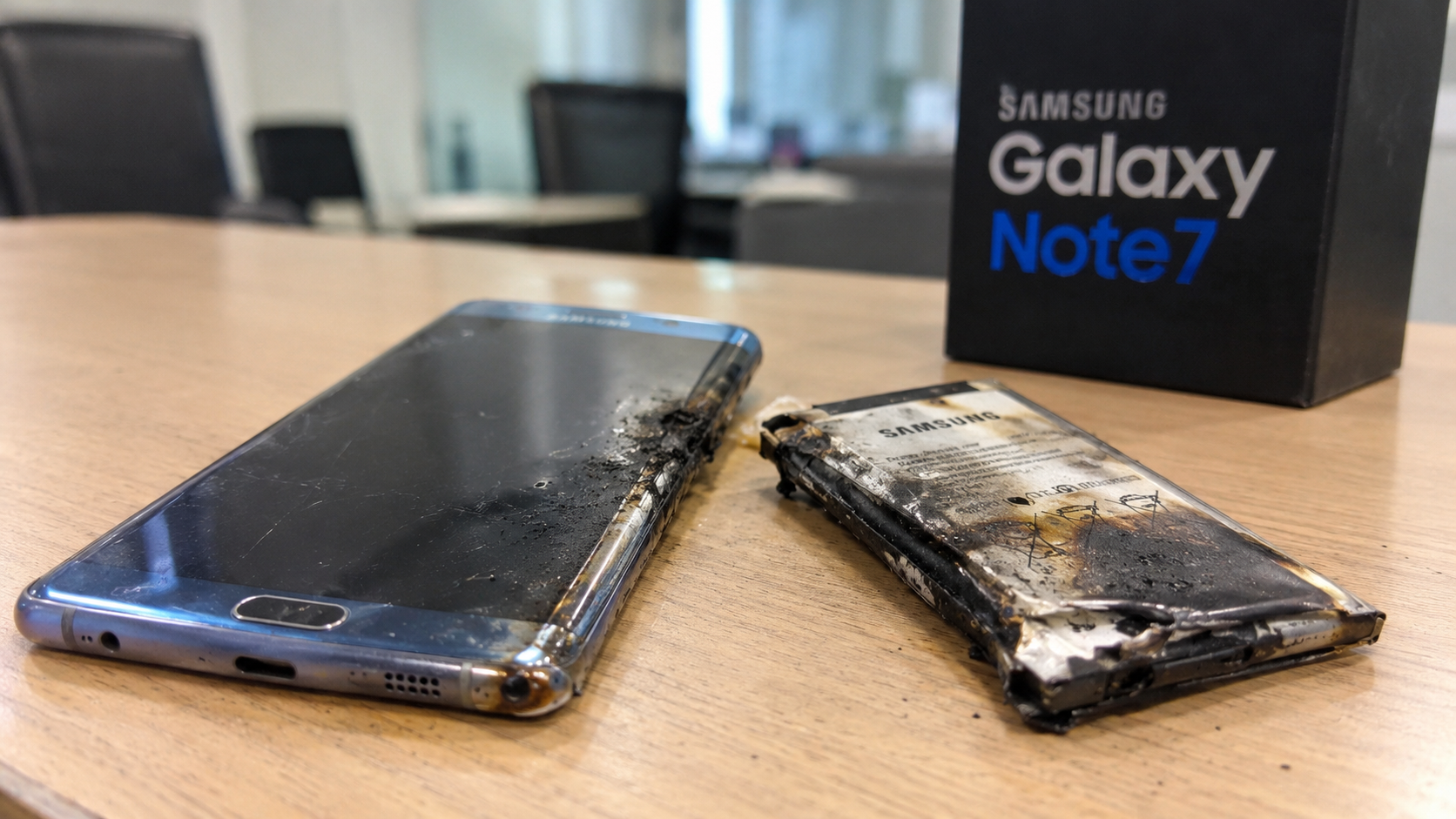
Shortly after 9 a.m. on October 5, 2016, a Southwest Airlines flight was sitting at its gate in Louisville, Kentucky, bound for Baltimore, when smoke began pouring from a passenger's pocket. All 81 passengers and the crew on Flight 994 got off. No one was hurt.
The phone was a Samsung Galaxy Note7. Its owner, Brian Green, told reporters it was a replacement, issued by Samsung to swap out the original, recalled model.
That detail changed the story. A defective phone is a product problem. A defective replacement means the fix itself can't be trusted. Six days later, Samsung ended production of its most advanced smartphone, less than two months after it went on sale.
The Galaxy Note7 discontinuation is usually told as a story about exploding batteries. The more useful version is about the distance between replacing something that failed and proving the replacement works. Samsung closed the first within weeks. It took until October to learn it had not closed the second.
What did Samsung know when it announced the first recall?
The Note7 went on sale on August 19, 2016, after a launch event in New York on August 2. Bloomberg reported that management moved the launch forward to get ahead of Apple's iPhone 7. Whether schedule pressure played a part has never been established. Samsung's own findings put the cause in battery design and manufacturing.
On September 2, mobile chief D.J. Koh told reporters in Seoul that Samsung would halt sales in 10 markets and replace phones already sold, an estimated 2.5 million devices in the hands of customers and carriers. The company said it had confirmed 35 cases worldwide as of September 1. It traced the problem to a battery cell from one of its two suppliers, without saying which. Phones sold in China, it said, used another supplier's cells.
The Wall Street Journal later reconstructed how that call was made, citing people familiar with the discussions. Scans of faulty devices showed an anomaly in batteries made by Samsung SDI, a Samsung affiliate, but not in cells from the other supplier. It was not a definitive answer, and the Journal reported that nothing explained the bulges. Koh, who ran the mobile business, thought the evidence was enough to act, and, according to the Journal, Samsung vice chairman Lee Jae-yong favored a fast recall.
A word on who decided. Samsung Electronics had three co-CEOs in 2016: Kwon Oh-hyun, Yoon Boo-keun and Shin Jong-kyun. Koh ran the mobile business. The picture of Koh and Lee at the center comes from unnamed sources.
The cost of moving fast showed up quickly. The Journal reported that Samsung moved ahead of U.S. regulators, and Stuart Statler, a former commissioner of the Consumer Product Safety Commission, told the paper the company should have engaged them early. On September 9, the CPSC told consumers to stop using their phones while it examined whether Samsung's replacement plan was an acceptable remedy. A formal U.S. recall followed on September 15, covering roughly one million phones sold before that date.
The first remedy rested on a plausible diagnosis, not a proven one. Samsung would later say as much. A spokeswoman told the Journal the company "did not correctly identify the issue the first time."
Why did the replacement Galaxy Note7 fail?
Samsung presented its findings on January 23, 2017. About 700 researchers and engineers had tested more than 200,000 phones and 30,000 batteries, and three outside organizations, UL, Exponent and TÜV Rheinland, ran their own analyses. The answer was not one defect but two.
The original battery, made by Samsung SDI, had a design flaw. Its pouch left too little room for the electrodes. In the upper right corner, the negative electrode could bend and touch the positive one, causing a short circuit.
Outside researchers found physical evidence pointing the same way. A University of Warwick team examined a Note7 cell with X-ray tomography and electron microscopy, and reported in the journal Batteries in 2018 cracked electrode material in tightly folded areas, a delaminated separator coating and an unusually thin separator.
The replacement battery, from a different manufacturer, failed in a different way. Samsung found welding defects around the positive electrode tab that could lead to an internal short, and some cells were missing insulation tape. EDN, citing a Recode interview, reported that Tim Baxter, head of Samsung's U.S. business, said the company believed the Note7 would still be on sale had it not been for the manufacturing problem on the second battery's production ramp.
That matters because of what it implies about the first recall. Samsung had initially believed SDI's batteries were solely at fault and steered owners toward phones using the other supplier's cells. Read together, the findings suggest the remedy moved demand onto a production line being scaled up in a hurry, and the defect that came with the scaling was not the one Samsung had been hunting. That reading is editorial analysis. The record does not show what proof of safety the replacements had to clear before they shipped.
Not everyone accepts Samsung's view that the phone's design was not to blame. UL's Sajeev Jesudas noted in January that higher energy density can make failures more severe, and the Associated Press reported that questions remained. The narrower reading is safer: the batteries failed in two ways, and the first diagnosis was right about one and silent about the other.
Why did Samsung discontinue the Galaxy Note7 instead of trying again?
By the first week of October the pattern was hard to ignore. After the Southwest evacuation, five replacement phones had been reported burning in the United States alone.
The carriers moved first. By October 9 and 10, major U.S. carriers had stopped exchanging Note7s. On October 10, Samsung asked partners worldwide to halt sales and exchanges and said it was temporarily adjusting production. On October 11, it told the Seoul stock exchange it was halting production and sales, citing consumer safety, and later confirmed the halt was permanent. Its shares closed about 8% lower.
The Journal reported that Lee and Koh made the call to discontinue the phone after carriers such as Verizon pressed Samsung to act. If that account is right, the decision looks less like a choice to abandon the product than an acknowledgment that the market already had.
Regulators confirmed the judgment within days. On October 13, the CPSC expanded the U.S. recall to about 1.9 million phones, including replacements, and reported 96 overheating cases in the United States, 23 of them new since the first recall. Chairman Elliot Kaye said the fire risk from both original and replacement phones was too great for anyone to take. On October 14, the Department of Transportation issued an emergency order banning the Note7 from U.S. flights, in carry-on bags, checked bags and cargo, effective at noon Eastern on October 15.
Why wasn't a third replacement a credible option? Three reasons stand out. The firmest is this: Samsung had no confirmed root cause. As late as October 23, the Journal reported that Samsung still did not know what had made the phones catch fire, and the full investigation would run until January. A third batch would have carried the same unanswered question.
Second, the people who had to accept the remedy had stopped accepting it. Carriers had paused exchanges, and regulators and airlines were involved.
Third, proving a third fix would have meant convincing customers, carriers, airlines and regulators at once, after being wrong twice. Days earlier, HI Investment Securities analyst Song Myung-sub had told Reuters the worst case was that U.S. regulators would judge the product fundamentally flawed and ban its sale. That was a prediction, not a fact, but it describes the exposure the company was weighing.
How much did the Note7 decision cost Samsung?
Samsung's own disclosures are the best guide, though they are forecasts as much as results. On October 7, it guided to third-quarter operating profit of 7.8 trillion won. On October 12, a day after halting production, it cut that to 5.2 trillion won, attributing the 2.6 trillion won difference to the decision. Two days later it estimated a further negative impact of about 3.5 trillion won across the fourth quarter of 2016 and the first quarter of 2017, mid-2 trillion for the fourth and roughly 1 trillion for the first. Reuters put the combined hit at about $5.3 billion.
That $5.3 billion is a forecast of lost operating profit, not a cash loss. It also excluded the cost of the first recall, which analysts estimated separately at 1 trillion to 2 trillion won. Bloomberg suggested the total could pass $6 billion.
When Samsung reported third-quarter results on October 27, group operating profit was 5.2 trillion won, down 30% from a year earlier. The mobile division earned 100 billion won, against 2.4 trillion won a year before. Samsung tied that weakness to the Note7, but its chip, display and consumer electronics businesses carried the group.
Analysts including Credit Suisse, cited by Reuters on October 11, estimated that ending the Note7 could mean lost sales of up to 19 million phones, or nearly $17 billion, over the product's life. That is projected revenue, not a loss on the books and not a fall in market value.
The harder comparison is with what continuing would have cost, and that number does not exist. It would have included injury liability, further regulatory action, flight restrictions reaching beyond one model, and damage to the Galaxy S7 range, which was selling well. The cost of stopping was visible and bounded. The cost of not stopping was neither.
What did Samsung change after the Note7?
The January 23 findings came with a new process. Samsung introduced an eight-point battery safety check: durability, visual inspection, X-ray, charge and discharge, total volatile organic compounds, disassembly, accelerated usage and a delta open-circuit voltage test. The disassembly test is the telling one. Samsung says it examines tab welding and insulation tape, the two things that went wrong in the replacement cells. The company also formed an outside battery advisory group with academics from Cambridge, UC Berkeley and Stanford.
The shift is worth noticing. The first response treated the problem as one supplier's defect. The second treated it as a gap in how Samsung verifies batteries it does not make itself, from components through assembly and shipment.
The recall itself was a large operation. Samsung had sold about 3.06 million Note7s worldwide. By mid-December it had recovered more than 2.7 million. In the United States, a software update disabled charging on remaining phones. Samsung said more than 96% had been returned worldwide by January 23, and the CPSC reported a 97% response rate in the United States.
The commercial recovery is real but should not be overread. Samsung regained the top spot in global smartphone shipments in the first quarter of 2017, with a 26.1% share according to TrendForce, up from 18.5% the quarter before, though the same report said brand confidence had not fully recovered. The Galaxy S8, launched on April 21, sold 5 million units in under a month, according to Yonhap.
Profit tells a more complicated story. Samsung's first-quarter 2017 operating profit rose 48% to 9.9 trillion won, but the mobile division's profit fell 47% to 2.07 trillion won. Memory chips did the heavy lifting. Surveys of trust pointed in different directions. A Reuters/Ipsos poll in November 2016 found 91% of current Samsung users likely to buy another Samsung phone. A Harris Poll fielded between late November and mid-December, and published in February 2017, dropped Samsung from seventh to 49th in its U.S. reputation ranking. That fall cannot be pinned on the Note7 alone, because the same weeks brought corruption allegations against Samsung's heir. Demand returned. Whether trust did is less clear.
What the Note7 teaches about corrective action
Three distinctions run through the story.
Fixing a defect is not validating a replacement. A recall announces a remedy. Only testing shows that the remedy works. Samsung's first remedy had a plausible cause and a schedule, and by its own account it had not identified the issue correctly. The gap cost a second recall and a dead product.
Speed is not free when evidence is partial. Samsung acted within two weeks of the first reports, and that left no room to be wrong. In a September video message, Baxter told customers the Note7 with the new battery was safe and the cell issue resolved. A month later that assurance was the thing regulators and carriers stopped believing.
Correcting the system is a different job from correcting the product. The eight-point check and the advisory group address how batteries are verified, not just which cells go into one phone. Other manufacturers can ask the same of their own supply chains: who validates a replacement part, and how a change of supplier is stress-tested.
The lesson has a limit. Samsung survived the Note7 because its other divisions were profitable enough to absorb it. A company without that cushion would have faced the same decision with far fewer options. Whether the Note7 was a design pushed too far or a manufacturing failure that a better ramp would have avoided is still debated. The sequence is not. A fix was announced, the fix failed, and the company stopped selling the product it had just tried to save.