Toyota Split the CEO Job in Two — And Both Halves Are Now Being Tested
Koji Sato wasn't simply replaced. Toyota concluded his expanding responsibilities required a different leadership structure — and rewrote what the top job means.
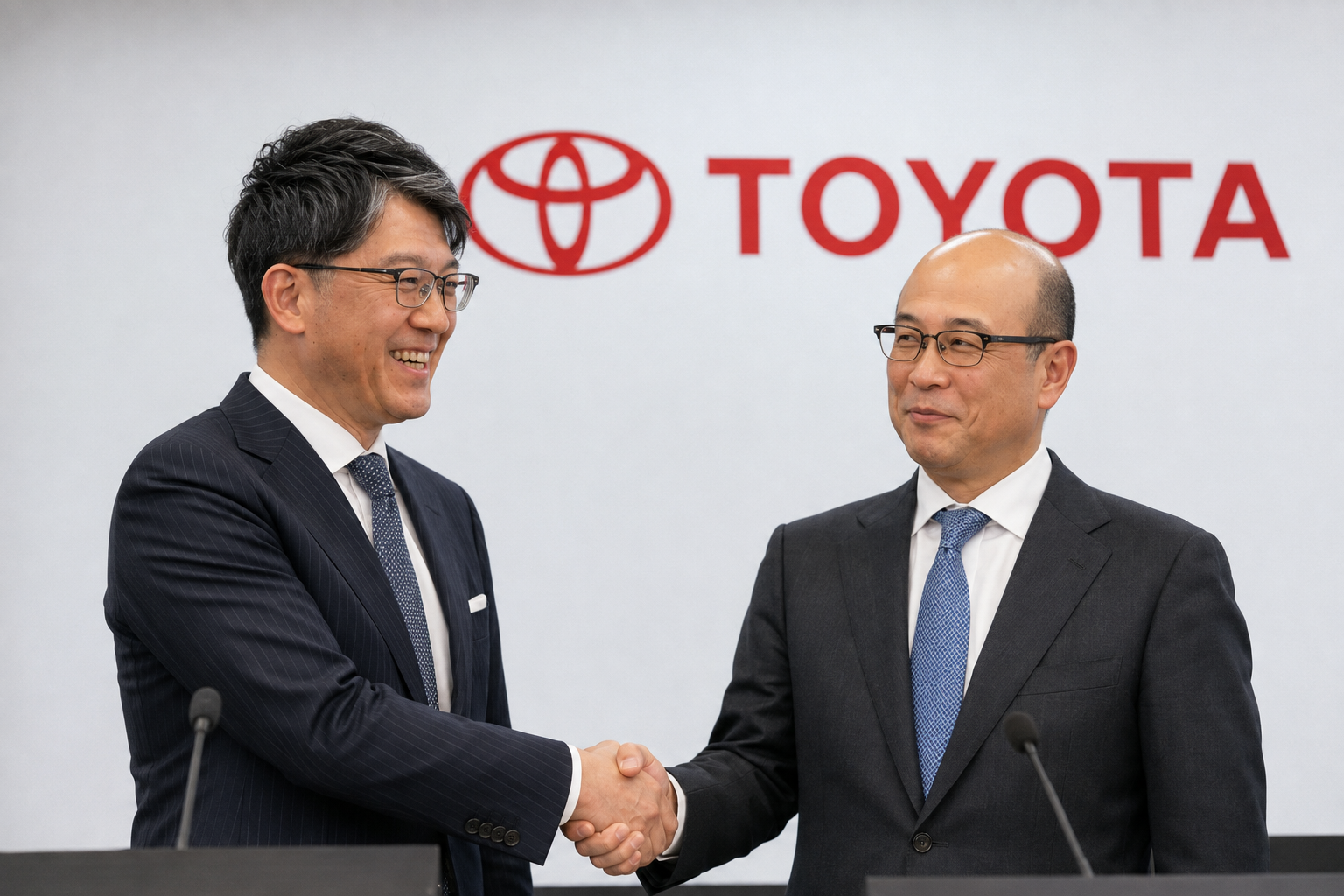
On February 6, 2026, Toyota Motor Corporation announced a leadership change that did not fit neatly into the usual pattern of CEO succession. It wasn't a firing. It wasn't a retirement. It wasn't even, in the conventional sense, a succession.
Koji Sato, who had been president and CEO for less than three years, was stepping into a newly invented title: vice chairman and chief industry officer. Kenta Kon, Toyota's chief financial officer, was becoming president and CEO. Both changes would take effect April 1.
Toyota's own explanation, released the same day, was almost clinical in its precision: Sato would "focus on the broader industry, including Toyota," while Kon would "focus on internal company management." The company said the goal was to speed up decision-making as the auto industry's internal and external environment kept shifting under it.
Read quickly, this looks like an ordinary reshuffle — a CEO moved upstairs, a CFO promoted. Using Toyota's own filings, its in-house Toyota Times interviews, and Kon's first international press interview in September, a more specific picture emerges: a company that concluded the job of "CEO" had quietly split into two increasingly demanding responsibilities, and decided to stop asking one person to carry both.
The Problem Wasn't Strategy. It Was Bandwidth.
Sato had been appointed CEO in April 2023, succeeding Akio Toyoda, with a mandate to push Toyota's transformation into what the company calls a "mobility company" — balancing hybrids, battery EVs, hydrogen, software and robotics all at once. Nothing in Toyota's public record suggests that strategy was abandoned or discredited. Toyota's multi-pathway approach to powertrains remained intact through 2026, and hybrid sales, in particular, kept setting records.
What changed was Sato's calendar. In May 2025, he was appointed vice chair of Keidanren, Japan's most powerful business lobby. In January 2026, he became chairman of the Japan Automobile Manufacturers Association (JAMA) — the body coordinating Japan's entire auto industry through a period of tariff shocks, EV competition from China, and structural upheaval. Both responsibilities added industry-wide work to Sato's existing responsibility for running Toyota.
Toyota's Executive Appointment Meeting — the internal body that reviews top personnel — reviewed the arithmetic. In a Toyota Times interview published four days after the announcement, Sato described what happened next in unusually candid terms: the meeting "pointed out that, objectively, in the current situation," he was "quite overloaded." He said the outside perspective let him step back and assess the situation more calmly.
Toyota has not publicly framed the change as a response to Sato failing in the role. What the public record does establish is narrower and, in its own way, more interesting: a formal internal review flagged an overlapping-workload problem, Sato himself confirmed it in his own words, and Toyota's response was structural rather than personal — redesigning the role instead of simply replacing the person in it.
Why Toyota Didn't Just Let Him Choose
The obvious alternative — have Sato pick one job and hand the other to someone else — turns out to have been harder than it sounds, and Sato's own account of his ambivalence is one of the more human moments in the record. He had come up through Toyota's "genba," its shop floor and engineering culture, first as chief engineer at Lexus and later running Gazoo Racing. He said part of him wanted to keep focusing on carmaking itself, calling it something worth dedicating a career to, even as he acknowledged the conflict that created.
There was also a strategic reason not to simply hand JAMA and Keidanren duties to Sato and walk away from the CEO question. Sato has said that if he led industry-wide coalition work while still carrying Toyota's presidential title, other automakers could reasonably see him as advancing Toyota's interests rather than the industry's. Stripping the CEO title while keeping him inside Toyota's top leadership — as vice chairman, and as the newly created chief industry officer — was Toyota's way of making him a more credible cross-company convener, not a lesser executive.
That single design choice is what separates this from an ordinary "kicked upstairs" story. The issue was less about Sato's status than about the credibility of an industry-wide coordination role.
Why Kon, Specifically
Kenta Kon's arrival at the top is easy to flatten into "Toyota picked a finance guy." That's true, but incomplete, and it undersells the more interesting parts of his record.
Kon joined Toyota in 1991 and built his career largely in the accounting organization, becoming CFO in 2020. He later moved to Woven by Toyota, the company's software and mobility unit, serving as its CFO — an experience Kon himself has said let him "see Toyota from a slight distance," which he called genuinely valuable. He returned to Toyota's group CFO role in July 2025, nine months before his promotion to CEO.
There's a more personal thread, too, one Toyota didn't put in its press release but that multiple independent outlets have confirmed: Kon served roughly eight years, from 2009 — when Toyoda became president — until 2017, as Akio Toyoda's personal secretary, a stretch that included the aftermath of the 2008–09 financial crisis, Toyota's recall crisis, and the 2011 earthquake and tsunami. The experience also gave Kon years of direct exposure to Toyoda's leadership and to Toyota's most consequential management challenges. He is not an outside hire brought in to impose discipline on a reluctant organization.
Kon's own framing of the job, offered at his introductory press conference, was disarmingly direct: "I'm a guy that loves numbers, I'm a guy that loves money." But he was equally clear that profit isn't the point of the exercise — it's the fuel for everything else. In the September 14 Automotive News interview, he put it plainly: Toyota needs to secure profit not as an end in itself, but to fund future investment.
An Unusually Fast Second Transition
There's a detail easy to lose in the headline story: this was Toyota's second CEO change in three years, in a company culture that has historically prized long, stable tenures at the top. Akio Toyoda ran Toyota for nearly fourteen years before handing the presidency to Sato in 2023. Sato lasted barely three.
The mechanics of the handover, though, point toward a considered structural change rather than an abrupt one. Sato remained inside Toyota's top leadership rather than exiting the company, and Kon's formal appointment as a board director was scheduled for Toyota's ordinary general shareholders' meeting in June — the normal governance channel for director appointments. Yoichi Miyazaki, an executive vice president who had previously held the CFO role before Kon's most recent return to it, stepped back into the position, preserving continuity in the finance function even as its former head moved into the top job.
The Numbers Behind the Decision
Toyota's operating margin fell from 11.9% in the fiscal year ended March 2024 to 10.0% the following year and 7.4% in the year ended March 2026 — a two-year slide — and the company's current FY2027 forecast implies a margin of about 6.3%, with U.S. tariffs, higher costs and other external pressures weighing on the outlook.
Kon has repeatedly zeroed in on one specific metric: breakeven volume, the number of vehicles Toyota must sell just to cover its costs. He told Kyodo News in August that the figure was "slightly high" and that he wanted to reverse the trend. It is a CFO's financial lens carried into the CEO role, and it helps explain the emphasis Kon has placed on earnings structure and breakeven volume since April.
The first hard evidence of that discipline in action arrived on August 4, 2026, when Toyota reported first-quarter results for fiscal 2027. Operating income came in at ¥1.0634 trillion, down 8.8% year-over-year — its fifth consecutive quarter of decline — weighed down by softer sales in China, disruption tied to the conflict in the Middle East, and tariff costs, even as revenue rose more than 10% on a weaker yen. Toyota was explicit that the improved outlook didn't yet account for a deadly earthquake that had just struck Japan's Kyushu island, forcing a halt at four domestic plants — a reminder that the earnings-power problem Kon inherited is being tested by exactly the kind of external shocks his framework is supposed to absorb.
Even so, the company simultaneously raised its full-year operating income forecast by ¥400 billion to ¥3.4 trillion, and announced a share buyback of up to ¥1 trillion — alongside a plan to retire 200 million shares, roughly 1.37% of its issued shares. The pairing was consistent with the financial-discipline approach Kon had been signaling since taking the job: acknowledge the pressure in the near-term numbers, and pair it with a concrete signal of confidence for shareholders.
What "Internal Management" Actually Looks Like
By September, Kon's cost campaign had a name and a target list that would have sounded almost trivial coming from anyone else: car seats, door handles, mirrors, headrests.
In his first international media interview, given to Automotive News on September 14, Kon explained that Toyota had let unnecessary complexity creep into its vehicles — multiple covering materials on a single seat, for instance — multiplying cost across millions of units and sprawling supplier networks. Where variation serves customers, he said, it stays. Where it doesn't, it's waste. Toyota is already working with supplier Toyota Boshoku on an initiative called RPT33 — Reduction in Part Types — targeting a one-third cut in part types; Toyota Boshoku says it has already cut headrest component variants by 76%. On the redesigned 2026 RAV4, Toyota says it trimmed door-handle variety by about a third and outer-mirror variety by half.
The examples show what "internal management" means in operational terms: reducing variation where customers don't benefit from it, while preserving the differences that matter to them.
Toyota Times has also documented Kon making regular front-line factory visits, a habit that echoes Sato's own emphasis on staying close to the genba.
What the Split Is Actually Betting On
None of this amounts to Toyota walking away from its technology bets. Kon has said the company's growth areas — full lineup electrification, hydrogen, AI, robotics, Woven City — remain in place; the argument is that they're sustainable only if the core business generates enough cash to fund them without strain. Meanwhile, Sato's side of the split is only beginning to be tested: his effectiveness as an industry coordinator, steering JAMA and Keidanren through tariff negotiations and a fragmenting EV landscape, will play out over years, not quarters, and there's no public scorecard for it yet.
Toyota has produced several early signals under Kon — a raised profit forecast, a buyback, and a visible parts-reduction program with supplier buy-in. None of that proves the underlying bet is correct. Breakeven volume is a multi-year metric; tariff policy and Chinese EV competition are both moving targets outside Toyota's control; and dividing responsibilities that had previously been concentrated in a single CEO role creates its own coordination risk, even if Toyota's structure — with both men still on the senior leadership team — is designed to minimize it.
The Lesson for Other Executives
Most CEO-transition stories reduce to a single question: was the new leader the right pick? This one poses a different question, and it's the more useful one for anyone running an organization: when a single role has quietly grown into two demanding, expanding jobs, is the fix a better person, or a better job description?
Toyota's answer, grounded in its own governance process rather than an activist investor's demand or a scandal, was the second. The company did not publicly frame the change as Sato failing at the job. Its documented rationale was structural: separate the industry-wide coordination role from Toyota's internal management, so both could get clearer focus. Toyota's Executive Appointment Meeting treated the overlap as a structural finding, not a personnel failure — and redesigned the architecture instead of simply replacing the person in it.
Whether that redesign holds up will be determined less by the February announcement than by what shows up in Toyota's margins, its breakeven volume, its execution on the ground, and Sato's industry-coordination outcomes over the next several fiscal years. Toyota did not present the 2026 leadership change as an abandonment of its strategy. Instead, it changed how responsibility for executing that strategy was divided — separating industry-wide coordination from the internal management of the company.