Kraft Heinz Hired Steve Cahillane as CEO. Six Weeks Later, the Board Paused the Split
Kraft Heinz announced a breakup in September 2025, brought in a new CEO in January and put the plan on hold in February. Seven months on, the company is spending more, earning less and still writing down its brands.
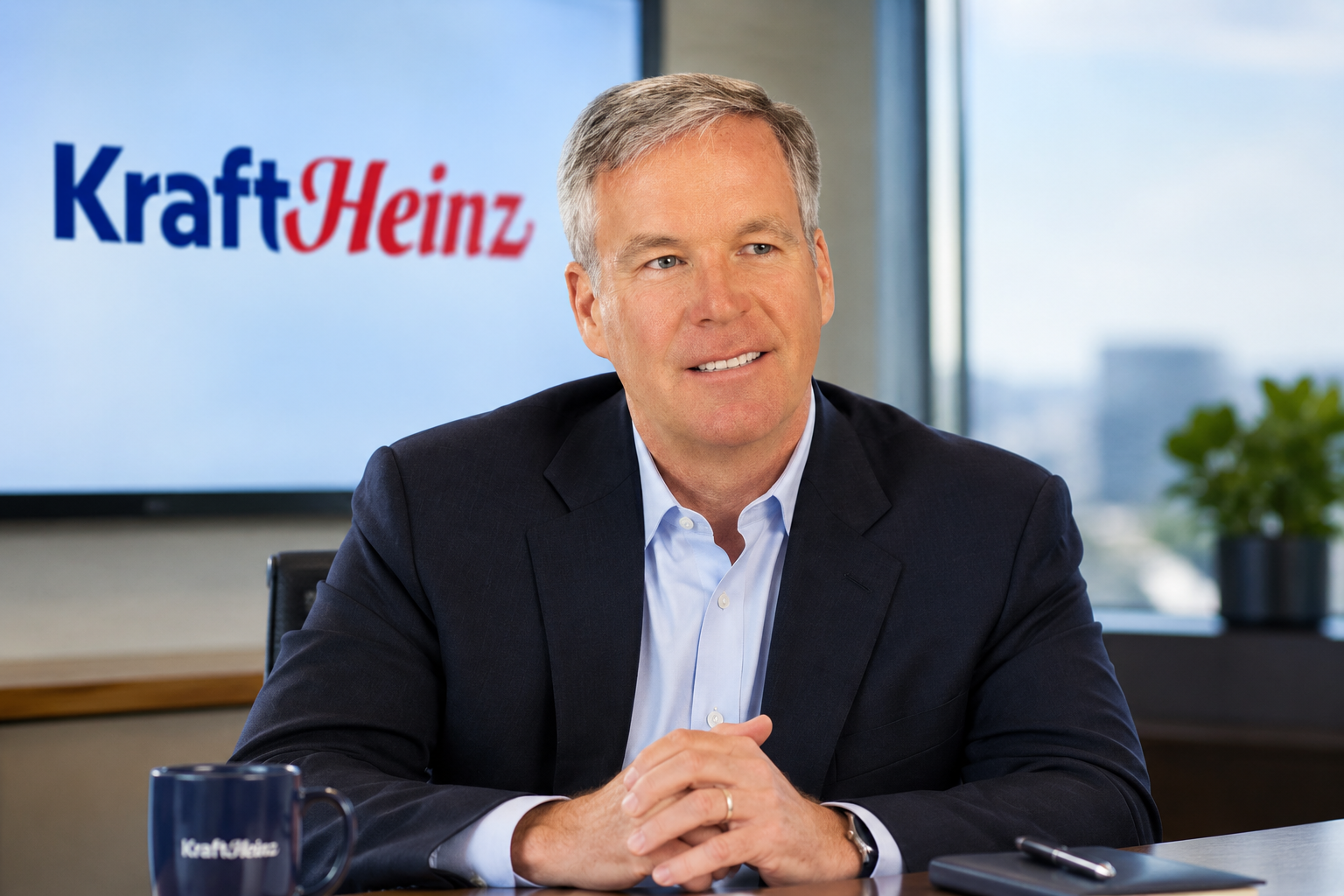
On February 11, 2026, Kraft Heinz reported its 2025 results and a change of direction in the same release. Net sales had fallen 3.5% to $24.9 billion. Adjusted operating income was down 11.5%, and $9.3 billion of non-cash impairments turned the year's operating result into a loss of $4.7 billion.
The change of direction was the bigger news. Steve Cahillane had been CEO for six weeks. The board had brought him in to lead Kraft Heinz through a planned separation into two public companies and then run one of them. The sequence had been quick: the split was announced on September 2, Cahillane was named on December 16, he started on January 1, and the pause came 41 days later. Now the company said it was pausing work on that separation and adding $600 million of investment in marketing, sales, research and development, product quality and selected pricing.
The pause has not been reversed, but its results are still being tested. In August the company raised the extra spending to about $700 million and, in the same quarter, recorded a further $7.4 billion in impairments. Underneath both moves is a basic question. Was Kraft Heinz's central problem its structure, or did its brands and operations need investment before a separation could make sense?
Why Kraft Heinz planned to split
On September 2, 2025, Kraft Heinz announced that its board had unanimously approved a separation into two publicly traded companies through a tax-free spin-off. Global Taste Elevation Co. would have about $15.4 billion of 2024 net sales, roughly 75% of it from sauces, spreads and seasonings, with Heinz, Philadelphia and Kraft Mac & Cheese among its billion-dollar brands. North American Grocery Co. would have about $10.4 billion, including Oscar Mayer and Lunchables. The company expected to complete the split in the second half of 2026.
The stated reason was complexity. Miguel Patricio, then executive chair, said the existing structure made it harder to allocate capital, set priorities and build scale in the most promising areas. Carlos Abrams-Rivera, the CEO at the time, was to lead the grocery company. A search began for someone to lead the other.
On December 16, the company announced that Cahillane would succeed Abrams-Rivera as CEO on January 1 and would lead Global Taste Elevation after the separation. It pointed to his record at Kellogg, where he led the split of the North American cereal business and the creation of Kellanova. Abrams-Rivera stepped down on January 1 and stayed on as an adviser through March 6, and John T. Cahill became chair of the board in the same handover.
What the board decided in February
The February 11 release is the clearest primary account. Cahillane said that since joining he had seen the opportunity was larger than expected and that many of the company's challenges were "fixable and within our control." His priority, he said, was returning the business to profitable growth, which required every resource to be focused on the operating plan. On that basis the company believed it was prudent to pause work on the separation, and it would no longer incur related dis-synergies that year.
The governance record is precise about who decided. The 2026 proxy statement says the board, with Cahillane's encouragement, decided in February to pause the separation in favor of the $600 million investment. Cahill, the chair, said in the same release that the board was confident the pause was the right move at this time.
The company's word is pause. It has not cancelled the separation. Its latest quarterly filing still refers to the previously announced plan, to the current pause, and to what would follow if work were resumed. The filings describe the pause without setting conditions for ending it.
The separation had already carried a cost. Kraft Heinz reported separation costs of $60 million in 2025 and $66 million in the first half of 2026, about $126 million spent preparing for a split that is now on hold.
The numbers Cahillane inherited
The 2025 results show what he was dealing with. Organic net sales fell 3.4% for the year. Price added 0.7 points, while volume and mix took away 4.1. In the fourth quarter alone, organic sales fell 4.2%. The company pointed to declines in categories that included cold cuts, coffee, frozen meals, snacks, certain condiments, bacon and spoonables. Adjusted operating income fell to $4.7 billion.
Cash was a different story. Free cash flow rose 15.9% to $3.7 billion, and the company returned $2.3 billion to shareholders. The plan started from a business that was shrinking in volume but still generating cash.
$600 million, then $700 million
The February plan spread the money across marketing, sales, R&D, product superiority and selected pricing, and the cost to profit was built into 2026 guidance. Kraft Heinz forecast organic net sales down 1.5% to 3.5% and constant-currency adjusted operating income down 14% to 18%. The release noted that the operating income range also absorbed roughly three points from lapping lower incentive pay in 2025, so not all of the expected decline came from the new spending.
In August the company added about $100 million, taking the plan to roughly $700 million, and updated its outlook. Organic sales are now expected to fall 0.5% to 2%, and adjusted operating income 16% to 18%. Applied to 2025's $4.7 billion, that range implies roughly $3.9 billion to $4.0 billion this year.
The second quarter showed the trade-off in practice. Organic sales fell 1.3%. Adjusted operating income fell 18.4% to $1.0 billion, which the company attributed to higher advertising, weaker volume and mix, cost inflation and higher variable compensation. Adjusted gross margin held flat at 34.1%.
What the second-quarter write-downs show
Also in the second quarter, Kraft Heinz recorded $7.4 billion of non-cash impairments: $2.4 billion of goodwill and $4.9 billion of brand values. The largest brand charges were $3.4 billion for Kraft, $660 million for Oscar Mayer and $445 million for Lunchables.
The goodwill charge came in two pieces. An interim test produced about $1.7 billion, including $788 million in Western Europe and $656 million in the Hydration, Desserts and Meals unit. After the company split its Elevation unit in two on the last day of the quarter, a second test added $725 million for Away From Home. The filing says that unit carries a higher asset base behind a lower-margin business than Taste Elevation does. Accumulated goodwill impairments now total $22.6 billion. After the brand charges, the impaired brands carried $9.3 billion in aggregate, within total brand assets of $29.2 billion at the end of June.
The quarterly filing explains the trigger. A sustained fall in the share price and market capitalization, along with volatility during the quarter, required an interim review. The company says the charges reflected two things together: the market's perceived risk about Kraft Heinz's ability to reach its projections, and updated cash flow expectations that include the announced spending on marketing, sales and R&D. It adds that it expects the investments to strengthen its brands, but believes the market remains uncertain about its ability to deliver the plan.
The investment decision is now visible in Kraft Heinz's financial statements. A non-cash charge takes no cash out of the business, but the filing itself ties part of it to the spending plan.
The pattern is not new. The second quarter of 2025 produced $9.3 billion of impairments after a similar share-price trigger, so the last two second quarters add up to about $16.6 billion. The 2025 brand charges named Kraft at $1.9 billion, Velveeta at $382 million, Lunchables at $175 million and Maxwell House at $100 million. Kraft and Lunchables appear in both years, and the Kraft and Oscar Mayer trademarks were part of the $15.4 billion write-down the company took in February 2019.
Several units have little room for error. After the June tests, four reporting units holding $18.2 billion of goodwill had less than 5% of fair value above carrying value, and two more holding $1.5 billion sat between 5% and 10%. The company warns that further impairments are possible if expectations for growth and margins are not met.
Structure or investment: what the record shows
The September plan treated structure as the constraint. The February release does not say that view was mistaken. It says the company should concentrate its resources on the operating plan, and it describes the investment as a way to build on momentum in the Taste Elevation portfolio while driving recovery in the U.S. business.
The 2025 volume decline ran across many categories rather than sitting in one corner of the portfolio. The second-quarter charges did too, touching the Kraft, Oscar Mayer and Lunchables brands and goodwill in the Elevation, Away From Home, Hydration-Desserts-Meals and Western Europe units. Kraft Heinz has also kept reorganizing inside a single company. In the quarter it split its Elevation reporting unit in two and announced changes to combine its emerging-market segments, moves it described as aimed at focus, clarity and efficiency.
The company's own statements can be read both ways. An August slide presents the share gains as evidence that the first investments are taking hold. The quarterly filing, in the same period, says the market remains uncertain about the plan. Both statements can be true at once: a plan can show early operating signs while investors still doubt its payoff.
None of that settles the question. The documents show a company that has chosen to fix first and hold the separation in reserve. They do not show whether the separation would have made the fix easier or harder, and they cannot, because that path was not taken.
What has improved and what has not
Kraft Heinz's own tracking shows movement. In its second-quarter business update, the share of total revenue gaining or holding market share rose from 21% in 2025 to 36% so far in 2026. In U.S. retail the figure went from 12% to 30%, and for its "Win Big" group of brands from 28% to 45%. The company notes that the figures rely on purchased retail data, from Circana in the U.S. through June 28 and Nielsen elsewhere, and may not cover all revenue. Emerging-market organic sales grew 8.5% in the quarter, and Cahillane said results beat the company's expectations in U.S. retail, global away-from-home and emerging markets.
The headline numbers remain weaker. North America organic sales fell 2.7%, with volume and mix down 3.8 points, and the release pointed to meats and spoonables. On the August call, the CFO said the share trend in the second quarter was similar to the first.
Cash and debt moved in the company's favor. First-half free cash flow was $1.7 billion, up 10.3%, with free cash flow conversion at 123%, and total debt fell from about $21.2 billion at year-end to $19.0 billion at the end of June.
The checkpoint ahead
Kraft Heinz will hold an investor day in New York on November 12, where it has said it will discuss long-term strategy, financial outlook and key milestones. As of late September, that is the next scheduled test.
The figures to compare against are already public. North American volume and mix, down 3.8 points in the second quarter. Adjusted operating income, guided down 16% to 18% for the year. The share indicators the company published in its August business update. And any language on the separation, which the company's filings still describe as paused.
The quarterly filing adds one more variable. Organizational changes announced in the third quarter, within the new Emerging Markets segment, could change how reporting units are composed and require new impairment tests, with a risk of further charges.
What other executives can take from it
The order in which a company tackles its problems can matter as much as the strategy itself. Kraft Heinz's February release does not reject the case for two companies. It argues for putting every resource behind the operating plan first.
A strategy can be paused without being disowned, but that leaves questions open. Kraft Heinz had already spent about $126 million preparing the separation, and its filings do not say when, or whether, the work resumes.
Publishing the trade-off makes it testable. The company stated the spending, the profit decline and the guidance changes in advance, which lets anyone check the plan against results.
And expect the accounts to reflect the plan. Kraft Heinz's own filing links part of its impairments to the spending it announced. A turnaround funded from near-term profit can lower stated asset values before it raises them in practice.
Sources
- 1.Kraft Heinz, Q4 and full-year 2025 results (SEC 8-K Ex. 99.1), Feb 11, 2026 ↗
- 2.Kraft Heinz, 2026 Proxy Statement (SEC DEF 14A) ↗
- 3.Kraft Heinz, Form 10-Q for quarter ended June 27, 2026 (SEC) ↗
- 4.Kraft Heinz, Q2 2026 results (SEC 8-K Ex. 99.1), Aug 5, 2026 ↗
- 5.Kraft Heinz, plan to separate into two companies (SEC 8-K Ex. 99.1), Sept 2, 2025 ↗