The Decision That Took Microsoft Office Beyond Windows
On his 52nd day as Microsoft's CEO, Satya Nadella stood on a stage in San Francisco and did something the company had avoided for years: he put Office on an iPad. The downloads were enormous. But what the launch meant financially was harder to measure.
For most of its history, Microsoft treated Office as an asset to be spent carefully, not spread freely. The full version of Word, Excel, and PowerPoint lived on Windows. If you wanted it elsewhere, you made do with something smaller. That wasn't an oversight. Office was Microsoft's most reliable moneymaker, and keeping its best experience tied to Windows gave people one more reason to stay inside Microsoft's ecosystem rather than move to a Mac, an iPad, or a Chromebook.
By 2014, that arrangement was under real strain. Tablets had become a genuine computing device for millions of people, and Apple's iPad led that category by a wide margin. An iPad version of Office was already in development — reporting from ZDNet's Mary Jo Foley as early as mid-2013 indicated the software was well along, and that outgoing CEO Steve Ballmer had reportedly agreed to ship it before he left. What Microsoft hadn't done was actually release it.
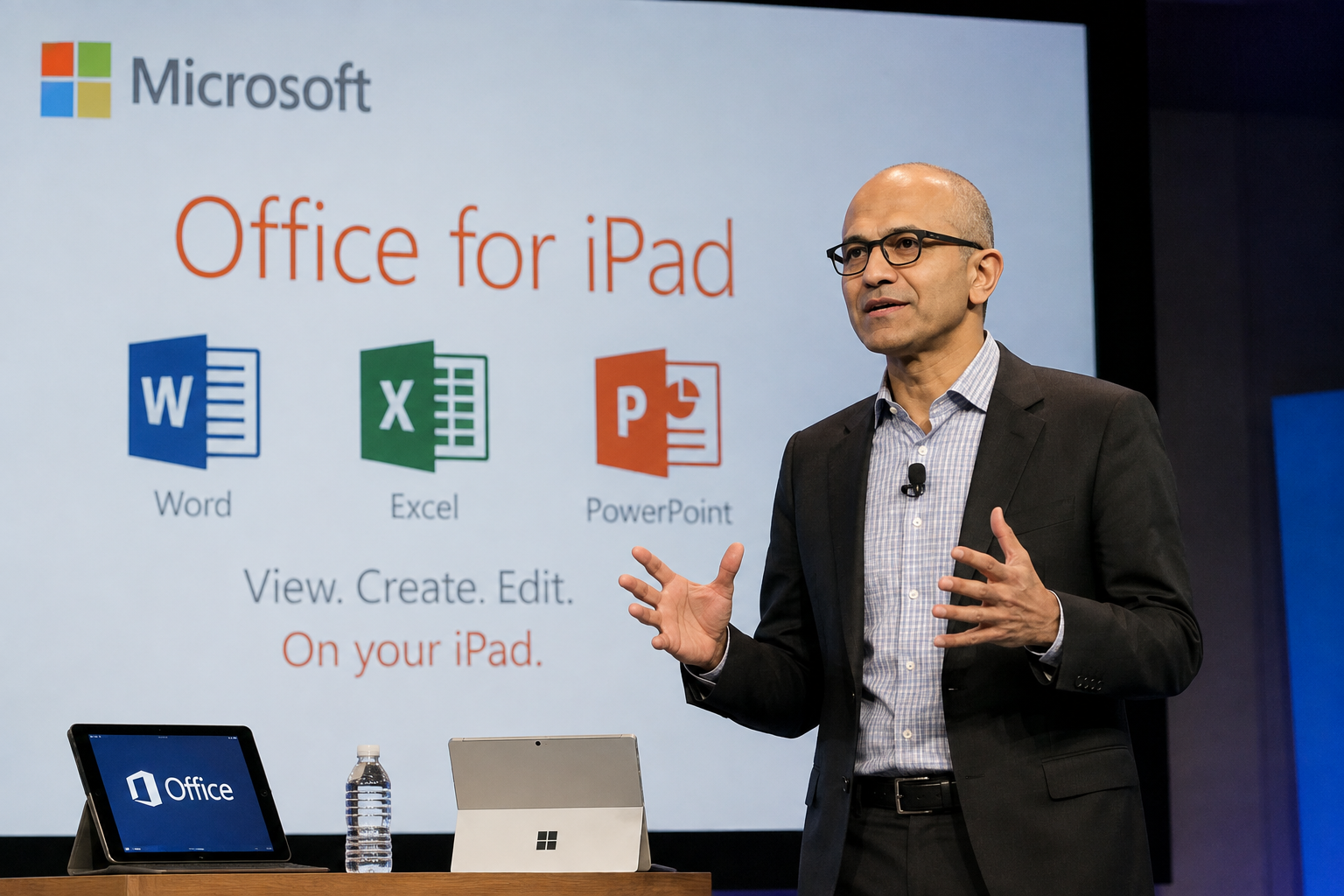
That changed on March 27, 2014. In his first major public appearance as CEO — 52 days after taking the job, a detail he joked about onstage — Nadella unveiled Office for iPad. It became the clearest early signal of how he intended to run the company: less protective of Windows as the center of gravity, more focused on getting Office in front of people wherever they happened to be.
What Microsoft actually inherited, and released
It's worth being precise about who gets credit for what. According to Microsoft's own account, relayed by the Office for iPad team in an April 2014 Reddit AMA, it was Ballmer who gave the go-ahead to ship the software before his departure. A follow-up clarification indicated that Nadella was the one who picked the launch date. So the more accurate framing isn't that Nadella personally reversed a decision he'd once opposed — there's no evidence he held a prior position on it at all. It's that Microsoft, under Ballmer, had built the software and sat on it, and Microsoft, under Nadella, finally shipped it and used the moment to say something larger about where the company was headed.
That distinction matters, because it changes what the decision actually demonstrates. It isn't a story about a CEO overruling his own past judgment. It's a story about a new CEO inheriting a finished, contested product and choosing, within his first two months, to release it as the centerpiece of his public debut — using the moment to declare a broader shift rather than treat it as a routine app launch.
Office itself was a genuinely large piece of Microsoft's business at the time. Fortune's report from the day of the launch put Office at roughly 90% of the revenue generated by Microsoft's Business Division — the unit built around Office and related products, not the company as a whole. That figure explains why the software had been guarded so closely for so long, and why choosing to put it on a competitor's device wasn't a small decision even if the app itself seemed unremarkable.
The decision
Office for iPad shipped the same day it was announced: native Word, Excel, and PowerPoint apps, built on top of OneDrive, free to download and use for viewing and presenting, with an Office 365 subscription required to create or edit. It was the same freemium structure Microsoft had already used for its iPhone version the previous year, just scaled up for a device where a full productivity suite mattered far more.
Nadella used the event to frame the release as something broader than a product launch. Describing how people actually work across devices, he told the audience, in remarks Microsoft's own transcript preserved: "We're not bound, in fact, to one device, one place or one time." He talked about building "a cloud for everyone on every device," and — according to Bloomberg's report from the event — said Microsoft would "hold nothing back" in getting its software onto whatever hardware people were using, even competing hardware. Weeks later, in an interview with Fortune, he put the underlying logic more bluntly: "We wanted to make sure we have full-touch Office on the platform with the most market share." That's not a company protecting Windows. That's a company chasing usage wherever it lives.
Why the timing made sense
The commercial argument had been building for a while. Analysts had been telling Microsoft for over a year that withholding Office from the iPad was leaving demand on the table. In January 2013, IDC's Bob O'Donnell had said that the day Microsoft brought Office to iOS and Android, "they'll start printing money." That March, MobileTrax analyst Gerry Purdy estimated Microsoft could add as much as $1.25 billion in first-year revenue from Office on tablets, using assumptions about attach rates and per-copy pricing that he acknowledged were rough. Neither of those numbers was Microsoft's own guidance, but they captured the expectation building around the release.
There was also a business-model shift underway that made the old logic less useful than it had been. Microsoft was moving Office from a product people bought every few years to a service they paid for monthly or annually through Office 365. A subscription business grows by putting itself in front of as many people as possible, not by rationing access to prop up a separate hardware line. An iPad owner paying for Office 365 was still a paying Microsoft customer, arguably an easier one to win than an iPad owner who had no reason to touch Microsoft software at all.
What happened next
The public response was immediate. Microsoft said on Twitter that the apps had been downloaded 12 million times within about a week of launch, and Word, Excel, and PowerPoint quickly topped download charts in more than a hundred markets. By May 12 — 46 days after launch — Microsoft's Julia White, general manager of Office, told the company's TechEd conference that downloads had reached 27 million. TechCrunch reported that Word held its position among the top downloaded apps in the U.S. store through that stretch.
By any measure of consumer interest, the release worked. People wanted Office on their iPads, and once it existed, they got it in large numbers.
Whether that translated into revenue is a separate question, and one Microsoft never fully answered in public.
The economic reality, and what it does and doesn't show
Because the apps were free to download and limited to viewing without a subscription, the meaningful financial question was never the download count — it was how many of those downloads turned into paying Office 365 customers. Microsoft doesn't break that number out publicly, so no one, including Microsoft, can say with precision how many subscriptions trace directly to the iPad launch.
The closest public attempt at an estimate came from Jan Dawson, chief analyst at Jackdaw Research, in comments reported by Computerworld about four months after the release. Working from Microsoft's own disclosed subscriber counts, Dawson noted that Office 365 added about 900,000 consumer subscribers in the quarter before Office for iPad shipped, and about 1.2 million in the quarter after — a difference of roughly 300,000. He was explicit that the number was a rough estimate, not a confirmed count of iPad-driven subscriptions, and that Microsoft had not identified any subscribers as coming specifically from the iPad launch. "The exact number is not important," Dawson told Computerworld. "What is, is that it's not a million new users."
It's worth being clear about the limits of this data. The 300,000 figure covers Office 365's consumer plans only. Microsoft discloses far less about Office 365 sold to businesses, so there's no way to know from public information whether the iPad launch moved the needle on the commercial side, where the app may well have been used just as heavily. The honest read is narrower than either the early bullish forecasts or a flat "it flopped" narrative: the consumer subscriber bump that can be measured was real but small, and a meaningful share of whatever value the launch produced simply isn't visible in what Microsoft has disclosed.
The longer arc
The picture looks different if the timeframe stretches out. Microsoft's SEC filings show Office 365 consumer subscribers at 12.4 million in the third quarter of fiscal 2015; by the same quarter a year later, the count had grown to 22.2 million, according to Microsoft's own reporting. That's real, substantial growth in the underlying subscription business Office for iPad was designed to feed.
But crediting that growth to the March 2014 launch specifically overstates what the record supports. In the two years after Office for iPad shipped, Microsoft kept removing restrictions across the board. On November 6, 2014, the company announced — through its own Source blog — that customers on iPhone, iPad, and Android could create and edit Office documents without any subscription at all, for personal use; a subscription remained necessary for certain advanced features and for commercial use. Android tablet support followed in a preview that same month, with general availability arriving in early 2015. Each of these moves widened Office's reach in the same direction as the iPad launch, and by the 2015–2016 period it's not possible to isolate how much of the subscriber growth came from any one of them individually, let alone attribute it all to the original iPad release. What the record supports is correlation across a multi-year strategy shift — not proof that the iPad launch, on its own, drove the increase.
What remains unproven
Several questions that would make this a tidier story simply can't be answered from what's public. How much of Microsoft's later cloud and subscription growth traces to the Office-for-iPad decision specifically, versus the many other changes the company made in the years after, isn't something the public record can isolate. How many Office 365 subscribers exist today because they first encountered Office through an iPad app, rather than through Windows, Android, or a browser, isn't disclosed. And whether Windows sales lost any measurable ground because Office became fully available on a competing tablet — the actual risk the old strategy was meant to guard against — has no clean, attributable metric behind it either; Windows revenue in the years that followed was shaped by the broader decline in PC sales, the Windows 8-to-10 transition, and other forces that have nothing to do with Office's availability on the iPad.
That uncertainty isn't a weakness in the story. It's a reasonably honest account of how strategic bets actually resolve: the qualitative shift is visible in real time, and the financial attribution stays blurry for years, if it's ever cleanly resolved at all.
The risk Microsoft accepted
The trade-off was real even where its size can't be measured. Putting a first-class Office experience on a competitor's tablet removed one concrete reason a household or business might have chosen a Windows device instead. Microsoft's own Surface line was competing directly against the iPad at the time, and a strong Office experience on Apple's hardware did nothing to make Surface more attractive by comparison. Nadella's early message effectively prioritized Office's reach over Windows' differentiation — a bet that the relationship with Office's users mattered more than protecting one specific reason to buy a Windows machine.
There was a quieter risk in the freemium structure too. Giving away a capable, well-reviewed viewing experience for free meant tens of millions of people got used to a version of Office they didn't have to pay for. Converting free users into paying subscribers takes time, and the Dawson estimate suggests that conversion, in the months right after launch, moved more slowly than the download numbers alone would have implied.
What other CEOs can take from it
The generic lesson here — "innovate," "embrace mobile" — doesn't hold up, because Microsoft's leadership plainly understood the mobile shift well before 2014; that recognition wasn't the hard part. The Ballmer-era company had a usable iPad app finished and still didn't ship it. The harder decision was accepting that protecting a legacy platform can come directly at the expense of the product that actually holds the customer relationship — and choosing the product anyway, without a guaranteed near-term payoff.
The consumer subscriber numbers in the months after the iPad launch didn't validate that choice on their own. The case for it rested on a broader judgment about where Microsoft's revenue and relevance would come from over a longer horizon — a bet that wasn't provable at the time and, in the narrowest financial sense, still isn't fully provable today. That's a harder trade to make than it sounds, especially for a large company whose profit still depends heavily on the platform being deprioritized. It requires tolerating numbers that don't look dramatic in the near term, on the strength of a directional judgment that won't be validated for years, if ever in a way that's cleanly measurable.
FAQ
What was the Office-for-iPad decision, and when did it happen? On March 27, 2014 — 52 days after becoming Microsoft's CEO — Satya Nadella used his first major public appearance to announce and release Office for iPad: native Word, Excel, and PowerPoint apps built for Apple's tablet, free to download for viewing, with an Office 365 subscription required to edit.
Did Nadella personally decide to build Office for iPad? The software was largely built under Steve Ballmer, who, according to Microsoft's own account, gave the go-ahead to ship it before leaving the company. Nadella picked the launch date and used the release as the centerpiece of his debut as CEO.
Why had Microsoft kept Office off the iPad before this? Office was tightly connected to Windows' competitive position — Fortune reported it accounted for roughly 90% of the revenue in Microsoft's Business Division at the time. Making it available everywhere risked removing one concrete reason people chose Windows devices.
Did the launch immediately increase Microsoft's revenue? Downloads were large — 12 million in the first week, 27 million within 46 days — but the measurable near-term increase in paying Office 365 consumer subscribers was modest. This is a third-party inference, not an iPad-specific figure Microsoft itself reported: one analyst, working from Microsoft's overall subscriber disclosures, estimated the difference at around 300,000 additional consumer subscribers in the quarter after launch — far below the billion-dollar-plus predictions some analysts had made the year before.
Did the decision hurt Windows? No public data isolates a specific Windows revenue impact from the iPad launch. The strategic risk was real in principle, but Windows results in the following years were shaped by many other factors, including the broader decline in PC sales.
What can other CEOs learn from it? That protecting a legacy platform can come at the direct cost of the product that actually holds the customer relationship, and that choosing the product's reach over the platform's protection can be the right call even when the near-term financial case isn't yet proven.