Rolex Bought Bucherer to Protect a Partnership. Now Its Retail Model Is Being Tested
The European Commission cleared the deal without conditions, reasoning from Rolex's stated reliance on independent retailers. Bucherer's 2026 openings and a handful of documented partner changes now put that reasoning to the test
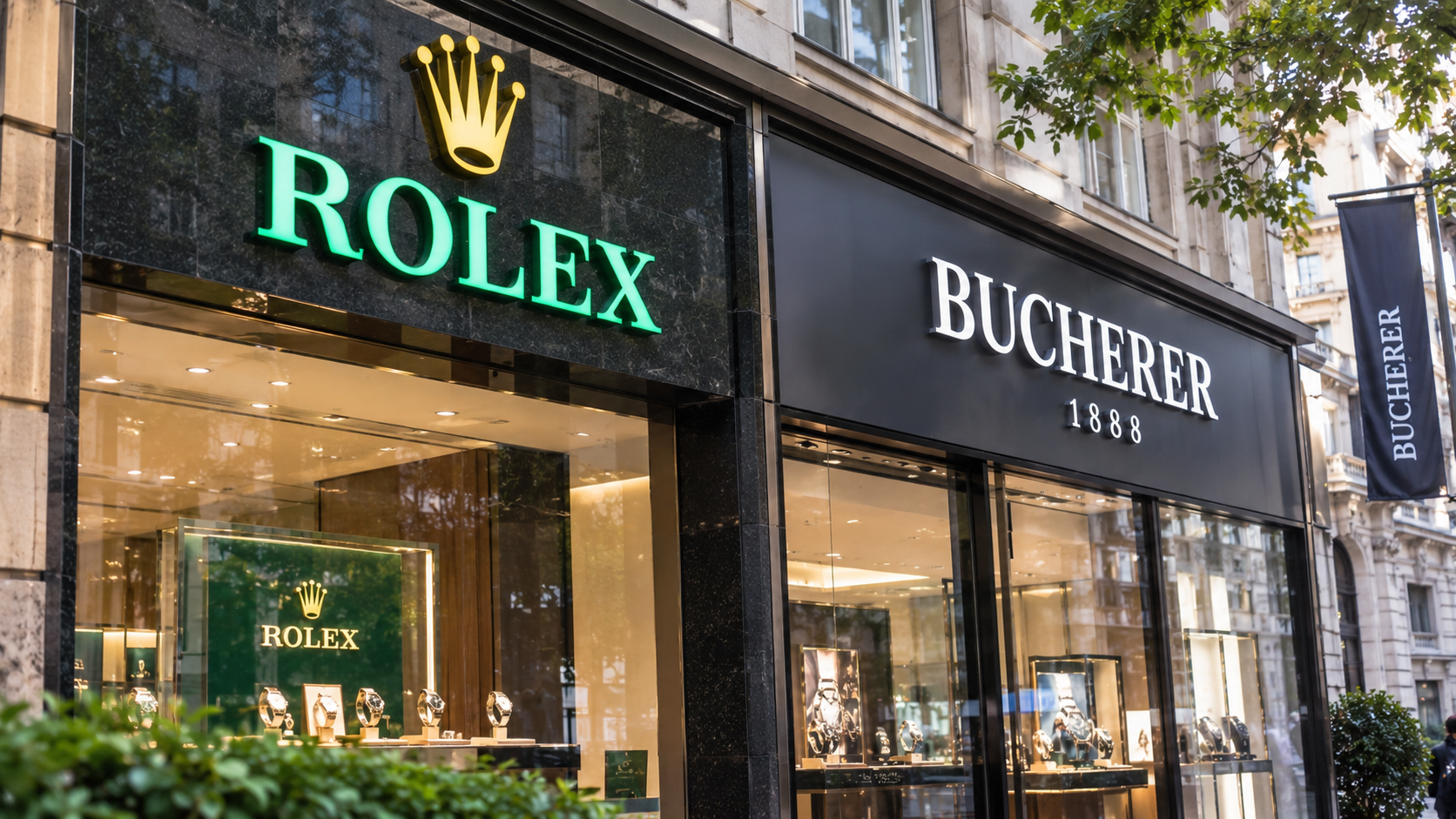
For most of its history, Rolex stayed away from the shop floor. It made the watches, set the standards and left selling to jewellers who owned the customer relationship. In August 2023 that division of labour was dented when Rolex announced it would buy Bucherer, the Lucerne retailer that had sold its watches since 1924 and is widely described as its largest retail partner.
On its face, the Rolex Bucherer acquisition was a succession story. Jörg Bucherer, the owner, had no direct heirs and had chosen Rolex as the buyer. Three years on, the more useful question is what happens after a brand buys one of its own customers: how much of the old arrangement survives, and how the remaining customers read what they see.
The short answer, as of November 2026, is that Rolex’s network still rests mostly on independent retailers, but Bucherer has become the operator of choice for some of Rolex’s most visible boutiques. Whether that is a sensible use of an owned asset or the start of a different distribution model is not yet settled by the evidence.
A partnership older than the Oyster
Rolex announced the deal on 24 August 2023. According to the European Commission’s later decision, the share purchase agreements had been signed a day earlier. Rolex said the purpose was to preserve a long partnership and shared history, that Bucherer would keep its name and continue to operate independently, and that its collaboration with other official retailers would remain unchanged. The price was never disclosed. Jörg Bucherer died on 6 November 2023, before regulators had cleared the transaction.
The market’s first reaction was fear. Watches of Switzerland, Bucherer’s largest listed rival and a heavy seller of Rolex, saw its shares fall as much as 30 percent, wiping out almost £500 million ($629 million) of market value, according to Bloomberg. The company then said the deal was not a strategic move into retail by Rolex, that there would be no operational involvement by Rolex in Bucherer, and, as its chief executive told Bloomberg, that Rolex had assured it its allocation system would not change. Those were Watches of Switzerland’s statements about what it had been told, not a Rolex press release. The distinction matters later.
Why Rolex bought at all is partly a matter of analysis. Rolex itself pointed to history and succession. A reasonable reading, and it is only a reading, is that a founder with no heirs put a very large Rolex retailer up for sale, and Rolex preferred to decide who owned it. Bucherer’s chief executive, Guido Zumbühl, later told BILANZ that having Rolex behind the company was the best succession outcome he could have asked for.
The business model Rolex had to protect
Rolex does not sell most of its watches itself. Under selective distribution, a brand chooses its retailers, sets standards for premises, staff and service, and supplies only those who qualify. In its 2024 decision, the Commission recorded that Rolex supplied watches to more than 1,540 retail stores in over 90 countries, while operating only one store in Switzerland and two in Greece.
The Commission also put numbers on the dependence. In 2022, independent multi-brand retailers, Bucherer included, handled roughly 70 to 80 percent of Rolex’s sales in the European Economic Area. Bucherer itself represented 0 to 5 percent of Rolex’s points of sale there, and its sales of Rolex watches equalled about 5 to 10 percent of Rolex’s EEA wholesale revenue. These are different measures and should not be mixed. The point is that Bucherer mattered, but the network did not hang on it. BILANZ, for its part, puts the industry rule of thumb at about half of a Rolex dealer’s revenue coming from the brand.
What European regulators examined
The Commission received the notification on 6 June 2024 and decided on 10 July not to oppose the deal. Its review asked three questions. Could Rolex starve other retailers of watches and favour Bucherer? Could Bucherer stop selling rival brands? And could commercially sensitive information flow between the two?
Market-share figures need care. In overall luxury-watch manufacturing and supply, Rolex held 30 to 40 percent by value in 2023. In the €10,000 to €49,999 price band it held 50 to 60 percent by value. That is a supply-side figure. In retail, Rolex and Bucherer each held 0 to 5 percent across the EEA.
The Commission found no serious doubts and cleared the deal unconditionally. It did not impose commitments about how Rolex should organise its retail. It did accept that most retailers regard Rolex as a must-have brand, so Rolex might have the ability to favour Bucherer. Its conclusion rested on incentive: Rolex could not profitably serve its market through Bucherer alone, so squeezing other retailers would cost it more than it gained. As one manufacturer told the Commission, Rolex needs “a lot of doors.” Rolex’s own stated strategy, a network of third-party retailers with Bucherer kept as an independent multi-brand business, underpinned that reasoning. The Commission added that Rolex had not integrated downstream in the past, and that any later shift in that direction would not be a result of this deal.
Information was the open question. The market investigation was inconclusive on whether access to Bucherer’s customer data or its other suppliers’ information would give Rolex an advantage. Rolex offered ring-fencing, need-to-know access, separate IT systems and aggregated reporting, and the Commission judged these sufficient. It did not find that data had been misused. The public record does not establish how the safeguards have worked in practice since the acquisition. Retailers also raised complaints about online-sales and other limits imposed within Rolex’s network. The Commission treated those as separate from the merger and left them to ordinary competition enforcement.
What Jean-Frédéric Dufour said, and what he didn’t
On 19 November 2025 at Dubai Watch Week, Rolex chief executive Jean-Frédéric Dufour addressed the subject. In Coronet’s published transcript, he said Rolex had become a bit of a mix through Bucherer, which was a very small part of its distribution network, and that it had no intention to grow further than that. Then came the line that reveals the most: “It was an opportunity, and we had to do it.” He added that owning a retailer was teaching Rolex more about retail.
WatchPro reported the same remarks more tersely, as Rolex having no intention of growing Bucherer. The longer version is better evidence, and it is ambiguous. It also came about two months after news broke in September 2025 that Rolex would part with Rüschenbeck in Germany, so Dufour spoke with that decision already on the record. “That” could mean Bucherer’s size, or Rolex’s overall share of owned retail. Neither version promises a fixed store count, and neither should be read as a pledge broken or kept.
“We had to do it” suggests a defensive purchase. That is interpretation, not disclosure, but it fits the Commission’s record of a company whose strategy rests on partners.
What Bucherer’s 2026 expansion shows
The best current picture of Bucherer comes from an interview its chief executive, Guido Zumbühl, gave Swiss magazine BILANZ in mid-2026. He said Bucherer operates more than 100 boutiques in nine countries with about 2,400 employees. Seventeen multi-brand stores are in the United States and 33 in Europe. Roughly half of the outlets are mono-brand boutiques run on behalf of watch brands, a little over half of those for Rolex and Tudor. About 40 renovations and openings are planned. These are his figures, not audited ones.
Zumbühl also said little had changed day to day. He said Bucherer sends Geneva monthly results in highly aggregated form, without other brands’ turnover, unit sales or terms. That is his account of the safeguards, not independent proof of them. BILANZ reported that Rolex’s chairman, Nicolas Brunschwig, chairs Bucherer’s board, with Dufour as deputy chair, and that Bucherer’s board closed its loss-making Carl F. Bucherer watch brand in 2025. Those board appointments show formal governance involvement, although they do not by themselves establish day-to-day operational control. Watches of Switzerland had said in 2023 that Rolex would appoint non-executive directors. Still, integration is real; the question is its direction.
WatchPro’s 27 October 2026 analysis identified 13 Rolex boutique openings and developments this year, seven of them run by Bucherer, including Munich, Stuttgart, Mount Titlis, Shanghai, Bellevue, Paris and Hong Kong. Some are upgrades of existing stores rather than new locations, and the report does not pin down the Hong Kong opening date. It is a trade-press count, not a Rolex disclosure. BILANZ separately estimated that about 8 percent of Rolex sales now run through Bucherer, with the share rising; it gave no basis for the figure and Rolex has not confirmed it.
Where independent partners enter the picture
Two cases are documented. In Düsseldorf, Rolex told German media its partnership with family jeweller Rüschenbeck would end by mutual agreement on 31 December 2026, according to WatchPro. Rolex bought property on the Königsallee, and Bucherer is due to open a two-storey Rolex boutique there in 2027. In Honolulu, a Hawaii Department of Labor notice shows Ben Bridge’s Ala Moana Rolex boutique closing on 31 December 2026 and moving to Bucherer USA on 1 January 2027. The notice, received on 15 October, says all 14 affected employees were offered jobs by Bucherer.
Outside experts read these as a pattern. Oliver Müller of LuxeConsult told BILANZ that Rolex is reducing multi-brand outlets in favour of flagships run by Bucherer. Coronet’s Dan Crivello described Bucherer as Rolex’s tool for expansion. Zumbühl declined to comment on Rolex’s strategy. German trade reports put the number of German doors being dropped near 40; WatchPro said Rolex had not confirmed that.
The evidence cuts both ways. WatchPro noted that Rolex’s London flagship went to Watches of Switzerland, not Bucherer, and that Rolex and the British jeweller Fraser Hart parted company in 2019, years before the acquisition. Pruning a network is not new. Watches of Switzerland reported revenue up 11 percent in its year to 3 May 2026. Two transitions do not prove a global policy of replacing partners. They do show that the capacity to do so now exists.
The risk that market-share tables miss
Watches of Switzerland’s FY2026 annual report explains the retailer’s side. Brand owners control distribution through strict selective distribution agreements, it says, and may terminate or decline to renew them, reduce the number of agencies, or distribute their own watches, bypassing third parties. That is a general risk statement, not a description of Rolex’s contracts. Still, it shows how the arrangement looks from the retailer’s chair.
Trust is the real asset. Retailers invest in staff, stock and showrooms because they believe the brand will not tilt the field. Once the brand owns a competitor, each flagship location, each allocation decision and each change of partner can be read as policy, whatever the intent. Brand executives told BILANZ they trust the information barrier. BILANZ added that whether that trust matches reality remains to be seen.
There is also a benefit for Rolex. Bucherer was the launch partner for Rolex’s Certified Pre-Owned programme in 2022, and the programme has since reached independents; Watches of Switzerland’s chairman cites its continued roll-out. Owning a retailer lets Rolex see what customers and staff actually experience. That learning is what Dufour pointed to.
What other executives can take from it
First, a promise that cannot be measured will be measured by other people. “No intention to grow further” can be read as store count, share of sales or share of flagships. Specifying it in advance is cheaper than debating it later.
Second, learning and advantage are separable only if the company shows it. Firewalls and aggregated data may work, but partners cannot see them. Regulators accepted the safeguards. Partners, who cannot audit them, may still ask for more.
Third, local decisions get read as strategy. A single boutique handover is a property decision to the company and a signal to every other partner. Rolex may be right that Düsseldorf and Honolulu are separate cases with separate reasons. Partners, though, compare notes, and a pattern forms in the telling long before it forms in the data.
Fourth, an owned asset changes the conversation even when it changes little else. Zumbühl says his daily work is much as before. The partners across the street are no longer judging Bucherer as just another customer of Rolex.
The decision’s outcome is still open. Rolex has not published how many partners it has, how many flagships Bucherer runs or how that share is changing, and it is a private company with no obligation to. What would settle the question is visible: the number of official retailers over time, who operates the biggest flagships, and whether independents keep investing.
The Commission cleared the deal without conditions, on reasoning that rested on Rolex’s reliance on independent retailers. Rolex’s retail model will be judged on whether that reliance holds.