Ford Put Its Blue Oval on the Line. The $23.5 Billion Bet That Was Tested by the Financial Crisis
In December 2006, Ford pledged much of its U.S. business to lenders to fund a turnaround. Two years later the credit markets froze, and the deal was put to use.
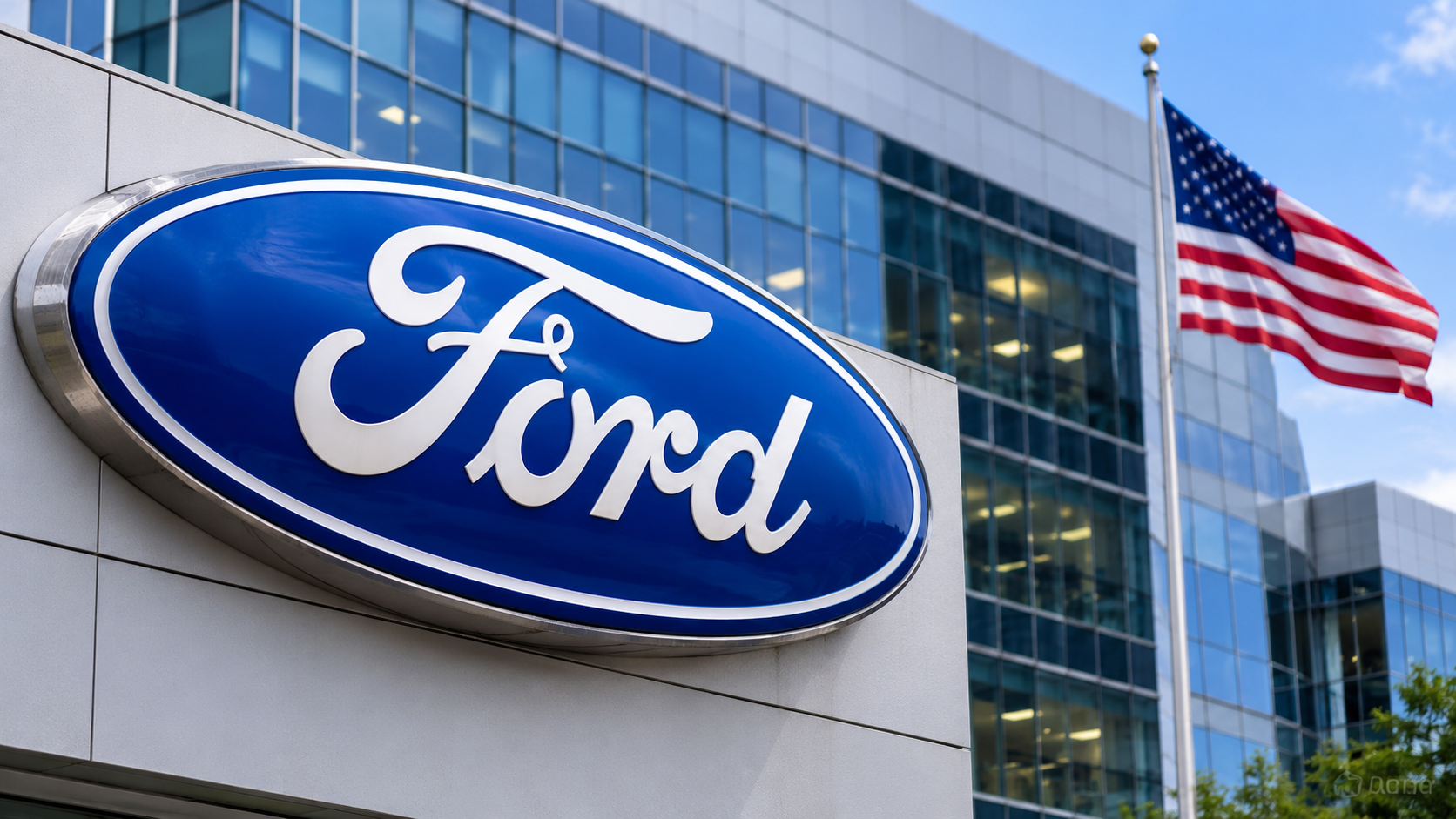
In December 2006, Ford Motor Company closed a financing package worth about $23.5 billion and handed its lenders a claim on a large part of its U.S. business. Factories and equipment were pledged. So were shares in major foreign subsidiaries, Volvo among them. So, too, were some of the most recognizable trademarks in American industry: the Blue Oval, the F-150 and the Mustang.
The money was meant to fund a restructuring that would take years and lose money along the way. A cushion like that has an obvious appeal. The harder question is why Ford was willing to pay for it with its own name.
That question got its answer in early 2009. On February 3, Ford drew $10.1 billion on the revolving credit line it had arranged in 2006, at a moment when almost no automaker could borrow anything. One lender, a Lehman Brothers subsidiary, failed to fund its share. The story invites exaggeration in both directions, so this account sticks to what Ford’s filings and the public record support.
Why Ford Needed Cash It Could Not Earn
Alan Mulally became Ford’s chief executive on September 5, 2006. Bill Ford, the great-grandson of the founder, stepped back to executive chairman. The company Mulally inherited lost about $12.6 billion that year.
The loss had two layers. Ford’s automotive operations lost about $5.2 billion before special items. On top of that came roughly $11.9 billion in pre-tax special charges for restructuring and asset write-downs. Add the layers and the pre-tax damage is about $17 billion, with tax benefits and profits at Ford Credit narrowing the final net loss.
Earnings were only part of the problem. A restructuring costs money first and saves it later. Closing plants, buying out workers and retooling product lines all require cash up front, and Ford’s credit ratings sat below investment grade. For a company in that position, ordinary borrowing is either expensive or unavailable.
So Ford went the other way. If it could not borrow on the strength of its earnings, it could borrow on the strength of what it owned.
What Ford Pledged, and Who Decided It
Ford announced the plan on November 27, 2006. It described a raise of about $18 billion: a five-year secured revolving credit facility of roughly $8 billion, a secured term loan of about $7 billion, and further unsecured debt that could include convertible notes.
The final package was larger. When it closed on December 15, 2006, the revolver stood at $11.485 billion and the term loan at $7 billion. The convertible notes came in at $4.95 billion. Add all three and the total is $23.435 billion, which is why almost every account rounds it to $23.5 billion.
This is where careless retellings go wrong. Only the revolver and the term loan, together $18.485 billion, were secured. The convertible notes were unsecured, and calling the whole package collateralized overstates the case by nearly $5 billion.
The collateral behind the secured portion was broad. It covered a substantial portion of Ford’s domestic automotive assets, the equity of major foreign subsidiaries and intercompany notes of foreign holding companies. It also covered the trademarks: the Blue Oval, the F-150 and the Mustang. If Ford failed to pay, the lenders would be first in line for those assets.
That arrangement had a price beyond interest. Anyone holding Ford’s older unsecured debt now stood behind the new secured lenders. Giving one group a first claim made everyone else’s claim less valuable.
Whose idea was it?
The record does not let anyone claim the idea alone. Mulally had been in the job for just over three months when the loan closed. Forbes reported in 2012 that he signed off on a plan put together by Bill Ford and then chief financial officer Don Leclair. The picture that emerges from the filings is a chairman, a finance chief and a new chief executive moving in the same direction. Who first proposed putting the trademarks into the package is not something the public documents settle, and guessing would add nothing.
February 2009: The Line Gets Drawn
Lehman Brothers collapsed on September 15, 2008, and the credit markets stopped working. For the full year Ford lost $14.7 billion. Its automotive gross cash fell from $34.6 billion at the end of 2007 to $13.4 billion at the end of 2008.
In December 2008, Mulally told the Senate Banking Committee in written testimony that Ford did not need a bridge loan right away, but that it wanted a standby credit line of $9 billion as a backstop. That was a request, and no money changed hands under it. In the same month the Treasury lent $13.4 billion to General Motors and $4 billion to Chrysler, and Ford received nothing from that program.
Then, on January 29, 2009, Ford gave its lenders notice that it would draw the unused portion of the secured revolver: $10.9 billion. On February 3, the lenders advanced $10.1 billion. Part of the shortfall was Lehman Commercial Paper, which had filed for Chapter 11 on October 5, 2008, and whose $890 million commitment was not funded. The borrowing carried an interest rate of LIBOR plus 2.25 percent and, as originally written, matured on December 15, 2011. It was later amended and extended.
This was the first real test of the 2006 decision, and it taught more than the headline number suggests. A committed credit line is a promise from a group of banks, and a promise is only worth what each bank can pay. About 8 percent of Ford’s unused line sat with a lender that was already in bankruptcy. The other banks covered their shares, so the damage stayed small. A company with fewer lenders, or weaker ones, would have been in a different position.
Drawing the whole line was also a defensive choice with a cost. Ford paid interest on cash it did not immediately need. The alternative was to wait and hope the rest of the syndicate stayed solvent, and for a company that had just reported a record loss, waiting looked riskier than paying.
The cash numbers, handled carefully
Ford’s automotive gross cash rose from $13.4 billion at the end of 2008 to $21.3 billion at the end of March 2009, an increase of $7.9 billion. It is tempting to say the credit line produced that rise. It did not, at least not by itself.
Several things moved at once. The revolver draw added $10.1 billion. Converting the UAW retiree health fund’s temporary asset account into a Ford note added about $2 billion to the measure. Operating-related cash flow was negative $3.7 billion for the quarter. Those three pieces add up to roughly $8.4 billion, which leaves about half a billion in other net outflows that the company’s release does not itemize.
There is also a trap in the number itself. Ford announced a separate package of debt-reduction actions in the same period that totaled $10.1 billion at par. That figure is unrelated to the revolver draw, and the match is a coincidence. Anyone repeating either one should be sure which they mean.
Did the Financing Save Ford?
The accurate answer is that it bought time, and time was what Ford needed most. A January 2009 Congressional Research Service report, “U.S. Motor Vehicle Industry: Federal Financial Assistance and Restructuring,” said Ford was not applying for immediate government assistance in late 2008 in part because it had already raised $23.5 billion in December 2006. The same report noted that at the time Ford was viewed as the Detroit automaker most likely to go under. By the time the market closed, Ford had already borrowed.
But the claim that one loan rescued the company does not hold up. Ford sold Jaguar, Land Rover, Aston Martin and most of its stake in Mazda. It reached a new labor agreement with the UAW in 2007 and pushed through a long program of plant closures and job cuts. In 2009 it reported net income of $2.7 billion, after three straight years of losses. Without that operating work, the 2006 cash would simply have run out more slowly.
Nor is it accurate to say Ford received no government support at all. The cleaner version is narrower. Ford did not take the emergency rescue loans from the Treasury’s TARP program that GM and Chrysler took. It did ask for the $9 billion standby line, which was never granted as a loan. In September 2009 it secured a Department of Energy loan facility of up to about $5.9 billion under the Advanced Technology Vehicles Manufacturing program, which was designed to fund fuel-efficient vehicle development. And Ford Credit, the finance arm, separately used the Federal Reserve’s Commercial Paper Funding Facility. That last item belongs to the subsidiary’s own funding, not to the parent company’s $23.5 billion package.
Nobody can prove what 2009 would have looked like without the 2006 deal. What the documents do support is that when Ford needed liquidity, a line existed, nearly all of it worked, and its two Detroit competitors had nothing comparable to draw on.
It would also be wrong to say Ford saw the crisis coming. Its 2006 announcement spoke of protection against a recession or other unanticipated events. That is the language of a company that wanted a cushion, and nothing public suggests management predicted the collapse of Lehman or the freeze that followed.
2012: Ford Gets the Blue Oval Back
Repayment came in stages. The term loans were repaid in 2011, and the revolver remained. The security agreement allowed the remaining collateral to be released once Ford’s senior unsecured debt reached investment grade with two of the three major rating agencies.
Fitch moved first, upgrading Ford on April 24, 2012. Moody’s followed on May 22 with a Baa3 rating. That same day, Ford reported that the collateral securing its remaining $9.3 billion revolver had been released. The Energy Department’s second-lien claim on the same collateral was released along with it. After five and a half years, the Blue Oval no longer stood behind anyone’s loan.
The order of events matters here. The pledge came first, in December 2006. The test followed in February 2009, when the line was drawn. The release came last, in May 2012, and only after the rating agencies decided Ford looked like a different kind of borrower. Each step depended on the one before it, and none of them was guaranteed on the day the papers were signed.
The release proves less than it might seem. It shows that Ford’s credit standing had recovered far enough that lenders no longer demanded security. It does not prove that the 2006 decision caused the recovery. It does not show the risk had been small, either. For years Ford’s plants, trademarks and subsidiary equity sat behind someone else’s claim, and the company paid interest and fees to keep that structure going.
It also did not make Ford debt-free. The release meant that lenders had returned to treating the company as an ordinary borrower, which is a lower bar than being a safe one.
What Other Executives Can Take From It
Four points follow from the record. One of them is analysis, not anything Ford has said.
Liquidity and profitability are different problems. Ford absorbed heavy losses across 2006, 2007 and 2008. The financing gave it access to liquidity during that stretch, but it was one part of a much wider restructuring. A company can be unprofitable and solvent if it has enough cash, and profitable and insolvent if it does not. The financing was a decision to fund the gap before it became a crisis.
The lender list matters as much as the headline number. Ford’s shortfall of $890 million was small because the syndicate was large. A company reading its own credit agreement should ask which banks hold which slices, and what happens to the line if one of them cannot fund.
Collateral can only be pledged once. This point is analysis, not something Ford has said. Pledging the trademarks and plants gave Ford access to capital that was otherwise out of reach, but it also meant there was less left to offer a new lender later. The same pledge that limited future options is what made the 2006 money possible, and it is worth weighing both sides of that trade before signing.
Foresight is not proven. Whether the decision reflected foresight or good timing cannot be settled from the documents. What they do show is narrower and more useful. When the freeze came, Ford already held a line it could draw, and nearly all of it worked.