Broadcom Bet That VMware’s Customers Would Stay. The Renewal Test Is Approaching
Broadcom replaced VMware’s perpetual licenses with subscription bundles, and the software business’s economics improved. Lawsuits, partner cuts and a fresh round of three-year renewals will show how many customers stayed because they wanted to, and how many because leaving was hard.
On August 19, 2024, AT&T executive Susan Johnson sent Broadcom CEO Hock Tan a short, direct email. AT&T, she wrote, had decided to pursue a legal strategy alongside a disciplined plan to migrate away from VMware, and both would soon become public. “I truly wish we had another option,” she added. Broadcom later included the message in its own court filings.
That sentence sits at the center of Broadcom’s VMware story. Since closing the roughly $69 billion acquisition in November 2023, Broadcom has ended perpetual licensing, collapsed a sprawling catalog into subscription bundles and reported software operating margins near 84%. It has also been sued and has drawn complaints to European regulators. At least three large customers, AT&T, Tesco and T-Mobile, have said or been reported to be working on exits.
The decision was a bet that customers who rely on VMware to run their data centers would pay more, and keep paying, because replacing it is slow and risky. Dependence and loyalty are different things. The next two years of contract renewals will show how much of Broadcom’s customer base is which.
What did Broadcom change after buying VMware?
Broadcom completed the acquisition on November 22, 2023. Less than three weeks later, on December 11, it announced what it called a simplification of VMware’s offers and licensing. New perpetual licenses and renewals of the support contracts attached to them, known as Support and Subscription, or SnS, were no longer for sale. Everything moved to subscription or term licensing, priced per core, with VMware Cloud Foundation, or VCF, and a lighter VMware vSphere Foundation as the main offers. The Register has reported that the product range shrank from more than 150 items to two subscription-only bundles.
One distinction matters here, because it is often blurred. Broadcom did not switch off licenses customers already owned. A perpetual license keeps working after support lapses. What lapses is the right to patches, updates and technical help, which now require an active subscription. For a company running thousands of servers, that gap is the real pressure point.
Pricing moved too. In a 2024 blog post marking VMware’s first 100 days under Broadcom, Tan wrote that the company had cut the previous VCF subscription list price in half and raised support levels. He also acknowledged that the scale of change had created unease among customers and partners.
Why did Broadcom choose subscription bundles?
Broadcom’s stated reasoning was simplicity and standard practice. The December announcement argued that subscription had become the industry norm for cloud consumption. A VMware marketing executive later put it bluntly, saying VMware “was one of the last to still do perpetual licensing.”
Tan has been plainer about the commercial goal. On an earnings call after the deal closed, he said Broadcom was focused on moving customers who already ran vSphere, VMware’s virtualization software, up to VCF.
What follows is editorial analysis rather than Broadcom’s account. Perpetual licensing gives a vendor a large payment once and then a thinner stream of support fees. A multi-year subscription tied to a bundle gives it a bigger commitment per customer and a scheduled moment to renegotiate. Broadcom’s own annual report acknowledges how much rides on those moments. It says many software customers hold multi-year agreements, that failing to renew them on attractive terms could harm the business, and that the timing of contracts and renewals makes its results lumpy.
Why can’t VMware customers simply leave?
Because VMware often sits underneath everything else. Virtualization software divides physical servers into many virtual ones, and for large organizations it becomes the layer on which hundreds or thousands of applications run.
In court, T-Mobile’s lawyers described its VMware deployment as “the base of the entire internal network,” and a Broadcom filing put the carrier’s VMware footprint at more than 303,000 processor cores. AT&T said in its 2024 lawsuit that about 75,000 of its virtual machines ran on VMware. These are the claims of parties in litigation, but they point to the same practical fact: migrations of that size take years, and mistakes can interrupt services.
That reality makes the strategy plausible, and it also makes it risky, because a vendor that prices against a customer’s inability to move gives that customer a reason to start moving.
What do the financial results show?
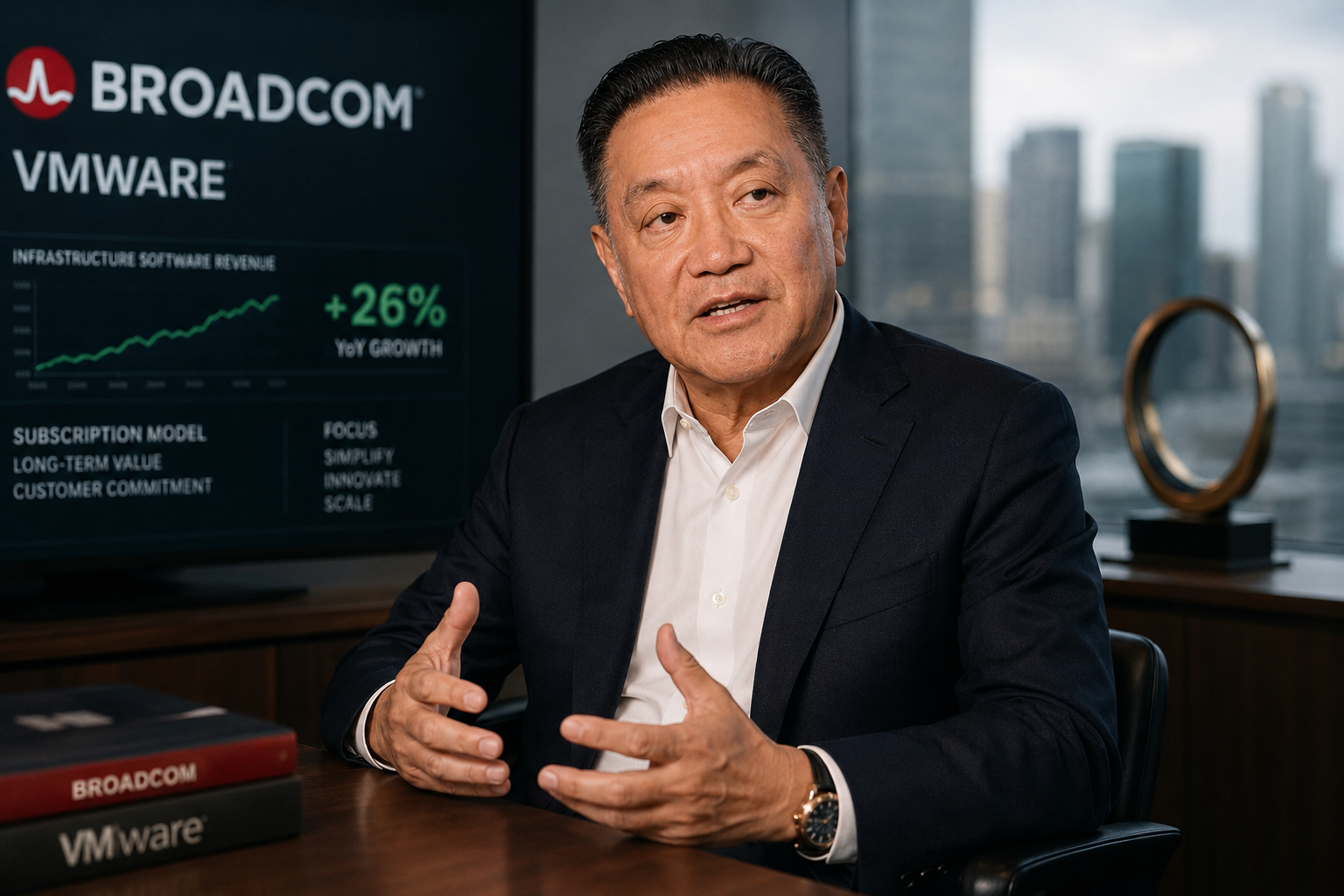
Broadcom’s numbers are strong, and they are also easy to over-read. In fiscal 2025, which ended November 2, 2025, total revenue reached $63.887 billion against $51.574 billion a year earlier. Infrastructure software revenue rose 26%, from $21.478 billion to $27.029 billion. The annual report attributes that increase primarily to demand for VCF.
The most recent quarter looks similar. In the quarter ended August 2, 2026, software revenue was $8.752 billion, up 29% from a year earlier, according to Broadcom’s 8-K. Management said annual recurring revenue grew 15% and software operating margin was roughly 84%, up about 650 basis points year over year. It guided the next quarter’s software revenue to about $8.7 billion.
A few cautions apply. The software segment includes mainframe, security and enterprise software alongside VMware, so its growth cannot be credited to licensing changes alone. The year-over-year path has also been uneven: software revenue grew 1% in the first quarter of fiscal 2026, 9% in the second and 29% in the third. Some of that swing is timing. Broadcom’s annual report discloses $7.8 billion of upfront license revenue in fiscal 2025. For software contracts that customers cannot cancel at their convenience, Broadcom books the license portion when control passes to the customer rather than spreading it over the term. Big renewals can land in one quarter and make the next one look slow.
Software is also shrinking as a share of the company. It was 43% of revenue in the third quarter of fiscal 2025 and 30% a year later, because AI chip sales grew so fast. VMware matters more for its margins than for the growth story investors now follow.
The numbers establish that the model is highly profitable. They don’t show whether customers are satisfied, whether they are using what they bought, or how many will renew.
Is buying VCF the same as deploying it?
Tan has been careful on that point himself. On Broadcom’s September 2025 call, he said more than 90% of VMware’s 10,000 largest customers had bought VCF, up from 87% a quarter earlier. VMware has about 300,000 customers in total, so the figure describes a small and selected group. And Tan said the number reflects licenses sold, not completed deployments. He called deployment the second phase of the work and said it would take about two years.
Observers read that differently. Some analysts argue many customers signed multi-year VCF contracts to buy time while they plan an exit. Broadcom’s position is that customers who move to VCF end up with more efficient infrastructure. Both readings fit the data so far, and neither is proven. The Register’s coverage of the same call described a lot of unused software, but that was the reporter’s inference, not a Broadcom disclosure.
Surveys sponsored by vendors that sell VMware alternatives report heavy interest in leaving, but they measure intent, and their sponsors have a stake in the answer. Broadcom’s quarterly releases do not publish a VMware retention rate.
What have the courts and regulators said?
The disputes differ from one another and should not be lumped together.
AT&T sued in New York state court on August 29, 2024, seeking an injunction to force Broadcom to honor a support extension in a contract signed before the acquisition. Its lawyers wrote that Broadcom could change its business model going forward but could not retroactively rewrite existing contracts. AT&T said its VMware costs would rise 1,050%. Broadcom answered that the covered support services no longer existed. The parties announced a settlement in principle in November 2024 and never disclosed the terms.
T-Mobile made a similar claim. It sued in New York state court in August 2025, saying a 2023 contract gave it the option to buy a third year of support for about $5.28 million. A court granted an injunction requiring Broadcom to keep providing support past August 2025, and an appeals court upheld it while sending the $500,000 undertaking back for a fresh look. The injunction ran through August 3, 2026. The sources reviewed for this article do not say what happened after that date, so T-Mobile’s current support status is unconfirmed. VMware’s lawyers have argued that thousands of customers accepted the end of availability without litigating, and that AT&T and T-Mobile are outliers. At an October 2025 hearing the judge, Jennifer Schecter, was not persuaded. She suggested other customers might simply prefer not to fight, or might find moving easier at smaller scale.
Tesco’s case is larger and later. It sued in the UK High Court in 2025 and seeks at least £100 million. Tesco says Broadcom would not honor support rights in a deal it had signed in 2021, with an option reaching to 2030. Filings show Broadcom put several offers on the table, and Tesco estimates one of them, covering VCF 9 and mainframe software for a year, would have cost $23.5 million, a 175% increase on its 2021 software deal. That figure is Tesco’s own calculation. Broadcom disputes the claim. A trial window opens on November 1, 2027. Meanwhile, Tesco is reported to be replacing VMware and expects to finish by the end of 2027.
Siemens runs the other way. VMware sued Siemens’ U.S. affiliates in Delaware, alleging unlicensed use of tens of thousands of instances. Siemens has contested where the case belongs and the claim itself.
In Europe, the cloud trade group CISPE is fighting on two fronts. It filed a General Court action in 2025 to annul the European Commission’s unconditional clearance of the deal. It also filed a competition complaint in March 2026, after Broadcom ended its previous VMware cloud service provider program in January and shifted to invitation-only participation. Broadcom has rejected the allegations. The General Court’s order of October 23, 2026, which let CISPE keep its supporting members’ names confidential from Broadcom, was procedural. It did not rule on the merits of either.
None of this is a finding against Broadcom. Allegations remain allegations until a court says otherwise, and Broadcom has argued that most customers have moved to subscriptions without a fight.
Why do the next renewals matter?
Tan said on Broadcom’s mid-2025 call that “most of our VMware contracts are typically three years,” and that working through the renewals of contracts signed around the acquisition would take another year or more. Contracts signed or renewed in 2024 and 2025 come due across 2026 and 2027.
Not every contract runs three years, and renewals will not arrive in a single wave. Even so, the calendar pressure is real. Broadcom’s own support notice puts the end of general support for vSphere 8 at October 11, 2027, which adds a version deadline to the same window. The Tesco trial falls in the same months.
The first round of renewals was the conversion. Among the 10,000 largest accounts, Tan says, more than nine in ten bought a bundle as perpetual support ended. Broadcom has not said how many of its other customers did the same. The second round asks a harder question. By then customers will have lived with the product and the price, and some will have spent two years testing alternatives.
A conversion rate cannot answer that. Renewal behavior can come closer, though even a renewal does not reveal motive. A customer that renews may value the platform, or may simply find leaving too costly this year. Telling the two apart will take more than a retention figure: how deeply customers deploy VCF, whether they buy the advanced services Tan has described, and how many keep a migration plan running in parallel.
What is the decision really betting on?
It is betting on a specific kind of customer: large, deeply embedded, unlikely to leave quickly, willing to pay for a platform rather than for components. For the 10,000 largest accounts, the evidence so far favors Broadcom. For the 290,000 or so others, Tan has said, results have been more limited.
It is betting on what comes after the sale, too. Tan has described deployment as the phase in which customers make VCF deliver value on their own hardware, and where Broadcom can then sell advanced services such as security, disaster recovery and private AI. That plan only works for customers who stay long enough to buy a second product.
It is also betting that the damage stays contained. Broadcom’s annual report says its dependence on channel partners has increased since the acquisition. In the same period it ended a partner program that European cloud providers relied on. Whether it can sell through partners it has narrowed is not yet answered.
Three results will say how this turns out. One is the share of renewing customers that stay on VCF at renewal rather than merely signing up for it. Another is how courts, starting with Tesco’s, read contracts that pre-date the acquisition. The third is whether the European complaints produce any change in how Broadcom treats its cloud partners.
For executives weighing a similar move, the practical points are narrow. Inherited contracts and customer expectations can limit an acquirer’s freedom more than the purchase price suggests. Sales are not deployments, and an investor-friendly figure like an adoption rate may mean little at the next negotiation. And switching costs buy time, not loyalty. What a company does with that time decides which of the two it ends up with.