Reed Hastings Took Nearly Six Years to Hand Over Netflix. Did the Succession Work?
Netflix’s transition from Reed Hastings to co-CEOs Ted Sarandos and Greg Peters unfolded over six years. The results offer lessons in succession planning, but they do not yet prove whether the model will succeed without its founder.
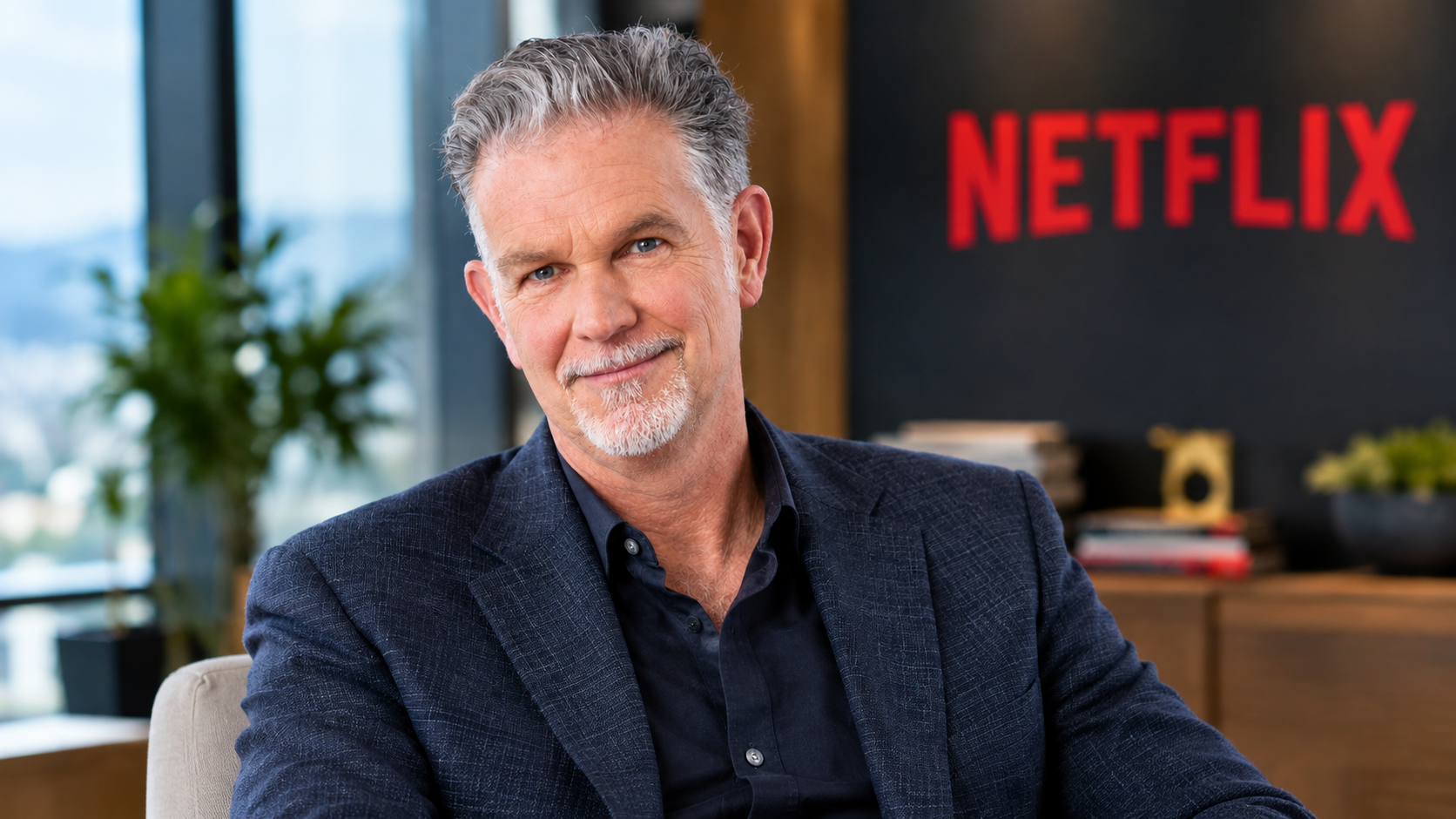
Reed Hastings did not leave Netflix in a single moment. He handed over the company in stages: first sharing the chief executive role, then giving it up, then stepping away from executive employment, and finally leaving the board. The process stretched from July 2020 to June 2026.
That distinction matters. A founder can announce a successor and surrender a title without truly transferring authority. Netflix’s transition offers a more revealing case: the company changed its leadership structure over several years, and the successors had to navigate a difficult business period before Hastings completed his exit.
In April 2026, Netflix told shareholders that Hastings would not stand for re-election to the board. Reflecting on his legacy, he said his contribution “wasn’t a single decision.” He pointed instead to the company’s focus on members, its culture and its ability to keep improving after its founder was gone.
That is the real test of succession. The public record shows a carefully staged handover, followed by years of strong financial growth. It cannot, on its own, prove that the transition caused those results—or reveal how much influence Hastings continued to exert behind closed doors. For founders planning their own exits, that gap between a well-managed process and a proven outcome is the most useful lesson.
The handover in four stages
July 2020: formalising a shared leadership model
Netflix appointed Ted Sarandos co-CEO alongside Hastings, effective July 14, 2020. Sarandos remained chief content officer, a role he had held since 2000. Greg Peters, then chief product officer, became chief operating officer as well.
Hastings said the promotion formalised how the business was already being run. Sarandos had played a central role in Netflix’s move into original programming, while Peters had developed deep experience across the product and technology side of the company. The announcement was not presented as an abrupt change in day-to-day management. Netflix described it as part of a long succession-planning process.
January 2023: Peters becomes co-CEO
On January 19, 2023, Peters joined Sarandos as co-CEO and Hastings became executive chairman. Hastings said the board had discussed succession for years and that he had increasingly delegated management to Sarandos and Peters during the previous two and a half years.
He also acknowledged that the period had been a trial by fire. The pandemic had changed viewing habits, growth had become more difficult to sustain, and Netflix had reported a net loss of paid memberships in 2022. Hastings said the two leaders had managed the challenges well and had developed a plan to reaccelerate growth.
April 2025: Hastings steps away from executive employment
A less visible milestone came on April 17, 2025. Hastings moved from executive chairman to chairman of the board and became a non-executive director. In practical terms, he was no longer a Netflix employee.
This was more than a change in wording. It narrowed his formal role from executive leadership to board oversight. The distinction matters because a founder who remains an executive chairman may still have an active management role, while a non-executive chairman’s formal responsibilities sit at board level.
June 2026: the board chapter ends
In April 2026, Hastings announced that he would not stand for re-election at Netflix’s annual meeting. The company said he planned to focus on philanthropy and other interests. His departure took effect after the June 4 meeting, ending his formal role on Netflix’s board.
Jay Hoag, a director since 1999 and previously the lead independent director, became chairman. Netflix’s filings said Hastings’ decision not to stand for re-election was not the result of a disagreement with the company.
Taken together, the stages show a gradual transfer of formal authority: co-CEO, executive chairman, non-executive chairman, and finally former director. The timeline is unusually useful because it separates the moment Hastings gave up the CEO title from the later moment he left the company’s governance structure altogether.
Why two co-CEOs instead of one?
Hastings did not describe the choice as an experiment in shared command. His public explanation focused on the leaders’ complementary skills, their knowledge of Netflix and the trust they had built through years of working together.
Their backgrounds help explain the logic. Sarandos had been responsible for content since 2000 and helped lead Netflix’s expansion into original programming, international productions, films and other formats. Peters had held increasingly senior roles since 2008, including chief product officer and chief operating officer. He also helped build and launch Netflix’s advertising business.
The division is not as simple as “one handles shows, the other handles technology.” Both jobs extend across a global entertainment business. But their experience gave Netflix two leaders with different areas of depth: one closely associated with programming and creative relationships, the other with product, operations and the systems that support the service.
There was also a practical reason the arrangement was plausible. Sarandos had already been co-CEO with Hastings for two and a half years before Peters joined him. Netflix was not introducing the model for the first time in 2023; it was expanding a structure that had been operating since 2020.
That does not mean co-CEOs are automatically the right answer for another company. The model depends on clear responsibilities, trust, a way to resolve disagreements and a board that understands how decisions are actually made. Two leaders with overlapping authority can create confusion just as easily as they can broaden a company’s capabilities.
Netflix has disclosed the titles and responsibilities of its leaders, but public filings do not provide a detailed account of how Sarandos and Peters resolve disagreements or divide every major decision. The structure is visible. Its internal workings are not.
The succession was tested before Hastings left
The timing of Netflix’s transition is important. Sarandos and Peters took on greater responsibility during a turbulent period for streaming, not after the business had returned to easy growth.
In April 2022, Netflix reported a net loss of paid memberships for the first time in more than a decade. The company responded with a series of changes, including introducing a lower-priced, advertising-supported plan later that year and taking steps to address account sharing. Its business model was evolving at the same time that the company was under pressure to restore growth.
Netflix ended 2022 with approximately 231 million paid memberships and $31.6 billion in revenue. Hastings was still co-CEO throughout that year. When he announced the next stage of succession in January 2023, he described the experience as a baptism by fire and said the two leaders had developed a clear path towards renewed revenue and earnings growth.
That sequence gives the handover some substance. The successors were not simply handed a stable business and asked to preserve it. They had already been working through a period of uncertainty while Hastings remained in the executive structure.
But it also complicates any verdict. Because Hastings was still co-CEO during the 2022 challenges, the episode cannot show how Sarandos and Peters would have performed entirely without him. It demonstrates preparation under pressure, not a fully independent test.
What the results tell us—and what they do not
Netflix’s financial performance strengthened after the CEO transition. In 2025, revenue rose 16% to approximately $45.2 billion. The company reported an operating margin of 29.5%, surpassed 325 million paid memberships during the year and grew advertising revenue more than 2.5 times to over $1.5 billion.
Those are substantial results. They show that Netflix continued to expand its business under Sarandos and Peters. They do not establish that the succession itself produced the growth. Pricing, programming, international demand, the advertising business, product changes and the broader entertainment market all influence performance.
The 2026 results offer a more mixed, and therefore more useful, snapshot. Netflix reported third-quarter revenue growth of 12% year over year and an operating margin of 34.6%. It also said subscription revenue growth had outperformed expectations. At the same time, the company lowered its forecast for 2026 advertising revenue to approximately $2.7 billion, from about $3 billion previously, citing a slightly slower rollout of some advertising capabilities.
Netflix’s third-quarter letter projected full-year 2026 revenue of $51.1 billion and an operating margin of 31.5%. It also estimated that recent headcount reductions would have a negative impact of about 30 basis points on the full-year operating margin, with a larger effect in the fourth quarter.
Separately, in October 2026, Netflix announced organisational changes affecting roughly 6% of its workforce, with the greatest impact in product, technology, legal and human resources. The company said the changes would allow it to keep investing in areas it considered important to its service and growth.
These developments are evidence of a company still making consequential choices. They are not a simple scorecard for the leadership transition. The advertising forecast, for example, reflects the pace at which product capabilities are being rolled out; it does not establish that the co-CEO structure caused the shortfall. Similarly, layoffs may indicate a change in resource allocation, but the announcement alone cannot tell us whether the decision was early, late or optimal.
The Warner Bros. Discovery episode offers another example of why context matters. In February 2026, Netflix declined to raise its offer after Warner Bros. Discovery determined that Paramount Skydance’s proposal was superior under the terms of the existing agreement. Sarandos and Peters said matching the new price was no longer financially attractive and described the transaction as a “nice to have” at the right price, not a deal they had to win at any cost.
That was a consequential decision made by the co-CEOs. But Hastings was still chairman at the time, so the episode cannot be treated as a clean demonstration of how Netflix operates without its founder. It does, however, illustrate the kind of capital-allocation judgment that leaders must make independently if a succession is to endure.
A useful assessment should therefore look beyond a single share-price move or quarterly result. Three questions matter more.
First, does management deliver on its stated priorities? Netflix’s advertising business is a relevant test because the company has identified it as a growth opportunity while acknowledging that parts of the rollout have been slower than expected.
Second, can the company change course when plans need adjusting? That includes making difficult decisions about staffing and investment while protecting the product and content that attract members.
Third, can the co-CEOs continue to make major decisions together without creating visible confusion about who is accountable? This is the hardest question to answer from outside the company. Results reveal what Netflix has achieved; they do not reveal the full process behind each decision.
The risk built into the co-CEO model
Research on shared leadership offers a useful lens, though not a verdict on Netflix. A study by Ryan Krause, Richard Priem and Leonard Love, published in the Strategic Management Journal, examined 71 co-CEO pairs at publicly traded US companies. It found that larger differences in power between co-CEOs were associated with better firm performance up to a point. The relationship weakened and turned negative when the power gaps became very large.
The finding does not prove that one co-CEO should always outrank the other. Nor does it show that equal titles lead to poor results in every company. It reports an association across a sample of firms and periods, not a universal rule.
Still, it raises a practical question for Netflix: how is authority shared when two people hold the same title?
The company’s public disclosures describe Sarandos and Peters as co-CEOs, but titles alone cannot show how influence works in practice. The leaders bring different experience and responsibilities to the job, and their long working relationship may help them coordinate. Yet the filings reviewed for this article do not spell out a formal mechanism for settling a serious disagreement between them.
That is not evidence of a problem. It is a limit on what outsiders can responsibly conclude. A company can present a clear organisation chart while leaving its most important decision-making rules private. For boards considering a co-CEO model, those rules deserve as much attention as the choice of people.
The founder’s exit is a governance question, too
Hastings’ gradual departure also highlights a tension that extends beyond Netflix. A founder who remains chairman can offer institutional memory, strategic perspective and reassurance to investors and employees. The same presence can make it harder for successors to establish their own authority if the organisation continues to look to the founder for the final word.
The public record establishes the sequence of Hastings’ roles and the eventual end of his board tenure. It does not show that he interfered with Sarandos and Peters, and Netflix said his departure was not prompted by a disagreement. Any claim that he either held the successors back or quietly made the transition succeed would go beyond the available evidence.
What can be said is that Netflix separated the stages of the exit. Hastings first gave up the CEO role, later stopped being an employee, and eventually left the board. That gave the company a longer transition than a single announcement would have provided. It also meant the formal boundaries changed over time rather than all at once.
For another company, the lesson is not necessarily to copy the same timetable. It is to decide what the founder’s role will be at each stage, how the board will evaluate the arrangement and what event will mark the end of the transition. A plan that never specifies the final boundary risks leaving successors permanently accountable to someone who no longer holds the executive title.
Five lessons other companies can take from Netflix
1. Formalise what already works. In 2020, Netflix described Sarandos’ promotion as formalising an existing way of running the business. That can be a sensible starting point when responsibilities have already evolved in practice. It is not a substitute for clarifying decision rights, especially when the incoming leaders have not worked together for years.
2. Treat succession as a sequence, not an announcement. Netflix changed the structure in stages: Sarandos became co-CEO, Peters later joined him, Hastings left executive employment, and then he left the board. Companies can set out their own stages, decision rights and review points in advance. The important part is making the destination clear, not copying Netflix’s exact schedule.
3. Give successors real responsibility before the final exit. Sarandos and Peters had meaningful management roles while Hastings remained co-CEO. That provided time to build experience and demonstrate how they handled difficult conditions. Founders cannot schedule a crisis, but they can transfer real decisions rather than merely delegate low-risk tasks.
4. Match authority with accountability. A co-CEO model needs a clear division of responsibilities and a reliable process for resolving disagreements. Equal titles do not automatically mean equal influence, and different strengths do not automatically prevent conflict. Boards should understand how the arrangement works in practice, not just how it appears on paper.
5. Plan the founder’s board role as carefully as the executive handover. Leaving the CEO job does not necessarily end a founder’s influence. Netflix’s transition continued after Hastings gave up executive duties and ended only when he left the board. A company should decide early whether the founder will remain as chair, become a non-executive director or leave governance altogether—and what will trigger the next step.
So, did the succession work?
The evidence supports a measured answer. Netflix completed a staged handover, gave Sarandos and Peters substantial responsibility before Hastings left, and continued to grow revenue, memberships and advertising under their leadership. Those are meaningful signs that the company did not depend on its founder to keep operating successfully.
But the strongest conclusion is not that the succession has been conclusively proved. Public financial results cannot isolate the effect of leadership structure, and the filings do not reveal enough about the co-CEOs’ private decision-making to judge how the partnership handles conflict. The advertising rollout and other operational choices also show that a strong business still has execution risks.
The handover is complete; the longer-term test is not. The next several years will show whether Netflix can sustain its performance, make difficult strategic decisions and keep its leadership structure effective without Hastings in the boardroom.
For founders, the takeaway is clear: succession is more than choosing a replacement. It is the work of transferring responsibility, establishing boundaries, preparing successors under real conditions and eventually making room for them to lead. Netflix has put that process on the record. Whether its model becomes a lasting example of successful succession will depend on what the company does next.
Questions about Netflix’s succession
Who runs Netflix now?
Ted Sarandos and Greg Peters are Netflix’s co-CEOs. Sarandos became co-CEO in July 2020, and Peters joined him in January 2023.
When did Reed Hastings stop being Netflix CEO?
Hastings gave up the co-CEO role in January 2023, when Peters became co-CEO with Sarandos. Hastings remained executive chairman before becoming non-executive chairman in April 2025.
Is Reed Hastings still on Netflix’s board?
No. Hastings did not stand for re-election at Netflix’s June 4, 2026 annual meeting and is no longer a director.
Did Netflix’s succession prove that co-CEOs work?
Not conclusively. Netflix’s post-transition growth is encouraging, but public results cannot isolate the effect of the leadership model. The internal process by which the co-CEOs share authority is not fully visible in public filings.