Bob Jordan Spent 38 Years Building Southwest. Then He Had to Rewrite It.
In September 2024, Southwest said free bags were its most important differentiator. Within six months it had cut about 1,750 corporate jobs and announced bag fees, and the 2026 results show higher revenue but unanswered questions about customer trust.
On September 26, 2024, Southwest Airlines handed investors a document that read like a vow. Open seating was on its way out, the company said, and assigned seats and extra-legroom rows would replace it. One promise would survive. According to the press release, Southwest’s research showed that free checked bags were “the most important feature by far” in setting it apart from other airlines, and the company believed that charging for them would cost more in lost demand than the fees could earn.
The same release carried a line of corporate pride: Southwest had a record of no involuntary furloughs or layoffs in its history.
Less than six months later, Southwest announced a corporate layoff of about 1,750 roles, a step it called unprecedented in its 53-year history. Three weeks after that, it told customers that most of them would soon pay to check a bag.
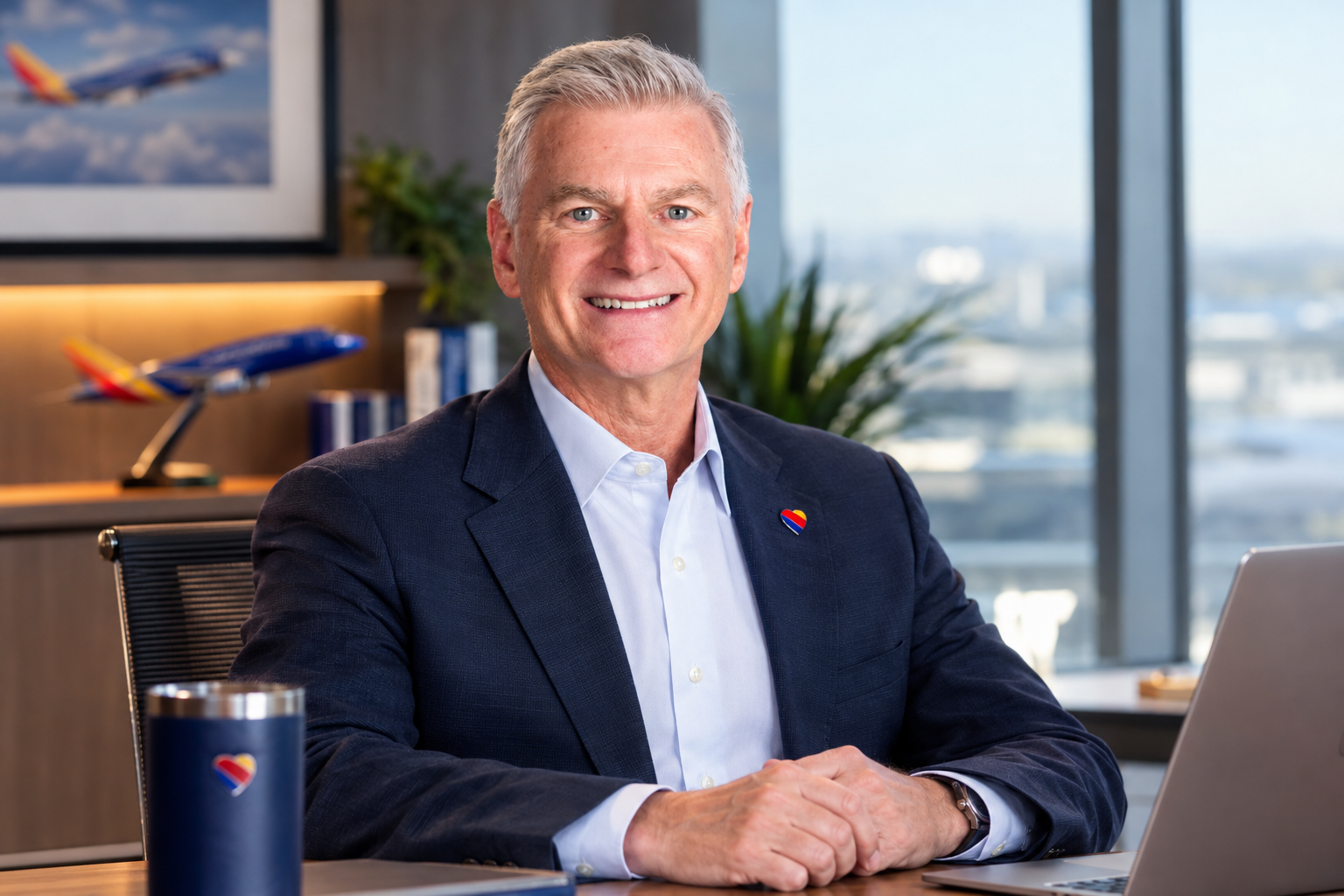
Bob Jordan’s name sat on all of it. He joined Southwest in 1988 as a programmer, and the company’s own biography now calls him a 38-year veteran. For most of those years he worked on the parts of the airline that customers use without thinking: the booking site, the loyalty program, the reservation system. As chief executive, he is now taking apart signature features of the company he helped run.
That makes the Southwest transformation a bigger leadership story than a fee announcement. The real question is whether an airline can change what made it distinctive without spending the trust that made those things valuable. The public record, from SEC filings to this month’s earnings release, does not settle it. It does show how the decision unfolded, who was pushing, and what remains unproven.
A Career Built Inside the Company
Texas Monthly opened its profile of Jordan in 1987, with a 27-year-old arriving at Dallas Love Field to interview for a programming job. He had been working as a programmer and financial analyst at Hewlett-Packard. He joined Southwest in 1988. By the time he became chief executive, the company says, he had held fifteen positions, from finance and procurement to technology and corporate strategy.
The company credits him with projects travelers touch: oversight of the Southwest.com booking platform and the 2011 Rapid Rewards revamp, the $3.2 billion AirTran acquisition, where he served as that airline’s president during integration, and, in 2020, the voluntary retirement and leave programs that, in the company’s telling, helped Southwest avoid layoffs, pay cuts and furloughs.
He became chief executive on February 1, 2022, succeeding Gary Kelly, who stayed on as executive chairman. The December 2022 holiday meltdown, when a systems failure cancelled a large number of flights, landed inside his first year.
Jordan has argued that the changes do not betray the founders. He told the New York Times in 2025 that he believed Herb Kelleher would have backed them, because Kelleher built Southwest around being different on service. Whether that holds is a judgment each reader can make. The record, at least, shows who is making it: an insider, not an outsider brought in to break things.
The Case Southwest Made in September 2024
Investor Day in Dallas was meant to give shareholders a map. Southwest laid out a three-year plan targeting roughly $4 billion in cumulative incremental EBIT contribution in 2027 and an after-tax return on invested capital of at least 15 percent. It promised about $500 million in annual cost savings, and its board approved a $2.5 billion share repurchase program.
The product plan was just as specific. Seats would go on sale in late 2025, with the first flights in the first half of 2026. About a third of the seats would offer up to five extra inches of pitch. Its research, the company said, found that 80 percent of Southwest customers, and 86 percent of passengers who fly other airlines, want an assigned seat. Those are Southwest’s survey results, not a measure of all flyers.
Then came bags. Executives said they had studied paid-bag models, including one free bag and a basic-economy-style fare, and concluded that customers would walk away. The release said any change to the two-free-bags policy would drive down demand by more than the fees would bring in. CNBC reported that the presentation put potential bag-fee revenue at $1 billion to $1.5 billion a year, against about $1.8 billion in lost market share. Both were forecasts from the company’s own model, not measured results, and they may not describe the same financial measure, so this article does not net one against the other.
Jordan had made the same point two months earlier, telling analysts on a July 2024 call that after fares and schedule, free bags was the top reason customers chose Southwest, and that changing it was not under consideration.
One more detail from that day: the release closes with legal notices about proxy materials and a white proxy card. Southwest was unveiling its new plan in the middle of a fight with an activist investor.
Less Than Six Months Later: Layoffs and the Bag-Fee Reversal
On February 17, 2025, Southwest announced it would cut about 1,750 roles, roughly 15 percent of its corporate positions. Eleven were at vice president level or above. The company estimated savings of about $210 million in 2025 and $300 million in 2026, against a one-time charge of $60 million to $80 million. “This decision is unprecedented in our 53-year history,” Jordan said in the release.
Four months later, he talked about the cost on a podcast with author David Novak, as AirlineGeeks reported. Jordan said that while the layoffs were being carried out he sometimes sat in his office crying, not over making the decision but over how hard it would be for his people. He also said where responsibility sat: “If folks are upset, be mad at Bob because Bob made the decision.”
Southwest’s careers page still lists a company promise of a stable work environment. It shows how much of the airline’s identity was built on stability.
The bag decision followed on March 11. For tickets purchased on or after May 28, most customers would pay to check a first and second bag. Top-tier loyalty members and customers on the highest fares kept free bags, and credit cardholders received a bag benefit. In his message to customers, Jordan said the changes would attract new customer segments and “return to the levels of profitability that both we and our Shareholders expect.” Chief operating officer Andrew Watterson said the airline needed more revenue to cover its costs.
On the second-quarter 2025 call, executives said they saw no measurable customer impact between the announcement and the late-May start, that bag-fee revenue was beating expectations, and that the chief financial officer expected more than $350 million in EBIT from bag fees that year. Those are company claims. In April 2026 the fees rose to $45 for a first bag and $55 for a second on most fares, according to Southwest’s current fee schedule.
Here the public record is thin. The documents reviewed for this article show no new study announcing that the 2024 research had been wrong. What changed in public was the company’s financial pressure, its board and the CEO’s standing. The stated reason was profitability. One plausible reading, which is analysis rather than fact, is that exempting the most loyal customers lowered the risk the original model feared. The filings do not say.
Who Was Pushing
In June 2024, Elliott Investment Management disclosed a stake of nearly $2 billion in Southwest and called for new leadership. It said Jordan and Kelly were “not up to the task of modernizing Southwest.” On October 23, 2024, the two sides settled. Five Elliott-backed directors and former Chevron chief financial officer Pierre Breber joined the board on November 1, Kelly retired early, and the board committed to naming a new independent chairman. Jordan kept his job.
Jordan says Elliott did not shape the changes. The sequence is public: the stake in June, assigned seating in July, Investor Day in September, the settlement in October, layoffs in February and bag fees in March. A sequence is not a cause, and nothing in the record shows that Elliott dictated any single decision.
A shareholder tested the question in court. Vladimir Gusinsky, who owned 100 shares, filed a derivative suit in July 2025 alleging that directors approved the bag change to yield to Elliott, to protect their board seats, or both. Southwest and its directors deny any wrongdoing. On March 17, 2026, a federal judge dismissed the case with prejudice. The ruling did not examine the board’s judgment. It rested on a bylaw, adopted under a new Texas law, that bars derivative suits by anyone holding less than 3 percent of the company. The plaintiff appealed to the Fifth Circuit, and, according to Southwest’s latest quarterly filing, his reply brief was filed on October 16, 2026. The appeal is pending, and the allegations remain allegations.
What Southwest’s Third-Quarter Results Show, and What They Do Not
On October 21, Southwest reported third-quarter operating revenue of $8.422 billion, up 21.2 percent from $6.949 billion a year earlier. Passenger revenue rose 22.8 percent. The company’s quarterly filing credits more customers choosing premium fare options, plus new ancillary products, including bag fees and, for travel from January 27, 2026, assigned and extra-legroom seating. Operating income was $379 million, against $35 million a year earlier. Net income was $270 million, against $54 million.
Revenue passengers fell 3.2 percent to about 33.5 million, while the average fare rose 26.9 percent to $231.69. Capacity fell 0.4 percent, and load factor was 79.8 percent in both years, so seat utilization was similar. The figures do not show which customers stopped flying, whether new ones took their place, or how much the policy changes influenced either.
The comparison quarter was weak: the 2025 operating margin was 0.5 percent as reported, so a large percentage gain was easy to post. Jordan said in the release that demand held as the airline lapped last year’s bag-fee launch, which is also a claim the company makes about itself.
Then there is fuel. Fuel expense rose $821 million to $2.152 billion, as the price per gallon went from $2.40 to $3.92, a reported $1.08 headwind to adjusted earnings per share. Full-year adjusted EPS guidance now stands at $2.60 to $2.85, down from $3.25 to $4.25 in July, which had itself replaced an earlier expectation of at least $4.00. Management points to fuel. The numbers support that explanation without proving it.
Adjusted figures deserve a caution. They exclude items such as severance, litigation accruals and impairments, and over nine months diluted EPS was $1.47 as reported against $2.05 adjusted. In the second quarter, Southwest also reversed $285 million of revenue previously booked on non-expiring flight credits, a special item left out of adjusted results. The company’s non-GAAP after-tax return on invested capital for the past twelve months is 11.3 percent, below the 15 percent it targeted for 2027.
Strong revenue does not prove that every decision worked. Fares, fees, seat products and fuel all moved in the same period, and no single number isolates the effect of any one. The filings can speak to revenue. They are silent on trust.
Customer Satisfaction and Culture After the Changes
The American Customer Satisfaction Index put Southwest at 77 in 2026, down from 80 in 2025, while the airline industry rose to 76. Delta scored 79, and American and JetBlue 78. Southwest went from first place to fourth among the eight major carriers.
J.D. Power tells a different story. Its 2026 North America study ranked Southwest first in the economy and basic economy segment for a fifth straight year, at 670, with Delta at 667 and JetBlue at 655. The 2025 figure was 694, according to press coverage of that study. The 2026 fieldwork ran from March 2025 to March 2026, so it captured bag fees but only about two months of assigned seating.
The surveys send different signals rather than one verdict. ACSI recorded a drop in Southwest’s score, while J.D. Power still ranked the airline first in its economy segment, by three points over Delta. The two use different questions, scales and samples, and neither establishes that a bag fee or a seat map caused the result.
The product changes keep coming. The latest release announces Southwest’s first airport lounges, with guests expected in 2027, a new Platinum tier for Rapid Rewards, and fleet-wide Starlink Wi-Fi by fall 2027. The airline that defined itself by what it declined to charge for is now building lounges. Whether its hospitality survives that shift is a question the surveys can only hint at.
What March 2027 Can and Cannot Settle
Southwest will host a Capital Markets Day in New York on March 2, 2027, where it says it will present a multi-year financial framework and the targets it is managing toward. That event will be a statement of intent, not a verdict. The 2024 Investor Day also offered targets and a firm statement about bags, and the distance between that day and what followed is why this story exists.
The checkpoints are plain. Will the company show how much of its 2027 earnings goal it has met, and from which initiatives? Will satisfaction scores recover as assigned seating matures? Will passenger counts hold once fares stop climbing so quickly? And how does the shareholder appeal end?
The honest answer, for now, is that Southwest earns far more from each passenger than it did a year ago. Whether it has kept what those numbers never measured will take longer to show.