Tesla Retired the Model S. Now Fremont Has to Prove a Robot Is Worth the Space
Tesla ended Model S and Model X production in May and gave their Fremont line to its Optimus humanoid robot. The plant is designed for one million robots a year, but Tesla has not published how many it has built.
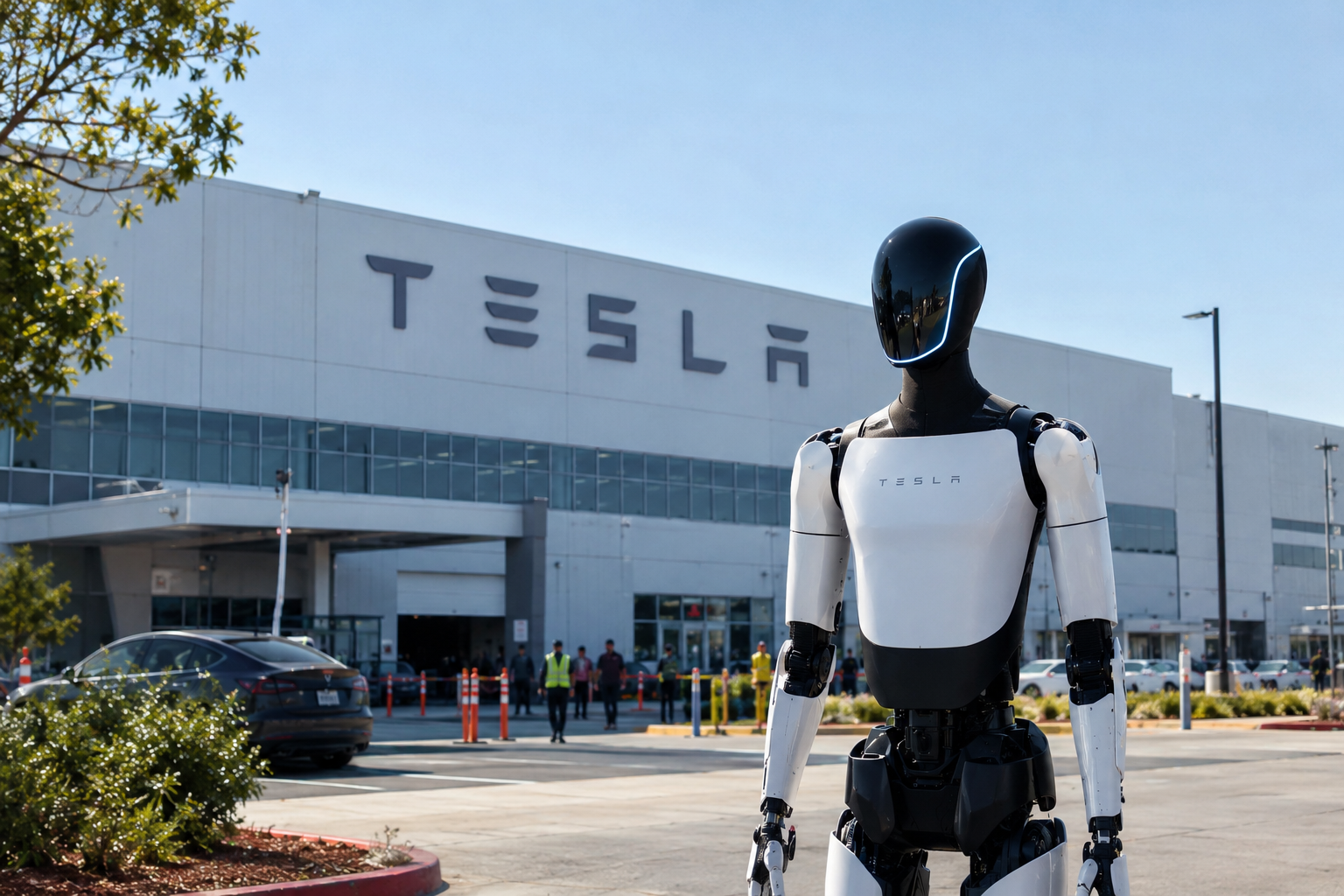
On May 10, 2026, Tesla put a short note on X: the last Model S and the last Model X had been built at the Fremont factory in California. Fourteen years of history for the sedan, eleven for the SUV. Tesla-focused outlets covering the send-off reported that workers signed the final bodies before they left the line.
Then the line itself disappeared. According to a video Tesla Manufacturing posted on July 10, the original assembly line was decommissioned in 46 days.
What is going in its place is not a new car. Tesla is building a production line for Optimus, its humanoid robot, on the floor where the Model S was born. The design target is one million robots a year. What the company has not said is how many Optimus robots it has built, how many are doing useful work, or when an outside customer can buy one. That gap between a factory plan and a factory output is what this decision will be judged on.
What did Tesla decide about the Model S and Model X?
Tesla announced it on its fourth-quarter 2025 earnings call on January 28, 2026. Elon Musk treated it almost as an aside. He said it was time to bring the two programs to "an honorable discharge" because Tesla was moving toward a future "based on autonomy."
The plan for the space was specific. Tesla would convert the Model S and Model X area at Fremont into an Optimus factory, with a long-term goal of one million units a year. Musk said Optimus needs "a completely new supply chain," because almost nothing in Tesla's existing parts network carries over to a robot.
Two details matter. First, this was not the end of car production at Fremont. Tesla's first-quarter capacity table lists more than 550,000 Model 3 and Model Y a year for its California plant, and those lines stayed. Second, the decision was presented as a manufacturing choice, not a rescue. Tesla has never published a profit figure for the Model S or the Model X.
How much did Tesla actually give up?
Less than the nameplates suggest, at least in volume. Tesla delivered 1,636,129 vehicles in 2025, and 1,585,279 of them were Model 3 and Model Y. The other 50,850 sit in one "other models" bucket that also holds the Cybertruck. Tesla does not report Model S and Model X separately, so nobody outside the company can say how many of those cars were sold. The most the two could have been is that whole bucket, about three percent of deliveries.
The quarterly tables show the bucket shrinking once the cars ended. Other-model deliveries were 16,130 in the first quarter of 2026 and 12,364 in the second, according to Tesla's second-quarter shareholder update, and 8,295 in the third, according to its delivery release. The Cybertruck is in the same bucket, so these are not Model S and Model X sales alone.
The company's finances at the time deserve a plain statement, without turning them into a motive. In its 2025 annual filing, Tesla reported revenue of $94.827 billion, its first annual decline, down about 3 percent. Net income was $3.794 billion, down from roughly $7.1 billion a year earlier. Total automotive revenue fell about 10 percent to $69.526 billion, while energy generation and storage grew 27 percent to $12.771 billion.
Those figures describe a car business under pressure. They do not show that the Model S and Model X were losing money, and Tesla has not tied the decision to their profitability.
Why Fremont, and why Optimus?
Tesla has given one reason, and it is strategic: autonomy and robotics are where the company wants its future to sit. On the second-quarter call, Musk said Optimus "will be the biggest product ever." He has made versions of that claim for years, and it remains a claim.
The operational logic is easier to see. A building with power, loading docks, nearby suppliers and decades of car-making behind it is a faster place to start a robot line than an empty field. Tesla's first-quarter update said the first-generation Optimus line, designed for one million robots a year, would replace the Model S and Model X lines in Fremont, while Gigafactory Texas was being prepared for a second-generation line meant for long-term capacity of 10 million. Musk said on that call that the Texas factory would probably start production around summer 2027.
Read together, Fremont looks like the place where Tesla intends to learn how to build the robot, and Texas the place where it hopes to build it at scale. That reading is editorial. Tesla has not described the two sites in those words.
What is the Optimus bet costing Tesla?
Tesla spent $8.53 billion on capital expenditure in 2025. On the January call it guided to more than $20 billion for 2026, spread across six factories that included the Optimus plant. By April the figure was more than $25 billion, and chief financial officer Vaibhav Taneja warned that free cash flow would turn negative for the rest of the year.
In the second quarter, capital spending was $5.789 billion, up 142 percent from a year earlier. Free cash flow was negative $1.092 billion, the first negative quarter in more than two years. Tesla still ended the quarter with about $43.5 billion in cash and investments, and it said it was arranging borrowing capacity of up to $30 billion.
The distinction matters. That spending is not the cost of the Fremont conversion. It also covers AI computing, chips, robotaxis, batteries, solar and new vehicle plants, and the negative cash flow cannot be assigned to the robot. Tesla does not publish an Optimus budget, so any article that puts a dollar figure on it is inventing one.
Capacity is not output: what the evidence shows
In April, Musk said Optimus production at Fremont would begin in late July or August. He called the rate impossible to predict, because the line "will move as fast as the least lucky, slowest, dumbest part in the entire 10,000," a reference to the robot's roughly ten thousand unique parts. When Tesla published its second-quarter update on July 22, the wording had moved. The deck said construction for Optimus had begun after the Model S and Model X lines were decommissioned, with production "anticipated later this year." Tesla also said the first Optimus units would go to an internal program it calls the Optimus Academy, to collect training data.
On the second-quarter call Musk said "the production scaling challenge is very substantial," and, according to a transcript, that Optimus is the hardest product Tesla has tried to scale "because everything on the robot is new." The early part of the ramp, he said, would be "quite flat and long."
That candor deserves credit. It also means the one-million figure is a design capacity. A line built to make a million of something is not the same as a line that has made a thousand.
Numbers circulating online make this easy to get wrong. Some blogs say Tesla has built more than 50,000 Optimus units, or that Fremont is turning out hundreds or even a thousand robots a week. Those figures do not come from Tesla. A July review by Technology.org noted that Tesla has never published an Optimus production count, audited or otherwise, and that the larger claims did not originate with the company. This article does not rely on them.
Tesla's earlier targets are part of the record too. On its January 2025 call, Musk said Tesla's internal plan was to build roughly 10,000 Optimus robots that year, though he said the company would probably fall short and end up with several thousand. Tesla published no output figure for 2025. On the January 2026 call, according to Electrek, Musk acknowledged that no Optimus robots were yet doing useful work in Tesla's factories. None of this proves the current schedule will slip. It does explain why outsiders ask for evidence before dates.
How does Optimus compare with other humanoid robots?
Several rivals have put specifics on the record, though every figure below comes from the companies themselves and is not independently audited. Figure AI said in November 2025 that its Figure 02 robots completed an 11-month deployment at BMW's Spartanburg plant, with more than 1,250 hours of runtime, more than 90,000 parts loaded and a contribution to more than 30,000 BMW X3 vehicles. Agility Robotics and GXO announced a multi-year agreement in June 2024 to deploy Digit robots, moving totes at a facility GXO runs for the apparel brand Spanx. Boston Dynamics said in January 2026 that it had begun producing its new Atlas robot, that all 2026 deployments were committed, and that the first fleets would ship to Hyundai and Google DeepMind.
These programs differ in robot type, task and scale, so they are not a leaderboard. The narrower point is what matters: others have put hours, tasks or named customers in public, and in its latest published update, from July, Tesla had given outsiders no comparable performance data.
Tesla's advantages are real: factories to serve as the first customer, and experience building in volume that most robot startups lack. Whether that is enough depends on reliability, which outsiders cannot yet measure.
What could go wrong at Fremont?
Four risks stand out, and each comes from Tesla's own statements or follows from its numbers.
Chips come first. Musk said on the second-quarter call that Tesla would be constrained in scaling Optimus if it could not secure enough AI chips. He also said the next chip, AI5, should reach volume production around the middle of next year and would go into Optimus first. A robot on a new supply chain, running on a chip not yet in volume, faces two bottlenecks before it reaches the factory floor.
The robot itself is the second. Musk said on Tesla's third-quarter 2025 call that a human-like hand is a "difficult engineering challenge." Reporting after the first-quarter call put the robot at more than 10,000 unique parts, and each one is a place for a delay.
Third, floor space cannot be used twice. The old line made cars, and the new one is not yet reporting robots at volume. That is an inference from Tesla's own timeline, not a measured loss.
Fourth is patience. Tesla's second-quarter revenue of $28.24 billion beat expectations, but adjusted earnings of 33 cents missed and the shares fell after the report, according to market coverage. Investors are being asked to accept negative free cash flow while the robot story develops.
What would prove the decision right or wrong?
The decision does not have to be judged on the one-million figure. It can be judged on things Tesla could disclose, and a bare production count would not be enough on its own.
A count of finished Fremont robots would end the guessing. Evidence of work would say more: units doing named tasks, in named plants, for stated hours, inside or outside Tesla. Reliability would follow, meaning how long a robot runs before it needs help. Then comes cost, because a robot priced like a car is a different business from one that costs several times as much. And the work has to repeat: a second site, a second customer, a second quarter. Texas is where that gets tested. If Fremont has not shown a clear ramp by the time the second factory is due, that timeline will be hard to defend.
Cash sets the clock. Taneja has said capital spending will keep growing for two or three years, so investors will want to see it become shipped product inside that window. Tesla's financial update for the third quarter, scheduled for October 21, is the first full report since the line was cleared.
What can other executives take from it?
The useful lessons come from how the conversion was sequenced, not from the robot.
Tesla tore down the old line in 46 days, before it had publicly reported any production from the new one. That is a one-way door. An executive converting a working plant could write down, before the demolition, the milestone the new line must hit and the date by which it must hit it.
Capacity and output also belong in separate columns. Tesla's decks describe what a line is designed to do. Boards and investors should insist on the second column, what it has actually done, because the distance between the two is where many manufacturing decisions go wrong.
Then there is who pays. Tesla's operating cash flow was $4.7 billion in the second quarter, and that is what lets it spend on a robot that does not yet earn revenue. A conversion funded by the legacy business runs on the legacy business's patience.
What does the evidence say so far?
It supports a narrow conclusion. Tesla made a real and costly choice, it has been open about how hard the robot will be to build, and it gave up a line that made only a small share of its cars. It does not yet support a broader one. Whether Fremont is better used by Optimus than by the Model S will depend on more than one number: whether the robots do useful work, whether they hold up, what each one costs to build, and whether the result can be repeated. Tesla has not yet given outsiders enough of those to judge, and when it does, they will tell the story.