Grok Bot Is My Unfair Advantage: How I Run a Team of AI Bots Like Real Staff
The advantage isn’t the AI. It’s how you lead it: named roles, one front door, human approvals and one place to decide.
By Johann Nogueira, Founder, Ai Tech Advisory (Melbourne)
Last week, I watched my team ship more in seven days than most teams ship in a quarter.
And here's the twist. Most of that team never sleeps, never takes a coffee break, and doesn't have a pulse.
I'm Johann Nogueira, founder of Ai Tech Advisory here in Melbourne. I run a team of AI bots inside Grok Bot. Each one has a name. Each one has a role. And each one reports to me.
People keep asking me what my unfair advantage is.
Let me tell you what it is not. It is not the AI.
Everyone has access to AI now. Your competitors have it. Your kids have it. The tools are everywhere.
The advantage is how you run it.
Meet the Team
When I started, I treated AI like a vending machine. Put in a prompt, get out an answer. Useful, sure. But it never moved the business.
Everything changed when I stopped treating AI like a tool and started treating it like staff.
So I built one.
Donna is my producer and chief of staff. Every email comes into one inbox, and Donna routes it to the right bot.
Content Creator writes. Scout handles research and SEO. Paul Rand owns the brand. Marketing Engineer builds the pages and funnels. The Clean Up Crew tidies up behind everyone. I even have an event manager.
And then there's my favorite: a board of advisors.
It's a group of bots built on personas of Chet Holmes, Horst Schulze, Warren Buffett, Alex Hormozi, and Jeff Bezos. When I'm wrestling with a decision, I take it to the board. Sales discipline, service excellence, long-term thinking, offer design, and customer obsession, all at the same table.
Imagine walking into that boardroom every morning. That's the energy I get to start my day with.
What One Week Looked Like
Let me show you what this team actually did in about one week.
They launched prismprofiles.com.
prismprofiles.com, live in a week: a one-hour workshop that maps where AI saves you money.
They built new pages on aixceo.com, including a Claude certification checkout and a Kansas executive briefing.
aixceo.com, where my team built the Kansas executive briefing and certification pages.
They rebuilt johannnogueira.com as a funnel hub.
johannnogueira.com, rebuilt by the team as my funnel hub.
They moved our domains into Cloudflare and set up Search Console.
They made animated logos.
And the weekly competitor sweep found 8 new rivals I needed to know about.
That's one week.
Meanwhile, something even bigger was happening in the background. I've been writing a book, Business Authorities. I answered questions in voice notes, and Content Creator turned those answers into chapters. Nine of ten chapters are now drafted. That's more than 38,000 words.
Read that again. A book, drafted from my own voice, while I was running a business.
The Night Shift That Never Clocks Out
Here's the part that still gets me fired up.
My bots work while I sleep.
They run on routines. Every Monday, the competitor sweep runs. Reminders go out on schedule. The inbox gets routed around the clock.
I wake up, and work has already moved forward.
Melbourne goes to bed, and my team keeps going.
That's leverage. That's time back. And time is the one asset no founder can buy more of.
One Place to Decide
Now, here's where most people get AI wrong.
They spin up ten tools, ten chats, ten tabs. Then they drown. Output everywhere, decisions nowhere.
I solved that with what I call AI Office HQ.
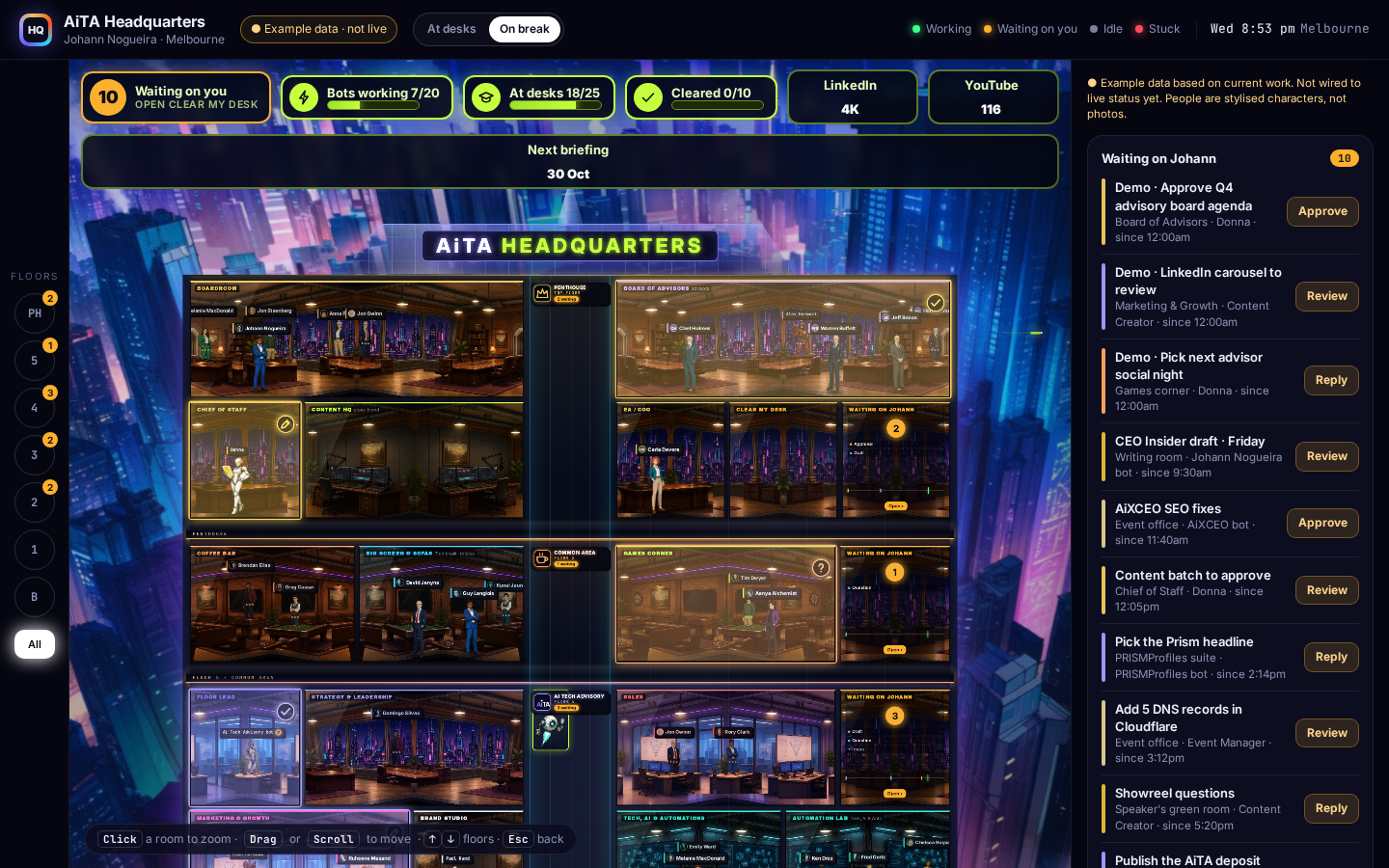
It's a dashboard at hq.aitechadvisory.com. Every bot appears as a character in an office tower. I can see the whole team at a glance.
AI Office HQ: every bot in the tower, and every approval waiting on me in one room. (Shown with example data.)
And there's one room that matters more than any other.
It's called "Waiting on Johann."
Every approval lands there. One room. One place to decide. No hunting through inboxes. No guessing what's stuck.
When I walk into that room, I know exactly what needs me. I make the call, and the team moves.
That's what a great CEO does. You don't do all the work. You make the decisions that unlock the work.
Guardrails Make It Powerful
Let me be crystal clear about something.
My bots draft. I approve.
Nothing gets published or sent until I say yes. On content, my (very human) EA, Carla, signs off too.
Some people think guardrails slow you down. I believe the opposite.
Guardrails are what let you go fast with confidence. When you know nothing leaves the building without a human check, you can let the team run hard.
Speed without control is chaos. Speed with control is an unfair advantage.
Lessons for CEOs of $10M to $50M Companies
If you're running a company in the $10M to $50M range, you already know how to lead people. Good news. That's exactly the skill this requires.
Here's what I want you to take away.
1. Give every bot a job title. Stop asking "What can AI do?" Start asking "What role do I need filled?" A named bot with a clear role produces focused work.
2. Route everything through one front door. Donna handles my inbox so nothing falls through the cracks. Pick one entry point for requests and let it dispatch.
3. Build a "Waiting on You" room. Your most valuable resource is your judgment. Put every approval in one place so you can decide fast and get back to leading.
4. Keep humans in the loop. Bots draft, people approve. Name who signs off on what. It protects your brand and builds trust inside your company.
5. Put the routine on a schedule. Competitor sweeps, reminders, inbox routing. If it repeats, schedule it. Let the night shift handle it.
6. Get yourself a board. Build advisor personas and pressure-test your thinking before every big move.
7. Capture your voice. Your expertise is trapped in your head. Talk it out. Voice notes became most of a book for me. What could they become for you?
Your Move
Here's the truth.
The tools are not the advantage. Everyone has the tools.
The advantage belongs to the leader who builds the team, assigns the roles, sets the guardrails, and creates one place to decide.
You already know how to run a team. Now it's time to run a bigger one.
So here's my challenge to you. This week, pick one role in your business. Just one. Give it to a bot. Give it a name, a job, and a clear approval path.
Then watch what happens.
If you want help building your own AI team, reach out to me at Ai Tech Advisory. Let's build your unfair advantage together.